semi合集-English.pdf - 第4791页
SEMI C56-0305 © SEMI 2005 1 SEMI C56-0305 SPECIFICATIONS AND GUIDELIN ES FOR DICHLORO SILANE (SiH 2 Cl 2 ) This specification was technically approved b y the Globa l Gases Com mittee and is the direct responsibility of …
5 SEMI C55-1104 © SEMI 2004
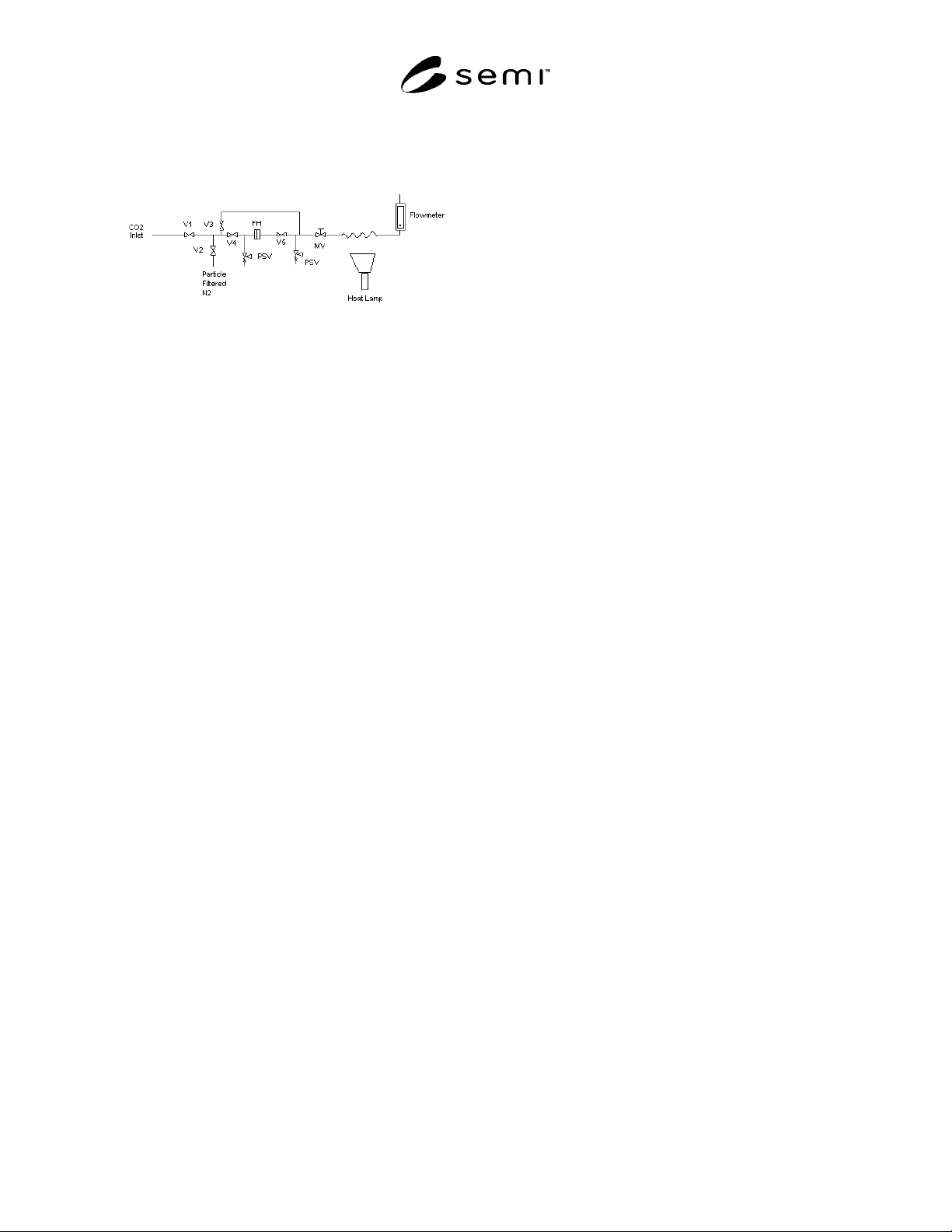
Figure 3
Potential Metals Sample Preparation System-
Filtration Method
8.3.5 Operating Procedure
8.3.5.1 Follow the procedures specified in the
instrument manufacturer’s manual for operating the
ICP-MS and introducing the sample solution.
8.3.5.2 Read and record the concentration of each
relevant metal, in ppmw. The result obtained shall not
exceed the value specified in Section 5 of this
specification.
NOTICE: SEMI makes no warranties or
representations as to the suitability of the standards set
forth herein for any particular application. The
determination of the suitability of the standard is solely
the responsibility of the user. Users are cautioned to
refer to manufacturer’s instructions, product labels,
product data sheets, and other relevant literature,
respecting any materials or equipment mentioned
herein. These standards are subject to change without
notice.
By publication of this standard, Semiconductor
Equipment and Materials International (SEMI) takes no
position respecting the validity of any patent rights or
copyrights asserted in connection with any items
mentioned in this standard. Users of this standard are
expressly advised that determination of any such patent
rights or copyrights, and the risk of infringement of
such rights are entirely their own responsibility.
Copyright by SEMI® (Semiconductor Equipment and Materials
International), 3081 Zanker Road, San Jose, CA 95134. Reproduction of
the contents in whole or in part is forbidden without express written
consent of SEMI.
SEMI C56-0305 © SEMI 2005 1
SEMI C56-0305
SPECIFICATIONS AND GUIDELINES FOR DICHLOROSILANE (SiH
2
Cl
2
)
This specification was technically approved by the Global Gases Committee and is the direct responsibility of
the North American Gases Committee. Current edition approved by the North American Regional Standards
Committee on November 4, 2004. Initially available at
www.semi.org January 2005; to be published March
2005.
NOTICE: This document replaced C3.18 and C3.31 in 2005.
1 Purpose
1.1 The purpose of this document is to provide a series of specifications for different grades of dichlorosilane
(SiH
2
Cl
2
) that are used in the semiconductor industry.
2 Scope
2.1 This document covers requirements for all grades of dichlorosilane (SiH
2
Cl
2
) used in the semiconductor
industry.
2.2 If analytical methods are not complete, the requirements are presented as a guideline.
NOTICE: This standard does not purport to address safety issues, if any, associated with its use. It is the
responsibility of the users of this standard to establish appropriate safety and health practices and determine the
applicability of regulatory or other limitations prior to use.
3 Description
3.1 Dichlorosilane is a flammable, corrosive, colorless liquid which hydrolizes in the presence of moisture. It
oxidizes readily and rapidly to release hydrogen chloride. It is easily ignited in the presence of air.
4 Referenced Standards
4.1 SEMI Standards
SEMI C1 — Specifications for Reagents
SEMI C3 — Specifications for Gases
NOTICE: Unless otherwise indicated, all documents cited shall be the latest published versions.
5 Terminology
5.1 Terminology appropriate to this standard is defined in SEMI C3.
6 Requirements
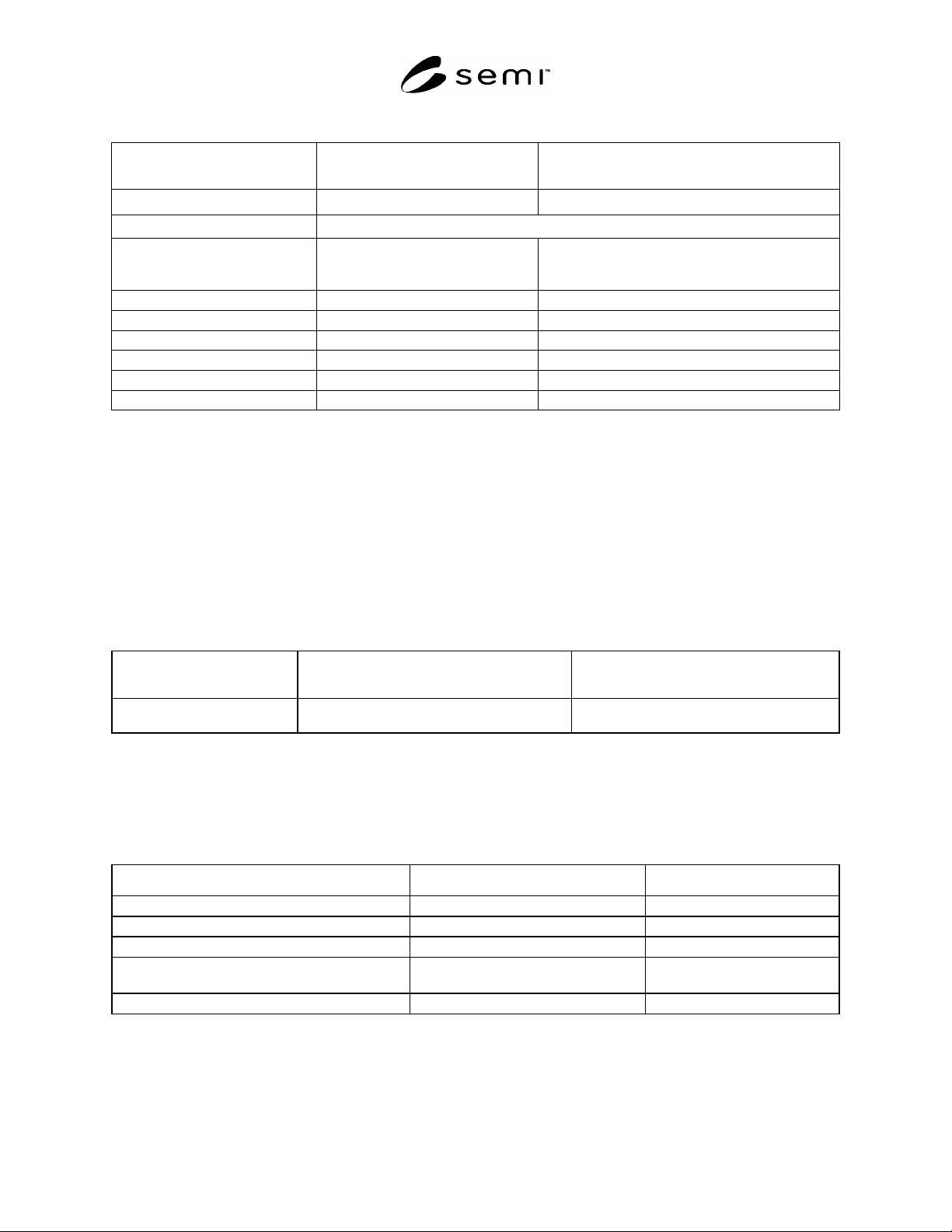
6.1 Purity and other requirements for the various grades of dichlorosilane are given in Table 1.
SEMI C56-0305 © SEMI 2005 2
Table 1 Impurity and Other Requirements for Various Grades of Dichlorosilane
Previous SEMI Reference #
C3.18-1102
(Specification)
C3.31-1102
(Specification)
Purity 97% 99%
Impurities Maximum Acceptable Level
#1
All Other Chlorosilanes
(Monochlorosilane, Silicon
Tetrachloride, Trichlorosilane)
3% (liquid phase) 1% (liquid phase)
#2
Aluminum 1.0 ppbw (vapor phase derived) 1.0 ppbw (vapor phase derived)
Arsenic 0.5 ppbw (vapor phase derived) 0.2 ppbw (vapor phase derived)
Boron 0.3 ppbw (vapor phase derived) 0.1 ppbw (vapor phase derived)
Carbon 10 ppmw (vapor phase derived) 1 ppmw (vapor phase derived)
Iron 50 ppbw (liquid phase) 50 ppbw (liquid phase)
Phosphorus 0.3 ppbw (vapor phase derived) 0.3 ppbw (vapor phase derived)
#1
An analysis of significant figures has not been considered. The number of significant figures will be based on analytical accuracy and the
precision of the provided procedure.
#2
Monochlorosilane not to exceed 0.5%
#3
This specification applies to the appropriate phase of the cylinder as delivered.
#4
The liquid phase purity is to be based on the chlorosilane determination. In addition, argon + helium are to be controlled in the vapor phase to
less than 0.5%. This argon + helium determination will not affect the percent purity determination.
#5
Initial purging of the vapor phase is recommended to reduce inert gas content used in the cylinder fill procedure.
#6
Analytical procedures for the doping elements, metals and selected impurities are to be determined between the user and supplier at the present
time.
7 Electrical Requirements
7.1 Electrical requirements for the various grades of dichlorosilane are given in Table 2
Table 2 Electrical Requirements for Various Grades of Dichlorosilane
Previous SEMI Reference #
C3.18-1102
(Specification)
C3.31-1102
(Specification)
Resistivity
#1
Greater than 50 ohm-cm (n-type)
#2
Greater than 150 ohm-cm (n-type)
#2
#1
The resistivity measurement technique is to be determined between supplier and user.
#2
Monocrystalline silicon formed from this material, not the material itself.
8 Physical Constants
8.1 The physical constants of dichlorosilane are given in Table 3 (for information only).
Table 3 Physical Constants of Dichlorosilane (for information only)
Metric Units US Units
Molecular weight 100.99 100.99
Boiling point at 1 atm 8.2°C 46.8°F
Density of gas at 25°C (77°F) and 1 atm 4.168 kg/m
3
0.260 lb/ft
3
Specific gravity of gas at 21.1°C (70°F) and 1 atm
(air = 1)
3.48 3.48
Density of liquid at 25°C (77°F) 122 kg/m
3
7.62 lb/ft
3