semi合集-English.pdf - 第5737页
SEMI P10-0705 © SEMI 1990, 2005 232 complexType XYCoordType diagram complexType XyrType diagram NOTICE: SEMI makes no warranties or represen tations as to the suitability o f the standards set forth herein for any partic…
SEMI P10-0705 © SEMI 1990, 2005 231
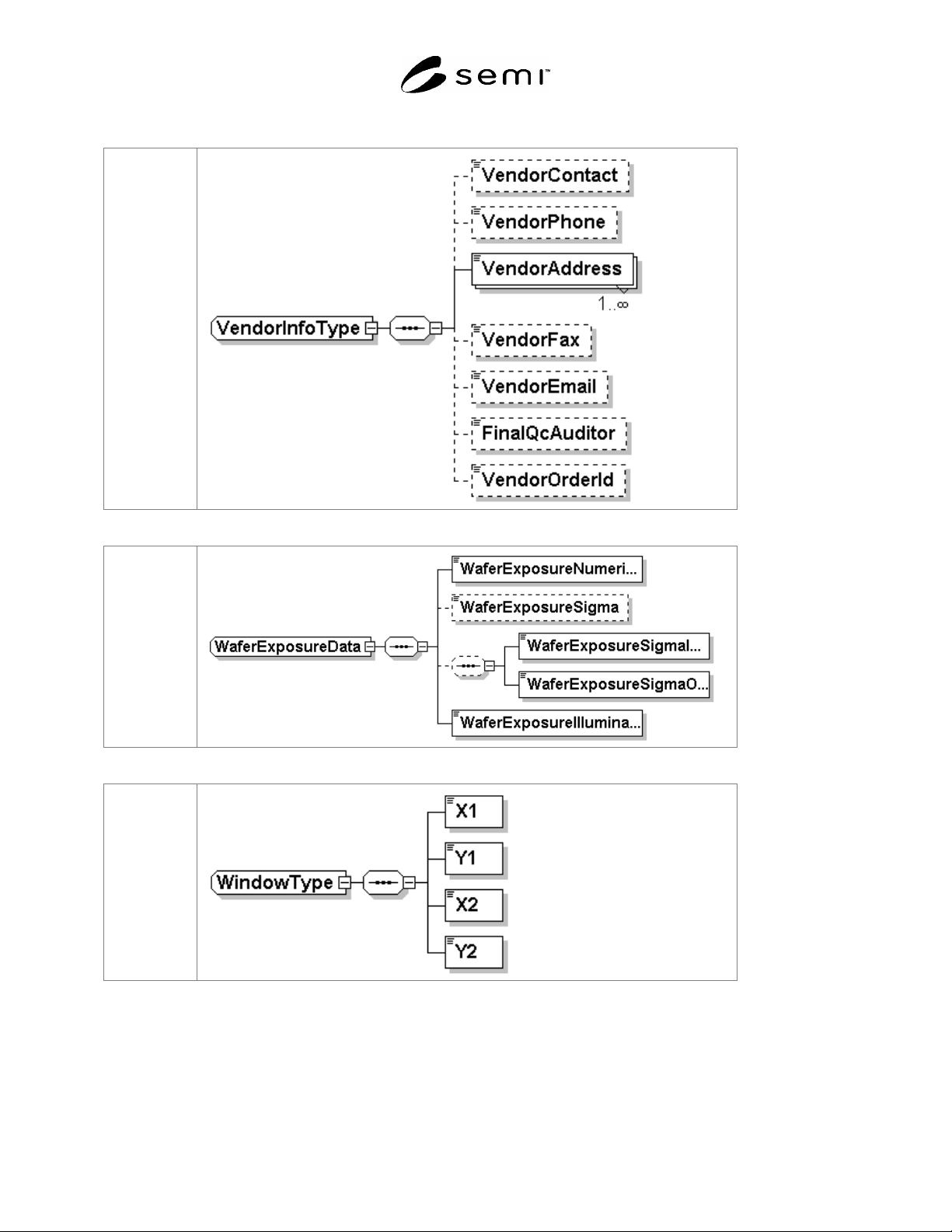
complexType VendorInfoType
diagram
complexType WaferExposureData
diagram
complexType WindowType
diagram
SEMI P10-0705 © SEMI 1990, 2005 232
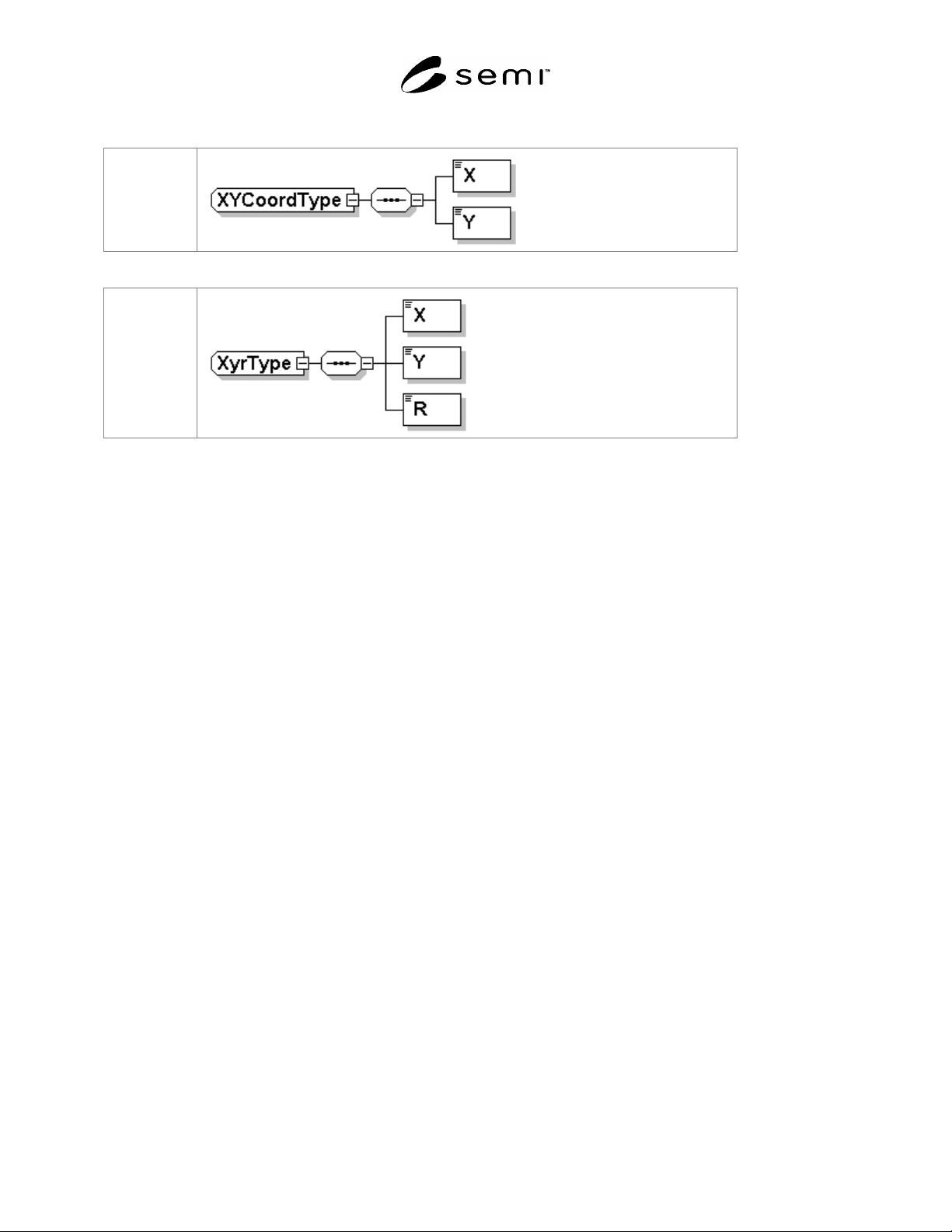
complexType XYCoordType
diagram
complexType XyrType
diagram
NOTICE: SEMI makes no warranties or representations as to the suitability of the standards set forth herein for any
particular application. The determination of the suitability of the standard is solely the responsibility of the user.
Users are cautioned to refer to manufacture's instructions, product labels, product data sheets, and other relevant
literature, respecting any materials or equipment mentioned herein. These standards are subject to change without
notice.
By publications of this standard, Semiconductor Equipment and Materials International (SEMI) takes no position
respecting the validity of any patent rights or copyrights asserted in connection with any items mentioned in this
standard. Users of this standard are expressly advised that determination of any such patent rights or copyrights, and
the risk of infringement of such rights are entirely their own responsibility.
Copyright by SEMI® (Semiconductor Equipment and Materials
International), 3081 Zanker Road, San Jose, CA 95134. Reproduction of
the contents in whole or in part is forbidden without express written
consent of SEMI.

SEMI P11-0997 © SEMI 1991, 19971
SEMI P11-0997
DETERMINATION OF TOTAL NORMALITY FOR ALKALINE
DEVELOPER SOLUTIONS
1 Scope
1.1 An acid-base potentiometric titration to single or
multiple inflection points is performed on an automatic
recording titrator using standardized hydrochloric acid
as the titrant. The normality (meq/mL) is then
calculated by the titrator using the data obtained.
2 Apparatus
2.1 Autotitrator
2.2 Glass combination electrode
2.3 Class A grade volumetric pipets in 1 to 25 mL
sizes
2.4 250 mL beakers
3 Reagents
3.1 1.0 N Hydrochloric acid (from concentrate or
ready to use 1.0 N)
3.2 Primary Standard — High-purity sodium
carbonate is available from most chemical supply
houses, but must be dried at 400 degree centigrade
before use. TMAH (tris (hydroxymethyl)
aminomethane) is also available from the National
Institute of Standards and Technology (Standard
Reference Material 723a) for this purpose.
3.3 Buffer solutions, pH 4.0, 7.0, 10.0.
4 Procedure
4.1 Standardize the 1.0 N Hydrochloric acid with the
primary standard.
4.2 Standardize the titrator by performing a two point
calibration with pH 4.0, 7.0, and 10.0 buffer.
4.3 Pipette an appropriate aliquot (1 to 25 mL) of
sample into a 250 mL beaker containing a magnetic stir
bar. Sample size should be determined according to the
expected normality and the amount of titrant to be
dispensed that will give the optimum precision and
accuracy. Generally this is between one-half and three-
quarters the capacity of the burette. (See the instrument
manual for the recommended optimum range.)
4.4 Add deionized water to bring the volume to
approximately 150 mL.
4.5 Without delay (to prevent carbon dioxide
absorption), begin stirring without a vortex and titrate
to beyond the inflection endpoint.
4.6 Determine the exact endpoint and record the
volume of titrant consumed at the middle of the
inflection endpoint. This will be done automatically on
most newer digital titrators. On analog titrators, the
inflection point can be determined by using the first
derivative mode, or accurately determining the middle
of the inflection.
5 Calculation
5.1 Calculate the normality of the sample by the
following equation.
N
ormality (N) =
Volume of titrant (mL) × Normality of titrant (N.HCL)
Sample Volume (mL)
NOTICE: These standards do not purport to address
safety issues, if any, associated with their use. It is the
responsibility of the user of these standards to establish
appropriate safety and health practices and determine
the applicability of regulatory limitations prior to use.
SEMI makes no warranties or representations as to the
suitability of the standards set forth herein for any
particular application. The determination of the
suitability of the standard is solely the responsibility of
the user. Users are cautioned to refer to manufacturer’s
instructions, product labels, product data sheets, and
other relevant literature respecting any materials
mentioned herein. These standards are subject to
change without notice.
The user’s attention is called to the possibility that
compliance with this standard may require use of
copyrighted material or of an invention covered by
patent rights. By publication of this standard, SEMI
takes no position respecting the validity of any patent
rights or copyrights asserted in connection with any
item mentioned in this standard. Users of this standard
are expressly advised that determination of any such
patent rights or copyrights, and the risk of infringement
of such rights, are entirely their own responsibility.
Copyright by SEMI® (Semiconductor Equipment and Materials
International), 3081 Zanker Road, San Jose, CA 95134. Reproduction o
f
the contents in whole or in part is forbidden without express written
consent of SEMI.