semi合集-English.pdf - 第5906页
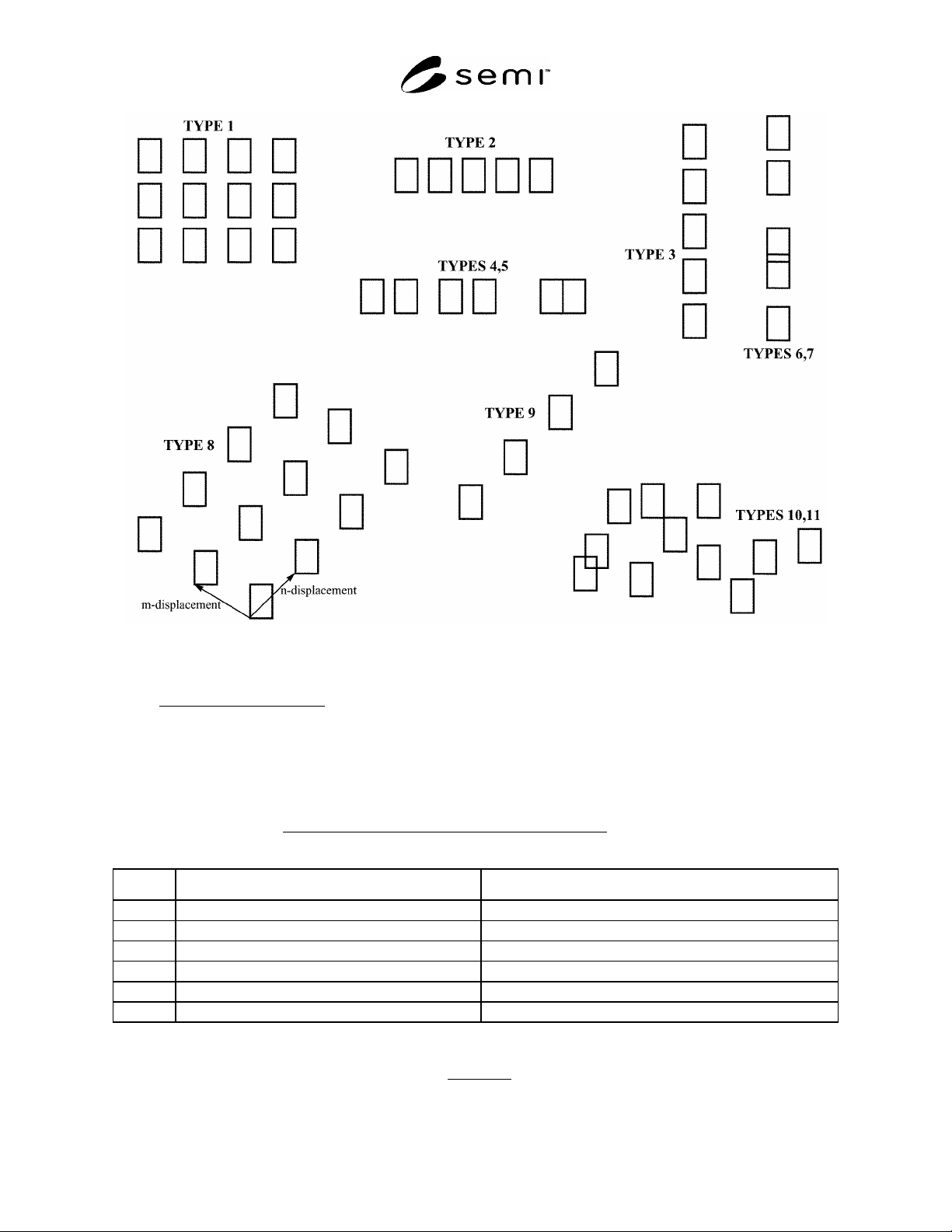
SEMI P39-0304 E2 © SEMI 2004 9 Figure 5 Repetition Types 7.6.14 EXCEPTION HANDLING — A repetition type outside t he range of 0 to 11 should be treated as a fatal error. A repetition type of 0 m ay not be the first repeti…

SEMI P39-0304
E2
© SEMI 2004 8
7.6.6 TYPE 4 is an N-column (N > 1) by 1-row vector with (potentially) non-uniform horizontal spacing between
the elements. x-dimension is N - 2. The (x-offset, y-offset) (cumulative spacing in the (horizontal,vertical) direction)
of element i of the repetition (i = 0, ..., N-1) is (x-space
0
+ ... + x-space
i
, 0), with x-space
0
= 0.
7.6.7 TYPE 5 is identical to TYPE 4, except that all offset values must be multiplied by grid during expansion of
the repetition.
7.6.8 TYPE 6 is a 1-column by M-row (M > 1) vector with (potentially) non-uniform vertical spacing between the
elements. y-dimension is M - 2. The (x-offset, y-offset) (cumulative spacing in the (horizontal,vertical) direction) of
element j of the repetition (j = 0, ..., M-1) is (0, y-space
0
+ ... + y-space
j
), with y-space
0
= 0.
7.6.9 TYPE 7 is identical to TYPE 6, except that all offset values must be multiplied by grid during expansion of
the repetition.
7.6.10 TYPE 8 is an N (N > 1) by M (M > 1) repetition with uniform and (potentially) diagonal displacements
between the elements. n-dimension is N - 2 and m-dimension is M - 2. Defining n-displacement in terms of its
components nx-space and ny-space (and similarly for m-displacement), the (x-offset, y-offset) (cumulative spacing
in the (horizontal,vertical) direction) of element (i,j) of the repetition (i = 0, ..., N-1 and j = 0, ..., M-1) is
(i * nx-space + j * mx-space, i * ny-space + j * my-space).
7.6.11 TYPE 9 is a P-element (P > 1) repetition with uniform and (potentially) diagonal displacements between the
elements. dimension is P - 2. Defining displacement in terms of its components x-space and y-space, the (x-offset,
y-offset) (cumulative spacing in the (horizontal,vertical) direction) of element k of the repetition (k = 0, ..., P-1) is
(k * x-space, k * y-space).
7.6.12 TYPE 10 is a P-element (P > 1) repetition with (potentially) non-uniform and arbitrary two-dimensional
displacements between the elements. dimension is P - 2. Defining displacement
k
in terms of its components x-
space
k
and y-space
k
, the (x-offset, y-offset) (cumulative spacing in the (horizontal,vertical) direction) of element k
of the repetition (k = 0, ..., P-1) is (x-space
0
+ ... + x-space
k
, y-space
0
+ ... + y-space
k
) with x-space
0
= y-space
0
=
0).
7.6.13 TYPE 11 is identical to TYPE 10, except that all offset values must be multiplied by grid during expansion
of the repetition.
SEMI P39-0304
E2
© SEMI 2004 9
Figure 5
Repetition Types
7.6.14 EXCEPTION HANDLING
— A repetition type outside the range of 0 to 11 should be treated as a fatal error.
A repetition type of 0 may not be the first repetition type used within a cell.
7.7 Point Lists
7.7.1 A point-list represents a list of geometric coordinates for polygons or paths, and consists of an unsigned-
integer denoting its type, followed by a list of deltas, in one of several formats. The initial vertex at (x,y) is supplied
by the POLYGON or PATH record and is not part of the point-list; vertex-count (an unsigned-integer) is the
number of points or deltas, excluding the initial vertex and any implicit vertices
.
Table 7 Point List Types
Type Format Description
0
vertex-count [ 1-delta [ ... 1-delta ] ] Implicit manhattan delta point-list (horizontal-first)
1
vertex-count [ 1-delta [ ... 1-delta ] ] Implicit manhattan delta point-list (vertical-first)
2
vertex-count [ 2-delta [ ... 2-delta ] ] Explicit manhattan delta point-list
3
vertex-count [ 3-delta [ ... 3-delta ] ] Explicit octangular delta point-list
4
vertex-count [ g-delta [ ... g-delta ] ] Explicit all-angle delta point-list
5
vertex-count [ g-delta [ ... g-delta ] ] Explicit all-angle double-delta point-list
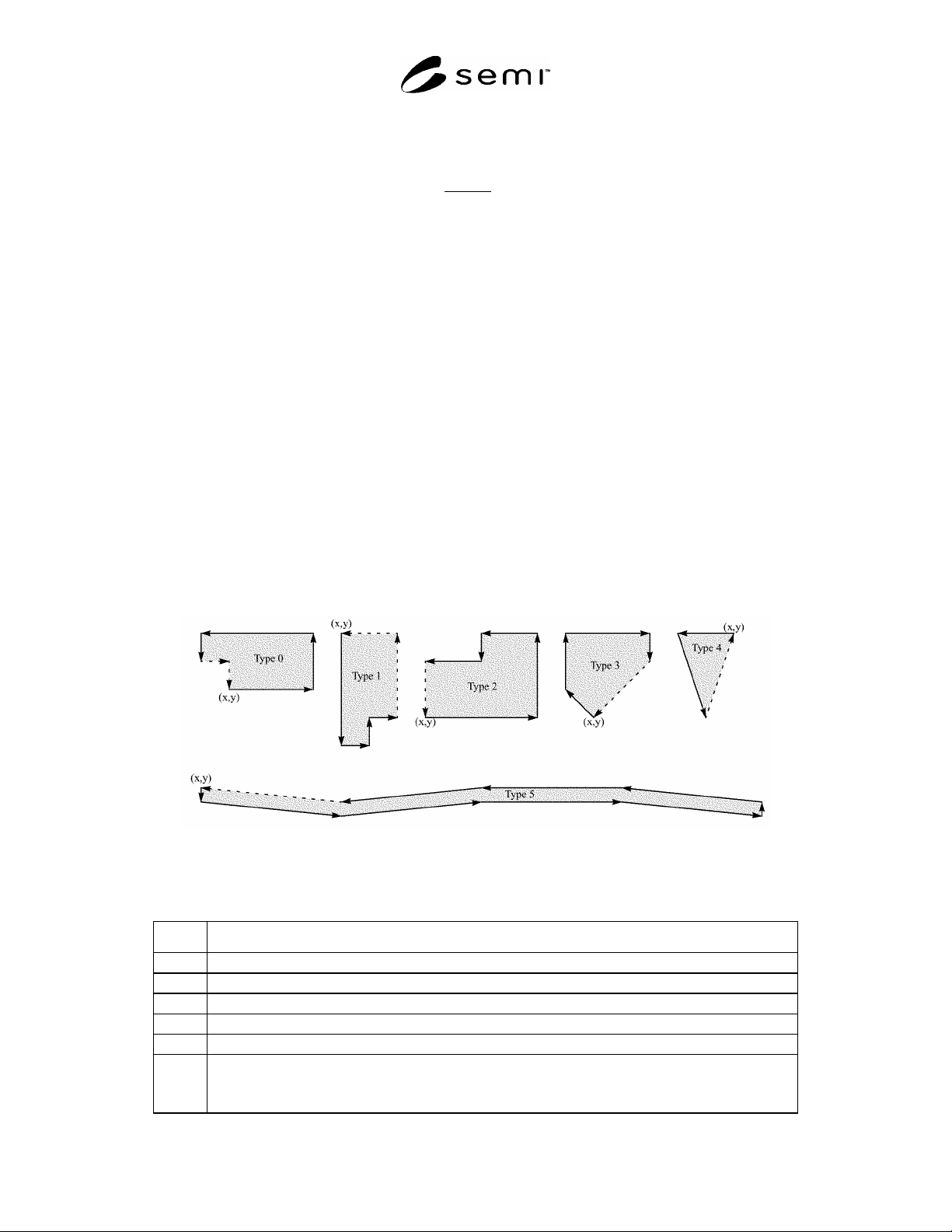
7.7.2 A point-list of type 0 consists of a list of 1-deltas, representing alternating horizontal and vertical relative
displacements, with the first displacement implicitly horizontal
. When describing a polygon point-list in this form,
the final two displacements are omitted, since they can be unambiguously implied from the current point, the last
SEMI P39-0304
E2
© SEMI 2004 10
edge, and the starting point. When describing a polygon, vertex-count must be an even number greater than or equal
to 2.
7.7.3 A point-list of type 1 consists of a list of 1-deltas, representing alternating vertical and horizontal relative
displacements, with the first displacement implicitly vertical
. When describing a polygon point-list in this form, the
final two displacements are omitted, since they can be unambiguously implied from the current point, the last edge,
and the starting point. When describing a polygon, vertex-count must be an even number greater than or equal to 2.
7.7.4 A point-list of type 2 consists of a list of 2-deltas, representing a series of manhattan relative displacements.
When describing a polygon point-list in this form, the final displacement is omitted, since the polygon is assumed to
be implicitly closed, but this final implicit displacement must be a manhattan displacement, with either x = 0 or
y = 0.
7.7.5 A point-list of type 3 consists of a list of 3-deltas, representing a series of octangular relative displacements.
When describing a polygon point-list in this form, the final displacement is omitted, since the polygon is assumed to
be implicitly closed, but this final implicit displacement must be an octangular displacement at an angle that is an
integral multiple of 45°.
7.7.6 A point-list of type 4 consists of a list of g-deltas, representing a series of any-angle relative displacements.
When describing a polygon point-list in this form, the final displacement is omitted, since the polygon is assumed to
be implicitly closed.
7.7.7 A point-list of type 5 consists of a list of g-deltas, representing a series of adjustments to a relative
displacement vector, with the initial vector set to (x = 0, y = 0). To calculate the coordinates of each successive
point, the x and y components of each successive g-delta are added to the relative displacement vector, which in turn
describes the relative displacement from the current point to the next point. When describing a polygon point-list in
this form, the final displacement is omitted, since the polygon is assumed to be implicitly closed. This form of point-
list is intended to allow more compact representation of polygons and paths which are approximations of large-field
curvilinear figures on a fine grid, where the curvature is not extreme.
Figure 6
Point List Describing Polygons
Table 8 Polygon Point List for Figure 6
Type Bit Pattern
0 00000000 00000100 00001100 00001000 00010001 00000101
1 00000001 00000100 00010001 00000100 00000100 00000100
2 00000010 00000101 00100000 00011001 00010010 00001011 00010010
3 00000011 00000100 00010101 00100001 00110000 00010011
4 00000100 00000010 01000100 00001001 00001101
5 00000101 00001001 00000001 00000011 00101001 00000000 00000001 00000100
00000001 00000011 00000001 00000011 00101011 00000100 00101011 00000000
00000001 00000011 00000001 00000011