semi合集-English.pdf - 第5920页
SEMI P39-0304 E2 © SEMI 2004 23 they are in the undefined state shoul d be treated as a fatal error. The interpretatio n of zero-area trapezoids is application- dependent. 29 CTRAPEZOID Record 29.1 A CTRAPEZOID record re…
SEMI P39-0304
E2
© SEMI 2004 22
28 TRAPEZOID Record
28.1 A TRAPEZOID record represents a trapezoid figure (a polygon with four vertices having at least two
opposite sides parallel and parallel to either the x- or the y-axis). It has the following format:
‘23’ trap-info-byte [ layer-number ] [ datatype-number ]
[ width ] [ height ] delta-a delta-b [ x ] [ y ] [ repetition ]
‘24’ trap-info-byte [ layer-number ] [ datatype-number ]
[ width ] [ height ] delta-a [ x ] [ y ] [ repetition ]
‘25’ trap-info-byte [ layer-number ] [ datatype-number ]
[ width ] [ height ] delta-b [ x ] [ y ] [ repetition ]
28.2 The trap-info-byte contains bit pattern ‘OWHXYRDL’.
28.3 R is 1 if repetition is present. L is 1 if layer-number is present. D is 1 if datatype-number is present. Both
layer-number and datatype-number are unsigned-integers. When layer-number and/or datatype-number are
unspecified, they assume the value of modal variables layer and datatype, respectively. W is 1 if width is present.
H is 1 if height is present. Width and height are unsigned-integers which describe the overall dimensions of the
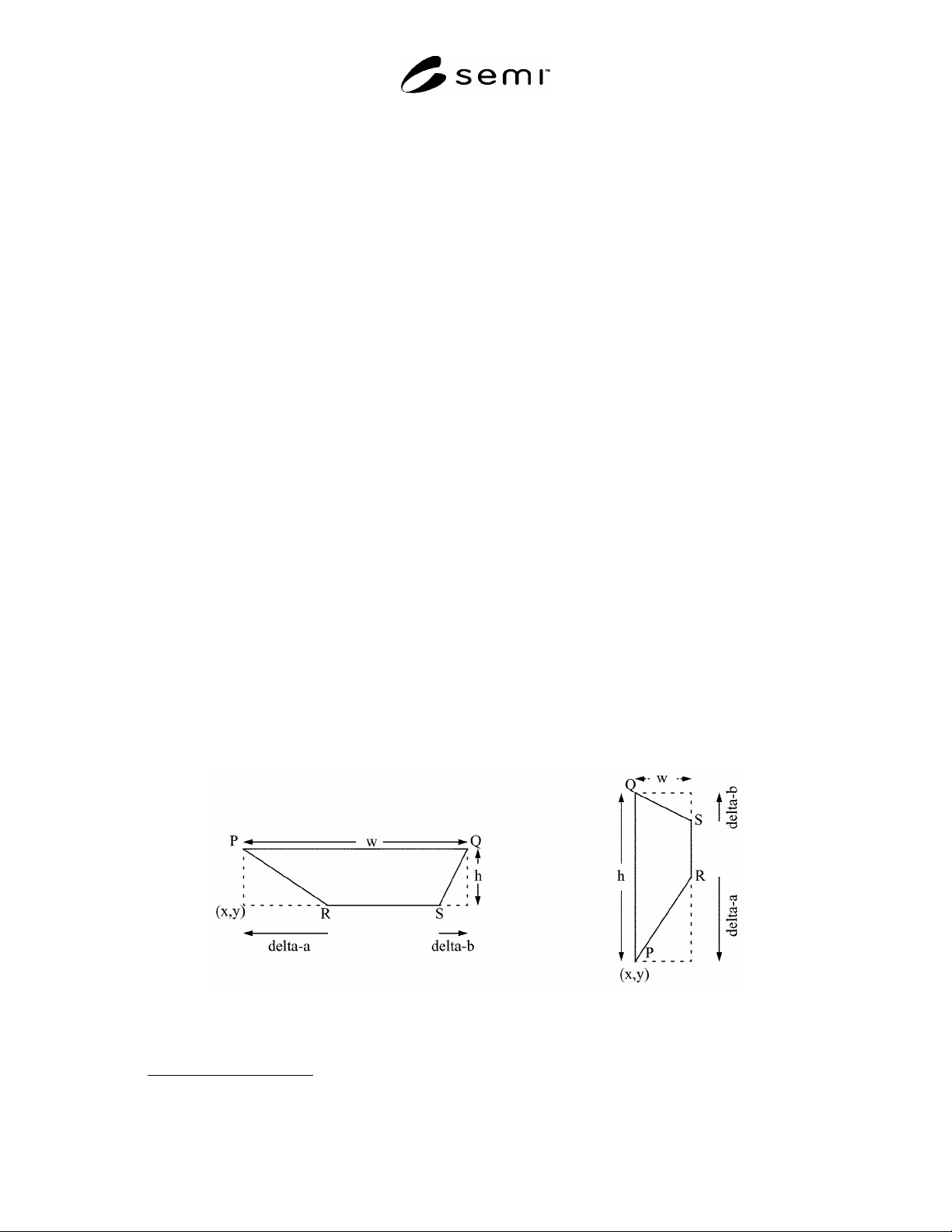
bounding box of the trapezoid as shown in Figure 7 on page 22. When width and/or height are unspecified, they
assume the value of modal variables geometry-w and geometry-h, respectively.
28.4 x and y are signed-integer coordinates representing either the absolute or the relative (x,y) location of the
lower-left corner of the trapezoid’s bounding box. X is 1 if x is present, and Y
is 1 if y is present. When either x or y
is unspecified, the value of modal variable geometry-x or geometry-y, respectively, is used instead. Refer to Section
21 on page 17 for a discussion of how absolute and relative modes affect the interpretation of x and y.
28.5 delta-a and delta-b are 1-deltas, and are both present in record type ‘23’. In record type ‘24’ delta-b is
assumed to be 0 and is omitted, and in record type ‘25’ delta-a is assumed to be 0 and is omitted.
28.6 O is 0 if the trapezoid is horizontally-oriented, with top (PQ) and bottom (RS) sides parallel to the x-axis. In
this case, delta-a represents (x
P
- x
R
) and delta-b represents (x
Q
- x
S
).
28.7 O is 1 if the trapezoid is vertically-oriented, with left (PQ) and right (RS) sides parallel to the y-axis. In this
case, delta-a represents (y
P
- y
R
) and delta-b represents (y
Q
- y
S
).
28.8 Each successive TRAPEZOID record updates all trapezoid-related modal variables.
Figure 7
Horizontal and Vertical Trapezoids
28.9 EXCEPTION HANDLING
— For any trapezoid, deltas of sufficient magnitude to cause segments PR and QS
to cross, as well as any delta which causes either segment PR or QS not to fit diagonally within the bounding box,
should be treated as fatal errors. Implicit use of modal variables geometry-w, geometry-h, layer, or datatype when
SEMI P39-0304
E2
© SEMI 2004 23
they are in the undefined state should be treated as a fatal error. The interpretation of zero-area trapezoids is
application-dependent.
29 CTRAPEZOID Record
29.1 A CTRAPEZOID record represents a trapezoid figure in a compact form by assuming that two sides are
parallel to either the x- or the y-axis, and the remaining two sides form either a 45- or 90-degree angle with them. It
has the following format:
‘26’ ctrapezoid-info-byte [ layer-number ] [ datatype-number ]
[ ctrapezoid-type ] [ width ] [ height ] [ x ] [ y ] [ repetition ]
29.2 The ctrapezoid-info-byte contains the bit pattern ‘TWHXYRDL’.
29.3 R is 1 if repetition is present. L is 1 if layer-number is present. D is 1 if datatype-number is present. Both
layer-number and datatype-number are unsigned-integers. When layer-number and/or datatype-number are
unspecified, they assume the value of modal variables layer and datatype, respectively. W is 1 if width is present.
H is 1 if height is present. Both width and height are unsigned-integers, and represent the width (w) and height (h)
of the trapezoid’s bounding box, respectively. When width and/or height are unspecified, they assume the value of
modal variables geometry-w and geometry-h, respectively.
29.4 x and y are signed-integer coordinates representing either the absolute or the relative (x,y) location of the
lower-left corner of the trapezoid’s bounding box. X is 1 if x is present, and Y is 1 if y
is present. When either x or y
is unspecified, the value of modal variable geometry-x or geometry-y, respectively, is used instead. Refer to Section
21 on page 17 for a discussion of how absolute and relative modes affect the interpretation of x and y.
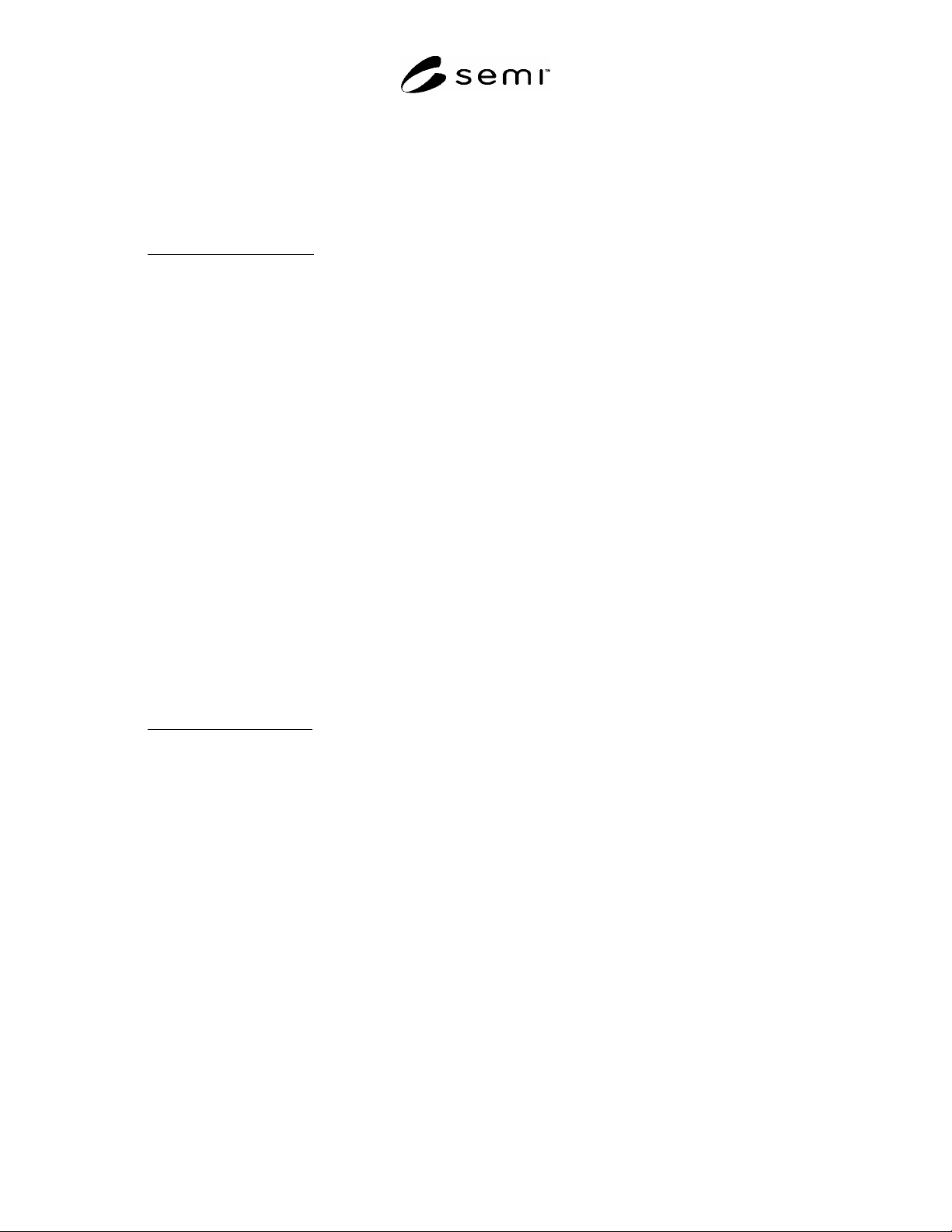
29.5 T is 1 if ctrapezoid-type (an unsigned-integer) is present; otherwise it assumes the value of modal variable
ctrapezoid-type. Types 0-25 are depicted in Figure 8:
Figure 8
The 26 Standard CTRAPEZOID Types
SEMI P39-0304
E2
© SEMI 2004 24
29.6 The triangle, rectangle, and square forms are provided for compactness and for compatibility with some mask
writing pattern file formats. For types 16–19, 22–23, and 25, height is not used, and H must be 0. For types 20–21,
width is not used and W must be 0.
29.7 Each successive CTRAPEZOID record updates all ctrapezoid-related modal variables with the following
exception: for the forms where only one of width or height is used (types 16–23 and 25), modal variables geometry-
w and geometry-h are both updated to match the specified dimension.
29.8 EXCEPTION HANDLING
— For types 0-3 and 6-7, (w < h) should be treated as a fatal error. For types 4-5,
(w < 2h) should be treated as a fatal error. For types 8-11 and 14-15, (h < w) should be treated as a fatal error. For
types 12-13, (h < 2w) should be treated as a fatal error. For types 16-19, 22–23, and 25, an H value of 1 should be
treated as a fatal error. For types 20-21, a W value of 1 should be treated as a fatal error. A value of ctrapezoid-type
greater than 25 should be treated as a fatal error. Implicit use of modal variables ctrapezoid-type, geometry-w,
geometry-h, layer or datatype when they are in the undefined state should be treated as a fatal error. The
interpretation of zero-area trapezoids is application-dependent.
30 CIRCLE Record
30.1 A CIRCLE record represents a circular figure. It has the following format:
‘27’ circle-info-byte [ layer-number ] [ datatype-number ] [ radius ] [ x ] [ y ] [ repetition ]
30.2 The circle-info-byte contains the bit pattern ‘00rXYRDL’.
30.3 R is 1 if repetition is present. L is 1 if layer-number is present. D is 1 if datatype-number is present. Both
layer-number and datatype-number are unsigned-integers. When layer-number and/or datatype-number are
unspecified, they assume the value of modal variables layer and datatype, respectively.
30.4 x and y are signed-integer coordinates representing either the absolute or the relative (x,y) location of the
circle’s center. X is 1 if x is present, and Y is 1 if y is present. When either x or y is unspecified, the value of modal
variable geometry-x or geometry-y, respectively, is used instead. Refer to Section 21 on page 17 for a discussion of
how absolute and
relative modes affect the interpretation of x and y.
30.4.1 r is 1 if radius is present, otherwise radius assumes the value of modal variable circle-radius instead.
30.5 Each successive CIRCLE record updates all circle-related modal variables.
30.6 EXCEPTION HANDLING
— Implicit use of modal variables circle-radius, layer, or datatype when they are in
the undefined state should be treated as a fatal error. The interpretation of zero-area CIRCLEs is application-
dependent.
31 PROPERTY Record
31.1 A property is an annotation element consisting of a name plus an optional list of values, supplying descriptive
information about the characteristics of the OASIS file or one of its components. A property may be associated with
the entire OASIS file, a <name> record, a CELL, a PLACEMENT, or an <element> record within a cell. The
PROPERTY record has the following format:
‘28’ prop-info-byte [ reference-number | propname-string ] [ prop-value-count ] [ <property-value>* ]
‘29’
31.2 Record type ‘29’ provides a compact way to specify a duplicate copy of the most-recently-seen property
together with its value list. It makes use of modal variables last-property-name and last-value-list, which were
defined by a previous PROPERTY record.
31.3 The prop-info-byte contains the bit pattern ‘UUUUVCNS’.
31.4 When C = 1, the property name reference is explicit, in which case N = 1 means that reference-number (an
unsigned-integer) is present, and refers to a PROPNAME record where the property name is stored; N = 0 means