semi合集-English.pdf - 第6590页
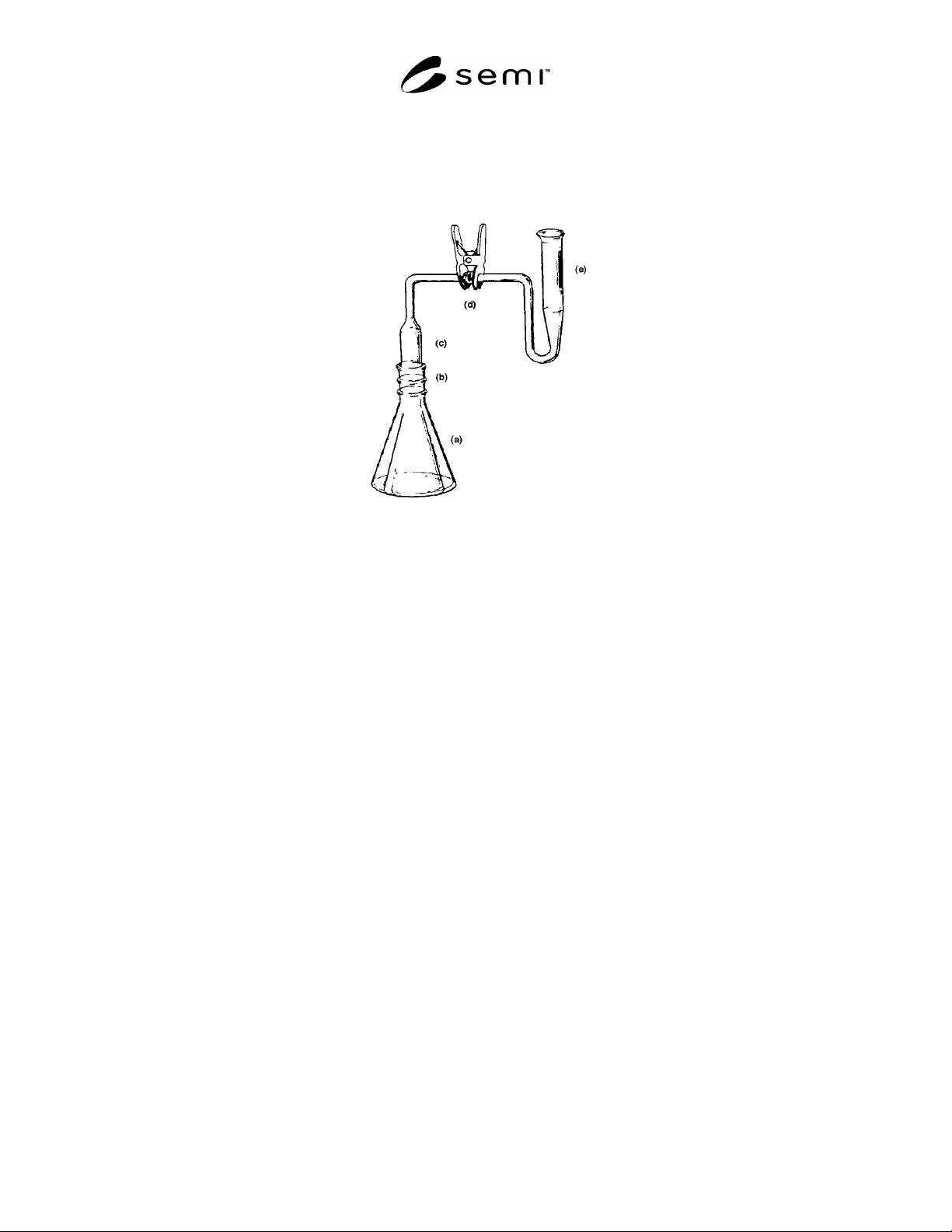
SEMI C1-0705 © SEMI 1978, 2005 16 7.6.2 Apparatus — The apparatus (see Figure 3) consists of a 1 25 mL arsine generator (a) fitted with a scrubber unit (c) and an absorbe r tube (e), with a 24/40 standard -taper joint (b…
SEMI C1-0705 © SEMI 1978, 2005 15
and, using gloves, pressing it around the base of an 800 mL beaker. The balance is a semi-micro type, and the static
electricity eliminator may be obtained from supply houses.
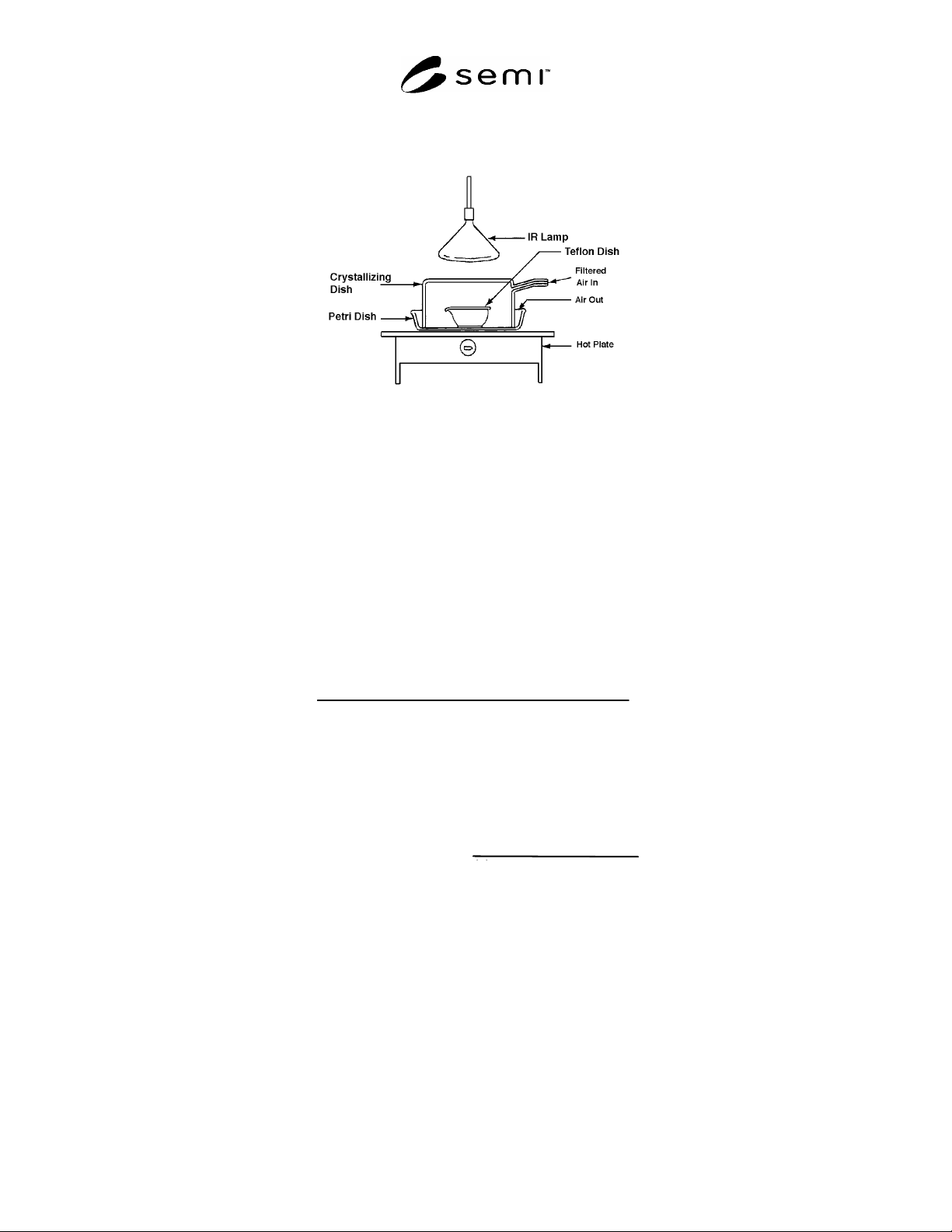
Figure 3
Thiers Assembly
7.4.4 Procedure
7.4.4.1 Rinse the 250 mL aluminum dish (or platinum dish in the case of halogenated solvents) with a portion of the
sample. Heat the dish at 105°C in an oven for 30 min and cool for 30 min (1 hr for platinum) in a desiccator
charged with calcium chloride and placed near the balance. Discharge static electricity using the eliminator and
weigh the dish on a semi-microbalance to the nearest 0.01 mg.
7.4.4.2 Start the flow of filtered nitrogen gas through the side arm of the Thiers assembly and place the dish inside.
Raise the cover briefly to add the specified amount of solvent from a clean, graduated cylinder. Adjust the nitrogen
stream so that the surface of the solvent is barely rippled. Also, adjust the heat lamp and hot plate so that the
evaporation rate does not exceed 8 mL/min and that no sample condenses on the top inner surface of the assembly.
7.4.4.3 When all of the sample has evaporated, heat the dish for 30 min in an oven at 105°C. Cool as given above,
discharge the static electricity, and reweigh. Calculate the residue as mg/mL.
[wt of dish plus residue (g)
-
wt of dish (g)]
10
6
sample wt (g)
For best results, room temperature should be kept constant to ± 5°C.
7.5 Residue after Ignition — A “residue after ignition” test serves to assess the amount of nonvolatile inorganic
matter present in a sample. Unless otherwise stated, the ignition shall be performed at 800° ± 25°C for 15 minutes.
Where the addition of sulfuric acid is specified, the result corresponds to what is often termed “sulfated ash.” The
calculation of the result, expressed in parts per million (µg/g), takes the form:
ppm Residue after Ignition
=
Net weight of residue
()
10
Weight of sample
6
7.6 Trace Arsenic (and Antimony) Determination
7.6.1 Introduction — This photometric procedure is based upon the color reaction of silver diethyldithiocarbamate
with arsine (and stibine). It provides for measurement of the absorbance of the sample and standards with
subsequent calculation of the arsenic and antimony content of the sample, expressed as arsenic. The procedure
given below differs from conventional ones by the omission of potassium iodide and stannous chloride. By this
omission, antimony is evolved as stibine and reacts with the silver diethyldithiocarbamate solution. The color
development is consequently due to both arsenic and antimony. The test sensitivity for arsenic is greater than for
antimony.
SEMI C1-0705 © SEMI 1978, 2005 16
7.6.2 Apparatus — The apparatus (see Figure 3) consists of a 125 mL arsine generator (a) fitted with a scrubber
unit (c) and an absorber tube (e), with a 24/40 standard-taper joint (b) and a ground glass ball-and-socket joint (d),
secured with a No. 12 clamp, connecting the units. In order to insure a more uniform rate of flow of gas into the
absorbing solution, various modifications may be employed, such as the use of a fritted-glass disk sealed into the
tapered end of the absorption tube.
Figure 4
Arsenic Test Apparatus
7.6.3 Reagents
7.6.3.1 Arsenic Stock Solution — (1.00 mg/mL of arsenic) — Transfer 0.66 g of arsenic trioxide to a 500 mL
volumetric flask and dissolve with 5 mL of 50% sodium hydroxide solution. Neutralize with 5 N sulfuric acid, add
an excess of 5 mL, dilute to the mark with water, and mix thoroughly.
7.6.3.2 Arsenic Working Solution — (1.0 µg/mL of arsenic) — Transfer exactly 0.5 mL of the arsenic stock solution
to a 500 mL volumetric flask, and 5 mL of 5 N sulfuric acid, dilute to the mark with water, and mix thoroughly.
Prepare immediately before use.
7.6.3.3 Lead Acetate Solution — Dissolve 10 g of lead acetate trihydrate in 100 mL of water.
7.6.3.4 Silver Diethyldithiocarbamate Solution — Dissolve 1 g of diethyldithiocarbamic acid, silver salt, in 200 mL
of pyridine and filter the solution. (The pyridine is best purified by passage through an alumina column.) Store this
solution in a light-resistant container and use within 1 month. Silver diethyldithiocarbamate as a dry solid is yellow
in color. Discard material that is markedly off color or develops a strong odor; alternatively, recrystallize from 1:1
pyridine-water and dry in vacuo at room temperature.
7.6.4 Sample Solution Preparation — Prepare the sample solution as specified in the procedures for the individual
liquid chemical.
7.6.5 Procedure
7.6.5.1 Treat the sample as described in the procedure for the individual chemical and transfer the resulting solution
to the generator flask. Swirl the flask, add 5 mL of 20% sulfuric acid, and allow to stand at room temperature for 15
minutes.
7.6.5.2 Pack the scrubber tube (c) with two pledgets of lead acetate-impregnated glass wool previously moistened
with lead acetate solution freed from excess solution by squeezing and dried in a vacuum. Allow a small space
between the two pledgets. Place 3.0 mL of silver diethyldithiocarbamate solution in the absorber tube (e), add 3 g of
zinc (granular) to the generator flask (a), and immediately connect the scrubber-absorber assembly to the flask.

SEMI C1-0705 © SEMI 1978, 2005 17
7.6.5.3 Place the generator flask in a water bath maintained at 25° ± 3°C and swirl the flask gently at 10 minute
intervals. (The addition of a small volume of 2-propanol to the generator flask may make the gas evolution more
uniform.) After 45 minutes, disconnect the tubing from the generator flask, transfer the silver diethyldithiocarbamate
solution to a 1 cm photometer cell, and measure the absorbance at 525 nm versus the water blank.
7.6.5.4 Carry a water blank and standard through the procedure, using the identical quantities of the same reagents.
The standard consists of a volume of the arsenic working solution corresponding to the amount of arsenic stated in
the procedure for the individual liquid chemicals. Any red color in the silver diethyldithiocarbamate solution from
the sample preparation should be no greater than that obtained with the standard.
7.7 Use of a pH Meter — The principles of pH measurement are given in documents and instrument manuals. The
purpose here is to describe in general terms how the technique is used with the procedures for individual liquid
chemicals, either to assure that a “pH of Solution” specification is met or to adjust the acidity or alkalinity of a
solution as required in the conduct of a procedure.
7.7.1 Equipment — The pH meter should be capable of reading to 0.02 pH units and should best be equipped for
temperature compensation. The electrodes should be calomel and glass and should be kept in appropriate solutions
when not in use, following the supplier’s recommendations.
7.7.2 Standardization — At time of use, the pH meter and electrodes should be standardized against two pH
standard buffers that preferably should bracket the expected pH of the solution to be measured. The meter with the
electrodes immersed in the first buffer should be adjusted to the stated value for that buffer. The electrodes should
then be rinsed, and the meter, with the electrodes immersed in the second buffer, should be adjusted to the stated
value for that buffer. This adjustment procedure should be repeated until two consecutive measurements for one of
the buffers gives the same value within ± 0.02 pH units. Where a temperature is specified for an individual liquid
chemical, either as part of the specification parameter or the relevant procedure, that temperature should be
maintained in the standardization with the corresponding assigned pH values for the pH standard buffers being
employed. During measurements, each buffer should be magnetically stirred at the same constant rate.
7.7.3 Quantitation — For the measurement of the pH of a solution, the meter and electrodes should be standardized
as given above. The electrodes should then be rinsed with water and immersed in the solution (held at the specified
temperature), and the pH read once the reading has stabilized. The solution should be magnetically stirred at the
same rate as used in the standardization. If the reading does not stabilize within 1 minute, the cause should be found
and eliminated. Any water used to dilute a sample for the “pH of Solution” test should be carbon dioxide-free.
7.8 Determination of Various Ions by Ion Chromatography — The theory of ion chromatography is given in many
documents, reviews, etc. The purpose here is to delineate some practical aspects for the determination of various
ions by Ion Chromatography. A complete detailed procedure for the ion chromatographic determination is not given
since available instruments vary from laboratory to laboratory.
7.8.1 Equipment — An ion chromatograph equipped with ion suppression is recommended. Single column ion
chromatography can also be used. The choice of reagents and columns is determined by the ions of interest.
7.8.2 Sample — Sample preparation varies depending upon the matrix effects of the liquid chemicals being
analyzed. Standard sample preparation techniques that may be used are (this list is not all inclusive):
7.8.2.1 Evaporation of the reagent to remove the matrix and then diluting the residual with the appropriate grade of
18.2 Mohm-cm water that meets ASTM Standard Guide D5127.
7.8.2.2 Diluting the reagent with the appropriate grade of 18.2 Mohm-cm water that meets ASTM Standard Guide
D5127 to lessen the matrix effects.
7.8.2.3 Direct injection of the reagent.
7.8.3
Columns — Many types of columns exist and can be used. Typical selection criteria for columns consist of
ion or ions of interest, the matrix of the reagent and eluent to be used.
7.8.4 Conditions — Appropriate conditions will vary from one ion chromatographic system to another. Analytical
conditions using ion suppression, which have been found acceptable using ion suppression, are listed under each
individual standard. The two broad classifications of ions are anions and cations. A typical eluent used in the
analysis of anions by ion suppression is a sodium carbonate and sodium bicarbonate in a solution with the
appropriate grade of 18.2 Mohm-cm water that meets ASTM Standard Guide D5127. A typical eluent used in the