semi合集-English.pdf - 第6714页
SEMI C41-0705 © SEMI 1978, 2005 1 SEMI C41-0705 SPECIFICATIONS AND GU IDELINES FOR 2-PROPANOL This specification was technically approved by the gl obal Liquid Chem icals Committee. This edition w as approved for publica…
SEMI C40-0699 © SEMI 19993
15 Tier B Procedures
15.1 This section does not apply to this chemical.
16 Tier C Procedures
16.1 This section does not apply to this chemical.
17 Tier D Procedures
17.1 This section does not apply to this chemical.
Table 1 Impurity Limits and Other Requirements for Potassium Hydroxide, 45% Solution
Previous SEMI Reference # --
Grade 1
(Specification)
Assay (KOH) 45.0 - 47.0%
Insoluble Matter 50 ppm max
Nitrogen Compounds (as N) 5 ppm max
Ammonium Hydroxide Precipitate 50 ppm max
Chloride (Cl) 50 ppm max
Phosphate (PO
4
) 2 ppm max
Potassium Carbonate (K
2
CO
3
)0.5% max
Sulfate (SO
4
) 10 ppm max
Heavy Metals (as Ag) 5 ppm max
Iron (Fe) 5 ppm max
Nickel (Ni) 5 ppm max
Sodium (Na) 0.03% max
NOTICE: These standards do not purport to address
safety issues, if any, associated with their use. It is the
responsibility of the user of these standards to establish
appropriate safety and health practices and determine
the applicability of regulatory limitations prior to use.
SEMI makes no warranties or representations as to the
suitability of the standards set forth herein for any
particular application. The determination of the
suitability of the standard is solely the responsibility of
the user. Users are cautioned to refer to manufacturer’s
instructions, product labels, product data sheets, and
other relevant literature respecting any materials
mentioned herein. These standards are subject to
change without notice.
The user’s attention is called to the possibility that
compliance with this standard may require use of
copyrighted material or of an invention covered by
patent rights. By publication of this standard, SEMI
takes no position respecting the validity of any patent
rights or copyrights asserted in connection with any
item mentioned in this standard. Users of this standard
are expressly advised that determination of any such
patent rights or copyrights, and the risk of infringement
of such rights, are entirely their own responsibility.
Copyright by SEMI® (Semiconductor Equipment and Materials
International), 3081 Zanker Road, San Jose, CA 95134. Reproduction o
f
the contents in whole or in part is forbidden without express written
consent of SEMI.
SEMI C41-0705 © SEMI 1978, 2005 1
SEMI C41-0705
SPECIFICATIONS AND GUIDELINES FOR 2-PROPANOL
This specification was technically approved by the global Liquid Chemicals Committee. This edition was
approved for publication by the global Audits and Reviews Subcommittee on April 7, 2005. It was available
at www.semi.org in June 2005 and on CD-ROM in July 2005. Originally published in 1978; previously
published in 2003.
NOTICE: This document was completely rewritten in 2005.
NOTICE: Paragraphs entitled NOTE are not an official part of this document and are not intended to modify or
supercede it.
1 Purpose
1.1 The purpose of this document is to standardize requirements for 2-propanol used in the semiconductor industry
and testing procedures to support those standards. Test methods have been shown to give statistically valid results.
2 Scope
2.1 The scope of this document covers all grades of 2-propanol used in the semiconductor industry.
2.2 The VLSI grade purity level is typically required by semiconductor devices with geometries of 0.8–1.2 microns.
NOTICE: This standard does not purport to address safety issues, if any, associated with its use. It is the
responsibility of the users of this standard to establish appropriate safety and health practices and determine the
applicability of regulatory or other limitations prior to use.
3 Referenced Standards and Documents
3.1 SEMI Standards
SEMI C1 — Guide for the Analysis of Liquid Chemicals
3.2 ASTM Standards
1
ASTM D5127 — Standard Guide for Ultra Pure Water Used in the Electronics and Semiconductor Industry
NOTICE: Unless otherwise indicated, all documents cited shall be the latest published versions.
4 Terminology
None.
5 Physical Property (for information only)
Density at 25ºC 0.78 g/mL
Boiling Point 82.3ºC
6 Requirements
6.1 The requirements for 2-propanol for Grades 1, 2, 3, 4 & VLSI Guidelines, are listed in Table 1.
7 Grade 1 Procedures
NOTE 1: Each laboratory is responsible for verifying the validity of the method within its own operation.
7.1 Assay — Analyze the sample by gas chromatography (see SEMI C1, ‘Assay by Wide Bore Column Gas
Chromatography’). The parameters cited have given satisfactory results.
1 American Society for Testing and Materials, 100 Barr Harbor Drive, West Conshohocken, Pennsylvania 19428-2959, USA. Telephone:
610.832.9585, Fax: 610.832.9555, www.astm.org
SEMI C41-0705 © SEMI 1978, 2005 2
Column: 30 meter × 530 micron I.D. fused silica capillary, coated with 5 micron film of DB-Wax or equivalent
(100% methyl silicone which has been surface bonded and cross linked).
Column Temperature: 40ºC isothermal for 5 minutes, then programmed to 200ºC at 10ºC/min.
Injector Temperature: 150ºC
Detector Temperature: 250ºC
Sample Size: 0.2 µL splitless
Carrier Gas: Helium at 3 mL/min
Detector: Thermal Conductivity
Approximate Retention Times (min):
Acetone 4.5
2-Propanol 5.0
7.2 Color — Dilute 2.0 mL of platinum-cobalt stock solution (APHA No. 500) to 100 mL with water. Compare this
standard (APHA No. 10) with 100 mL of sample in Nessler tubes. View vertically over a white background. The
sample must be no darker than the standard.
7.3 Acidity — To 25 mL of water in a glass-stoppered flask, add 10 mL of sample and 0.1 mL of phenolphthalein
indicator solution. Add 0.01N sodium hydroxide until a slight pink color persists after shaking for one-half minute.
Add 64 mL (50 g) of the sample, mix well, and titrate with 0.01N sodium hydroxide until the pink color is
reproduced. Not more than 1.0 mL of the sodium hydroxide solution should be required.
7.4 Alkalinity — Add 128 mL (100 g) of sample to 25 mL of water and mix well. Add 0.05 mL of methyl red
indicator solution. Titrate with 0.01 N hydrochloric acid until a slight pink color is produced. Not more than 1.0 mL
of the hydrochloric acid should be required.
7.5 Residue after Evaporation — Evaporate 256 mL (200 g) of sample to dryness. Dry at 105ºC for 30 minutes,
cool in a desiccator, and weigh (see SEMI C1, ‘Residue after Evaporation’).
7.6 Water — Add 25 mL of methanol to a dry titration flask and add Karl Fischer (KF) reagent to a visually or
electrometrically determined endpoint that persists for 30 seconds. Add 25 mL (20 g) of sample, taking care to
protect the sample and contents of the flask from moisture. Stir vigorously and titrate with Karl Fischer reagent to
the same endpoint.
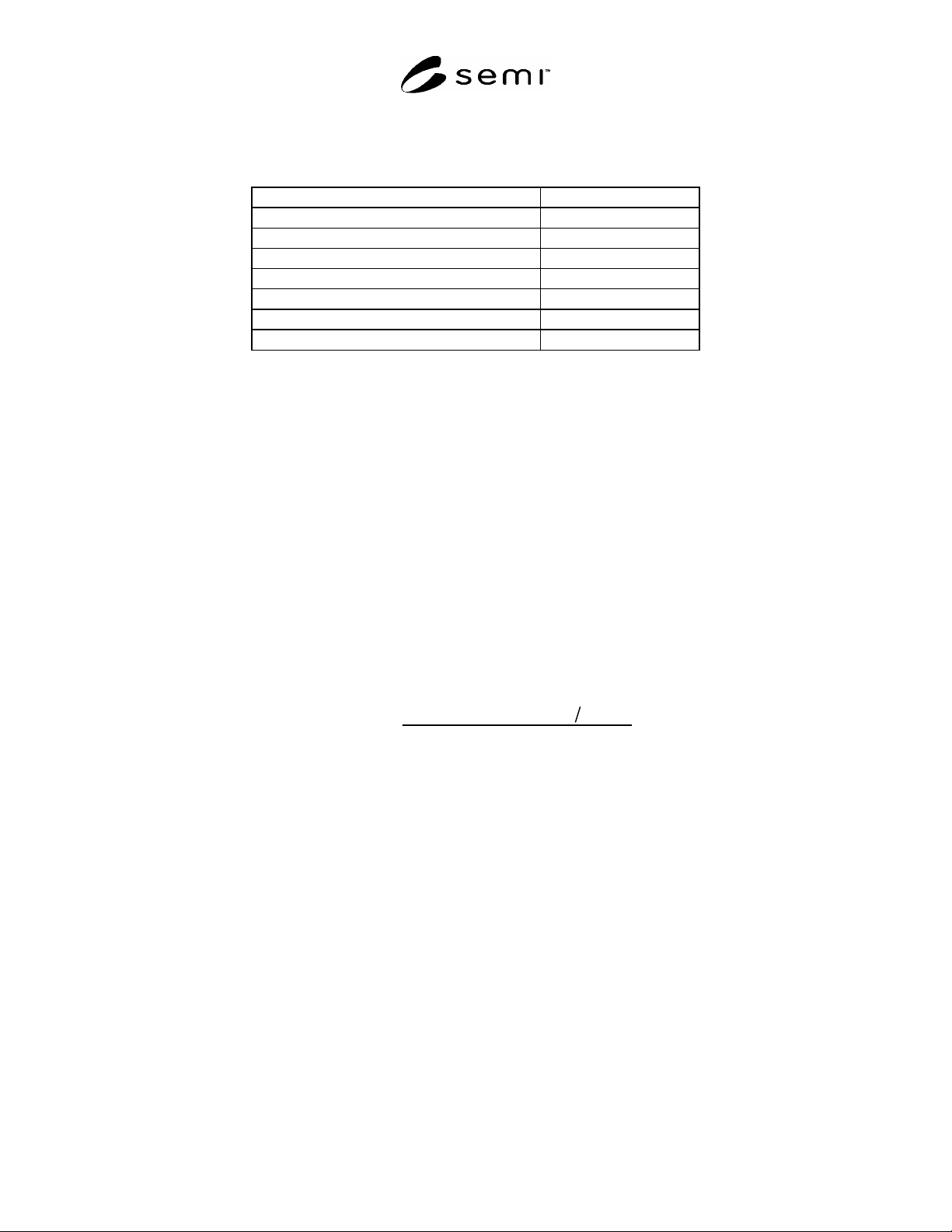
% Water (H
2
O)
mL KF reagent
KF factor g H
2
OmL
100
Weight of sample g
7.7 Solubility in Water — Mix 10 mL of sample with 40 mL of water. Allow to stand 1 hour. The solution should
be as clear as an equal volume of water.
7.8 Chloride — To 64 mL (50 g) of sample, add 10 mL of sodium carbonate reagent solution and evaporate to
dryness on a steam bath in a hood. Dissolve the residue in 10 mL of water, add 1 mL of nitric acid and dilute to 20
mL with water. Add 1 mL of silver nitrate reagent solution. Any turbidity produced should be no greater than that
produced when 0.01 mg of chloride ion (Cl) is treated as the sample.
7.9 Phosphate — To 26 mL (20 g) of sample, add 10 mL of sodium carbonate reagent solution and evaporate to
dryness on a steam bath in a hood. Dissolve the residue in 25 mL of 0.5 N sulfuric acid. Add 1 mL of ammonium
molybdate reagent solution and 1 mL of p-(methylamino)phenol sulfate reagent solution. Allow to stand at room
temperature for 2 hours. Any blue color produced should be no greater than that produced when 0.01 mg of
phosphate ion (PO
4
) is treated like the sample.
7.10 Arsenic and Antimony (as As) — Evaporate 256 mL (200 g) of sample in a 400 mL beaker to a small volume
in a hood. Add 50 mL of water and again evaporate to a small volume. Repeat the evaporation with water addition.
Do not allow to go to dryness. Add 5 mL of nitric acid and 5 mL of sulfuric acid and evaporate to dense fumes of
sulfur trioxide. Cool, cautiously add 10 mL of water, and again evaporate to dense fumes of sulfur trioxide. Cool,
and cautiously wash into a generator flask with water to make a volume of 35 mL. Proceed as described in the
SEMI C1, ‘Trace Arsenic (and Antimony) Determination’, starting with the sentence that begins, “Swirl the