semi合集-English.pdf - 第6764页
SEMI S1-0701 E © SEMI 1986, 2001 11 14 Translation 14.1 This guideline is not in tended to suggest that safety labels be written in or tran slated into any particular language. NOTE 22: National laws may requ ire that sa…

SEMI S1-0701
E
© SEMI 1986, 2001 10
11.2 For languages using the “Roman” alphabet, such as the official languages used in the Americas and in much of
the European Union, the lettering should be a combination of upper- and lowercase sans serif letters. Uppercase only
lettering may be used for short messages or for emphasis of individual words.
NOTE 17: Preferred Roman sans serif lettering styles include those named Arial, Arial Bold, Folio Medium, Franklin Gothic,
Helvetica, Helvetica Bold, and Univers.
11.3 Lettering should be of a size that enables a person with normal vision, including corrected vision, to read the
safety label at a safe viewing distance from the hazard.
NOTE 18: Related Information 1 provides an example of a method of calculating minimum letter heights.
NOTE 19: The proportions and spacing of individual letters also affect readability.
12 Colors
12.1 Color Specifications — Colors should conform to those colors specified in ISO 3864.
NOTE 20: For purposes of reproduction, the closest PANTONE
color match for opaque safety colors is:
Red – PANTONE 485
Orange – PANTONE 152
Yellow – PANTONE 109
Blue – PANTONE 2945
(PANTONE
is a registered trademark of Pantone, Inc.).
NOTE 21: Perceived color will be different under colored light (e.g., “yellow room”) conditions. The committee knows of no
current technical solution.
12.2 Symbol and Surround Shape Color Specifications — See section 9.10 for symbol and surround shape color
criteria.
12.3 Signal Word Panel — The three signal words should be colored as follows (see Figure 5):
12.3.1 The word DANGER should be in white letters on a red background.
12.3.2 The word WARNING should be in black letters on an orange background.
12.3.3 The word CAUTION should be in black letters on a yellow background.
12.3.4 Safety Alert Symbol — The solid triangle portion should be the same color as the signal word lettering, and
the exclamation mark portion should be the same color as the signal word panel background.
12.4 Optional Use of Red — The color red may be used in a symbol to indicate heat or fire.
13 Placement
13.1 Location of Safety Labels — Safety labels should be permanently attached to the equipment and, when
possible, located near the hazard.
13.2 Safe Viewing Distance — Safety labels should be placed to allow the viewer enough time to:
be informed by the safety label; and
have sufficient time to avoid the hazard or take appropriate evasive action to reduce the potential harm from the
hazard.
13.3 Placement — Safety labels should be placed so that they are legible, non-distracting, and not hazardous in
themselves.
13.4 Inadvertent Removal, Visual Blockage — Safety labels should not be located in areas where they may be
removed by the motion of equipment or rendered ineffective by situational conditions.
13.4.1 Safety labels should not be blocked from view by moveable panels such as doors, windows, and racks where
this would limit the effectiveness of the blocked label.

SEMI S1-0701
E
© SEMI 1986, 2001 11
14 Translation
14.1 This guideline is not intended to suggest that safety labels be written in or translated into any particular
language.
NOTE 22: National laws may require that safety label information be provided in one or more particular languages.
15 Related Documents
15.1 ANSI Standards
1
ANSI C95.2 — Radio-Frequency Warning Symbol
ANSI N2.1 — Radiation Symbol
ANSI N12.1 — Fissile Material Symbol
ANSI Z136.1 — Safe Use of Lasers
ANSI Z535.2 — Environmental and Facility Safety Signs
ANSI Z535.5 — Accident Prevention Tags
15.2 NEMA Standard
4
NEMA 77 — Standards for Warning Labels
15.3 NFPA Standards
5
NFPA 70 — National Electrical Code
NFPA 178 — Standard Symbols for Fire Fighting Operations
15.4 NIST Documents
6
NBSIR 80-2003 — Workplace Safety Symbols
NBSIR 80-2088 — The Assessment of Safety Symbol Understandability by Different Testing Methods
NBSIR 82-2485 — Symbols for Industrial Safety
15.5 United States of America Government Document
7
21 CFR Part 1040 — Performance Standards for Light-Emitting Products
15.6 IEC Standards
8
IEC 60825-1 — Safety of Laser Products - Part 1: Equipment Classification, Requirements and User's Guide
15.7 ISO Standards
9
ISO 9186 — Comprehension Testing of Graphical Symbols
4 National Electrical Manufacturers Association, 2101 L Street, N.W., #300, Washington, D.C. 20037, USA, http://www.nema.org
5 National Fire Protection Association, Batterymarch Park, Quincy, MA 02269, USA, http://www.nfpa.org
6 U.S. Department of Commerce, National Institute of Standards and Technology, Center for Building Technology, Washington, D.C., USA,
http://www.nist.gov/public_affairs/faqs/qpubs.htm
7 U.S. Government Printing Office, Washington, D.C., USA, http://bookstore.gpo.gov/prf/ordinfo.html
8 International Electrotechnical Commission, 1 rue de Varembe, Geneva, Switzerland, http://www.iec.ch
9 International Organization for Standardization, C.P.56, CH-1211 Geneva 20, Switzerland, http://www.iso.ch
SEMI S1-0701
E
© SEMI 1986, 2001 12
APPENDIX 1
SAFETY SYMBOLS
NOTE: The material in this appendix is an official part of SEMI S1 and was approved by full letter ballot procedures on April 30,
2001 by the North American Regional Standards Committee.
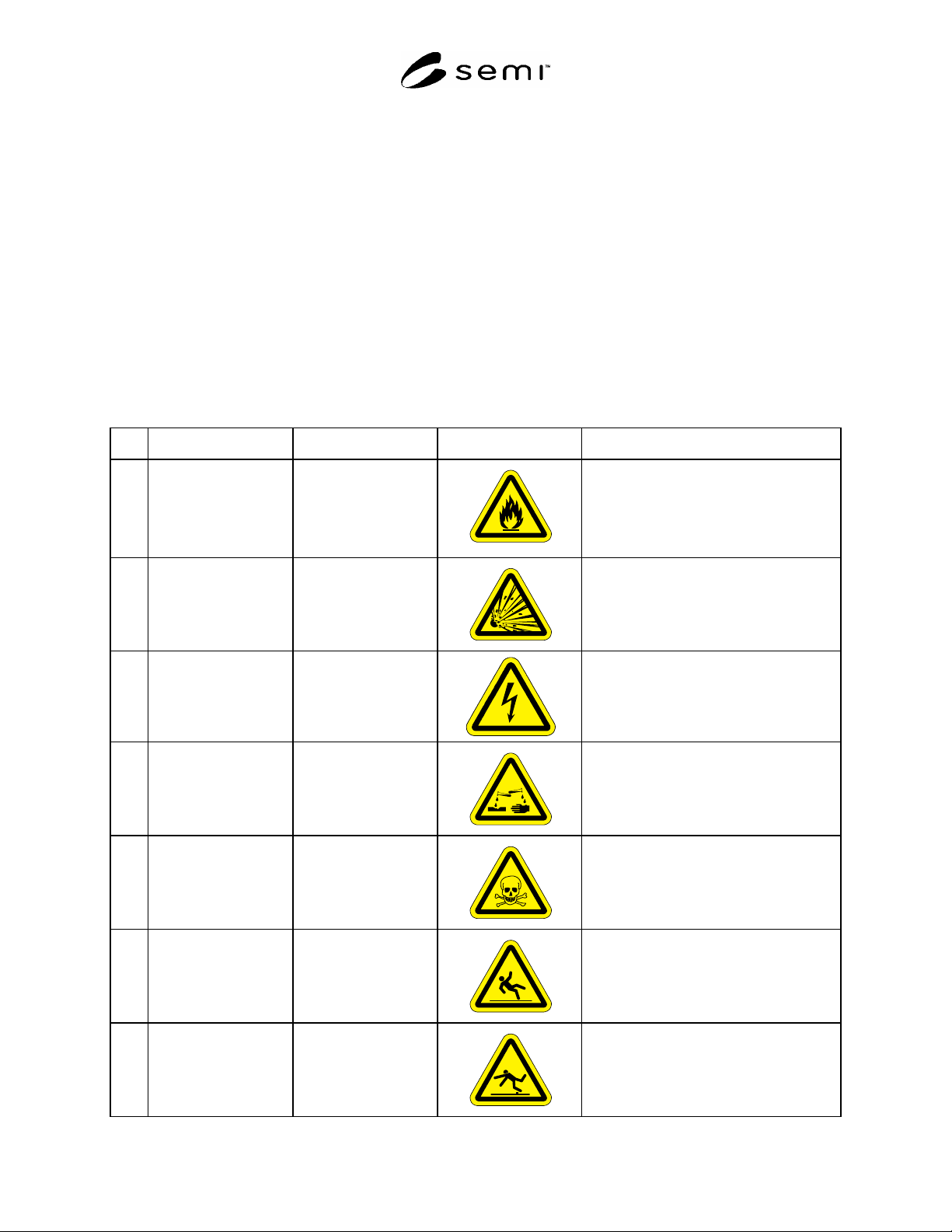
This appendix illustrates symbols used on safety labels for hazards commonly found in the semiconductor
manufacturing industry. Additional symbols may need to be developed for other hazards (see ANSI Z535.3-1998
Informative Annex A for an example of symbol development guidelines).
To determine what symbol should be used on a safety label, it is first necessary to determine what message is to be
communicated. Symbols may enhance a safety label’s meaning and may be useful to communicate across many
languages.
When appropriate, the following symbols should be used.
NOTE A1-1: Some symbols (e.g., laser, biohazard, and radiation) are required by law or regulation in some jurisictions.
Table A1-1 Hazard Identification Symbols
# Referent Source Symbol Description
1
Flammable Material IEC 61310
Flames
2
Explosive Material,
Explosion Hazard
IEC 61310
Object exploding
3
Danger: Electricity,
Electrical Hazard
IEC 61310, ISO
3864
Lightning bolt
4
Corrosive Material,
Corrosion
IEC 61310
Test tube, hand, drops
5
Toxic Material,
Poison
IEC 61310
Skull and crossbones
6
Slip Hazard ANSI Z535.3
Person falling on surface
7
Trip Hazard ANSI Z535.3
Person tripping over object