semi合集-English.pdf - 第6837页
SEMI S2-0703a E © SEMI 1991, 2004 66 RELATED INFORMATION 7 DOCUMENTATION OF IONIZING RADI ATION (SECTION 24 AND APPENDIX 4) INCLUDING RATIONALE FOR CHANGES NOTICE : This rel ated information i s not an of ficial part of …
SEMI S2-0703a
E
© SEMI 1991, 2004 65
RELATED INFORMATION 6
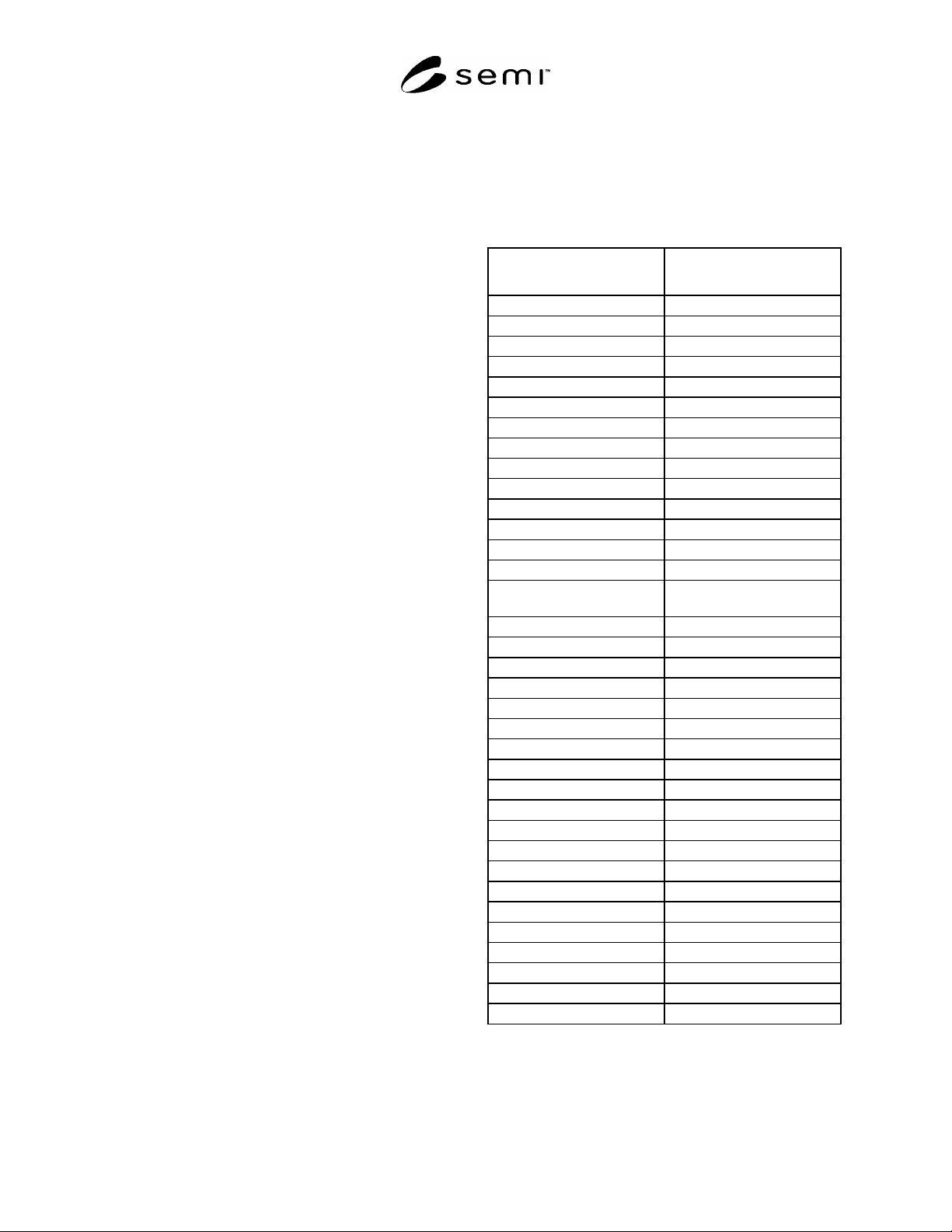
CONTINUOUS HAZARDOUS GAS DETECTION
NOTICE: This related information is not an official part of SEMI S2 and was derived from practical application by
task force members. This related information was approved for publication by vote of the responsible committee on
October 21, 1999.
R6-1 Scope — This related information provides a list
of gases for which continuous monitoring is
recommended, and another list of gases for which
continuous monitoring may be recommended
depending on variables listed below. The list is not
intended to be exhaustive (gases that do not appear on
the list may need to be continuously monitored).
R6-2 Intent — The purpose of this Related Information
is to provide equipment manufacturers with an
indication as to what gases are currently continuously
monitored by device manufacturers, as guidance for
when it may be appropriate to provide an interface (see
also Section 23).
R6-3 The following variables should be taken into
consideration when determining the necessity for
continuous monitoring:
Chemical toxicity,
Warning property/OEL ratio,
Delivery pressure,
LEL,
Flow rate of potential leak,
Engineering controls in place, and
Concentration.
Monitoring Recommended Monitoring May Be
Recommended
ammonia
arsine
boron trifluoride
bromine
carbon dioxide
carbon monoxide
carbon tetrabromide
chlorine
diborane
dichlorosilane
disilane
fluorine
germane
germanium tetrafluoride
flammable mixtures
containing hydrogen
hydrogen bromide
hydrogen chloride
hydrogen fluoride
hydrogen selenide
hydrogen sulfide
Methane
methyl chloride
methyl fluoride
nitric oxide
nitrogen dioxide
nitrous oxide
nitrogen trifluoride
ozone
phosphine
silane
silicon tetrachloride
silicon tetrafluoride
sulfur dioxide
trichlorosilane
tungsten hexafluoride

SEMI S2-0703a
E
© SEMI 1991, 2004 66
RELATED INFORMATION 7
DOCUMENTATION OF IONIZING RADIATION (SECTION 24 AND
APPENDIX 4) INCLUDING RATIONALE FOR CHANGES
NOTICE: This related information is not an official part of SEMI S2 and was derived from practical application by
task force members. This related information was approved for publication by vote of the responsible committee on
October 21, 1999.
R7-1 International Background Information
R7-1.1 The International Atomic Energy Agency
(IAEA)
Mailing address:
P.O. Box 100
Wagramerstrasse 5
A-1400, Vienna, Austria
Telephone: (+43-1) 2060-0; Facsimile: (+43-1) 20607:
E-mail: Official.Mail@iaea.org
R7-1.2 Basic approaches to radiation protection are
consistent all over the world. The International
Commission on Radiation Protection (ICRP)
recommends that any exposure above the natural
background radiation should be kept as low as
reasonably achievable, but below the individual dose
limits. The total individual dose limit for radiation
workers over 5 years is 100 mSv, and for members of
the general public, is 1 mSv per year. These dose limits
have been established based on a prudent approach by
assuming that there is no threshold dose below which
there would be no effect. This hypothesis proposes that
any additional dose will cause a proportional increase in
the chance of a health effect. This relationship has not
yet been established in the low dose range where the
dose limits have been set.
R7-1.3 The ICRP and the IAEA recommend the
individual dose must be kept as low as reasonably
achievable and consideration must be given to the
presence of other sources that may cause simultaneous
radiation exposure to the same group of the public.
Also, allowance for future sources or practices must be
kept in mind so that the total dose received by an
individual member of the public does not exceed the
dose limit.
R7-2 How Does This Apply to the
Semiconductor Industry?
R7-2.1 A person who can potentially be exposed to
ionizing radiation during the normal course of business
in excess of the annual limit for the general public
should be considered a radiation worker. A radiation
worker is trained to recognize and protect him or
herself from the hazards of ionizing radiation. They
may require exposure monitoring to determine
compliance with local radiation regulations. Radiation
workers are covered by a radiation safety program. A
radiation safety program is an administrative control.
Engineering controls minimize the need for spending
resources in a large scale radiation program.
R7-2.2 The exposure limit for the radiation worker is
20 millisievert (2000 millirem) per year. Based on a 40
hour/week, 50 week/working year basis, the allowable
ionizing radiation emissions are 10 microsieverts/hr
(1.0 millirem/hr). This exposure rate should be
evaluated as an emission rate from any accessible
surface of the equipment (the closest approach to the
surface that the radiation is penetrating).
R7-2.3 Maintenance technicians for radiation machines
should be participants in the radiation safety program as
radiation workers. The equipment should be designed to
allow maintenance technicians access to areas that do
not exceed 10 microsieverts/hr.
R7-2.4 Service technicians for radiation machines
should be participants in their employer’s radiation
safety program as radiation workers. The equipment
should be designed to allow service technicians access
to areas that exceed the 10 microsievert per hour level
when operating, but not while the radiation is present.
R7-2.5 The person operating radiation producing
equipment (Operator) should not be considered a
radiation worker. The emission limit for the operator
accessible areas is recommended to be 20% of the
occupational limit. The maximum allowable ionizing
radiation emissions for operator accessible areas is
recommended to be 2 microsieverts/hr (0.2
millirem/hr). This exposure rate should be evaluated as
an emission rate from any surface foreseeably
accessible by an operator of the equipment, and should
be measured as an instantaneous rate.
R7-3 Definitions
R7-3.1 accessible — a significant part of the whole
body, head, or eyes.
R7-3.2 bremsstrahlung — is radiation produced by
slowing of charged particles. The term means “braking
radiation.”

SEMI S2-0703a
E
© SEMI 1991, 2004 67
NOTE 1: During design of shielding, the properties of the
radiation should be considered as well as the properties of the
shielding materials. Bremsstrahlung production should be
minimized. Some shielding materials are considered
hazardous materials. These hazardous properties should be
considered and identified.
R7-3.3 radiation machine — means any device
capable of producing ionizing radiation except those
devices with radioactive material as the only source of
radiation.
R7-3.4 radiation producing machine — is a radiation
machine that produces ionizing radiation as a by-
product of the process it uses, e.g., ion implanter or
scanning electron microscope.
R7-3.5 radiation worker — “worker” means an
individual engaged in radiation related work under a
license or certificate of registration issued by the
Agency and controlled by a licensee or registrant, but
does not include the licensee or registrant.
R7-3.6 radioactive material – means any material
(solid, liquid, or gas) that emits ionizing radiation
spontaneously.
R7-3.7 X-ray machine — is a radiation machine that
generates X-rays as a primary function of the
equipment. This category of radiation machine has a
specific limit due to the existence of performance
standards against which the equipment is evaluated.
The equipment must be below this limit to be sold in
some parts of the world.
R7-3.8 X-rays — are produced with electricity and
therefore can be turned off. X-rays seem to be the most
prevalent radiation type in semiconductor
manufacturing equipment. They are produced when
charged particles are slowed or stopped. This slowing
results in “bremsstrahlung.” The majority of the
equipment does not intentionally produce X-rays. This
energy is a by-product of the process.
R7-4 Radioactive Materials
R7-4.1 Gamma radiation is a by-product of atomic
transformations (decay) and is a release of energy from
the nucleus. This radiation energy must be shielded
since there is no off switch.
R7-4.2 Radioactive Materials are controlled by
licensing. There are quantities of certain radioactive
materials that are exempt from regulation. These
sources should be identified.
R7-4.3 External radiation hazards from radioactive
materials include gamma rays. These are controlled and
evaluated much like the X-rays.
R7-4.4 Internal radiation hazards from radioactive
materials include Alpha and Beta particles. Radioactive
materials ingested or inhaled can be metabolized or
damage surrounding tissue. Allowable levels of
airborne radioactivity and radionuclide intakes are
specified in regulations. The objective is still to
maintain all exposure to ionizing radiation (internal and
external) as low as reasonably achievable, but always
less than the allowable regulatory limits.