semi合集-English.pdf - 第7095页
SEMI S20-0303 © SEMI 2003 4 8 Graphical Representations in Manuals, Documentation & Proced ures 8.1 Supplier-provided inst ructions for lockout/tagout and graphical r epresentatio ns of LOTO EIDs should be included w…

SEMI S20-0303 © SEMI 2003 3
5.2.10 service
unplanned activities intended to
return equipment that has failed to good working order.
(See also the definition for maintenance.) [SEMI S2]
5.2.11 tagout the placement of a tagging device
(such as a tag and a secure means of attachment) to an
energy isolation device in accordance with an
established procedure. The tagout indicates that the
energy-isolation device may not be operated until the
tagging device is removed.
6 Task Specific Information
6.1 For each task requiring hazardous energy isolation
(i.e., LOTO), the following information should be
provided in a combined format (including labels,
maintenance manuals, and graphical reference guides as
described in Sections 7, 8, and 9 of this document).
NOTE 8: In some jurisdictions the bulleted items below are
required.
6.1.1 Identification of:
• type and magnitude of hazardous energies to be
isolated,
• LOTO EIDs necessary for controlling sources of
hazardous energy, and
• lockout devices necessary to secure the LOTO
EIDs.
6.1.2 Instructions for the following:
• isolating each source of energy,
• blocking energy, or reducing the potential to a zero
energy state (such as blocking chemical lines or
blocking the suspended energy state in a spring or
raised weight),
• dissipating any residual energy,
• isolating hazardous energy sources that are isolated
by disconnection, but for which there are no
lockable EIDs. These instructions should state that
the protection depends on the means of
disconnection remaining in the immediate control
of the personnel performing the work,
• attempting to restart the equipment or re-energize
the system(s) that is/are to be isolated from
hazardous energy, and
• verification that there is no hazardous residual
energy in the system.
NOTE 9: An example of minimum Hazardous Energy Control
Procedures can be found in 29 CFR 1910.147 Appendix A.
NOTE 10: The intent of instructions is to meet the need for a
valid verification method that energy is isolated and to ensure
that proper procedures are provided. An instruction is not
required if the condition is not present or possible or the
method is not technically feasible.
7 Energy Isolation Device Identification
7.1 Each LOTO EID should be uniquely and
consistently identified on the system, drawings,
schematics, procedures, etc. to reduce confusion.
EXCEPTION: Equipment consisting of a grouping of
functional modules (e.g., a “cluster tool”), where more
than one module is used in the same grouping, may use
the same identifying numbers in each module.
NOTE 11: Where there are multiple control devices such that
one or more operating devices might be confused with the
LOTO EID, a differentiation marking may be used to prevent
confusion. One example of such a differentiation marking is
shown in Related Information 3.
7.2 All LOTO EIDs integral to the equipment should
be marked on the equipment.
7.2.1 LOTO EID markings should be located on the
equipment adjacent to (not on) the EIDs they identify.
NOTE 12: Marking directly on the EID can mean that
replacement of the EID will also remove the EID marking.
7.2.2 Where the LOTO EID marking is obscured
(covered by wiring, tubing, installation hardware, etc.),
an additional marking should also be placed on the EID
itself.
7.3 For LOTO EIDs required by the supplier but
provided and installed by the user, the supplier should
specify the requirements for such devices.
7.3.1 When such devices are specified, users should
provide lockable EIDs.
7.3.2 Users should provide to the supplier, if requested,
the location of the device.
7.3.3 Utility connection points for which LOTO EIDs
are located external to the equipment should be marked
to indicate that a user-provided EID is the method of
energy isolation. Space on the equipment should be
provided for the user to indicate the location of the
LOTO EID.
7.4 The style and size of letters and numbers on LOTO
EID markings should meet the criteria of SEMI S8 in
order to be readable from the normal viewpoint of
access to the LOTO EID.
7.4.1 The LOTO EID marking (as it appears on the
equipment) need not be colored according to Table 1 in
Section 9.

SEMI S20-0303 © SEMI 2003 4
8 Graphical Representations in Manuals,
Documentation & Procedures
8.1 Supplier-provided instructions for lockout/tagout
and graphical representations of LOTO EIDs should be
included with each maintenance task or in a separate
section of the manual referenced by each maintenance
task to which they pertain.
8.2 The text instructions should refer to the equipment
and all support equipment related to the task.
8.2.1 When the supplier does not provide the support
equipment, a generic graphical-reference placeholder
for the equipment should be used. Generic LOTO
procedures should also be included where the supplier
maintenance procedures require isolation of that
equipment.
NOTE 13: A graphical reference placeholder can be provided
by any method that allows space for the user to identify user-
installed support equipment and its associated LOTO EIDS
(e.g., a blank outlined space, a blank underlined space, a
numbered line with space for inserting text).
8.3 The size of the LOTO EID identifiers on the
graphical representation of the equipment should be
large enough to indicate the EID in question, but not so
large as to confuse location of the device in relation and
orientation to the rest of the equipment.
8.4 Each of the LOTO EID physical locations on the
equipment should be identified on a graphical
representation of the equipment with an image similar
in shape and text to the marking on the equipment.
8.5 LOTO EIDs that are not provided by the supplier
but are necessary to complete the associated task safely,
as defined by the supplier, should be graphically
identified as a generic external device in the
procedures. The procedure should mention that the end
user provides these devices.
8.6 For each specific task, the graphical representation
should illustrate at least the portion(s) of equipment
involved in the specific maintenance task.
EXCEPTION: Graphical representation need not be
duplicated for each task, but may be referenced by more
than one instruction.
8.6.1 The representation should be easily capable of
being associated with the LOTO procedure for the task
being completed or include the procedure text in written
form at the bottom of the graphical representation.
8.6.2 Task level instructions should identify those
LOTO EIDs that are required for the specific task being
completed and link them to the graphical
representation.
8.7 Energy isolation instructions for equipment options
or nonstandard procedures should be provided with the
equipment option or nonstandard process change as
purchased from the supplier.
NOTE 14: Nonstandard procedures include customer specific
tasks such as chamber cleaning for unique chemistries, use of
special lifting devices for single customers, and other tasks
that are not part of the standard procedures for the normal
supplier-delivered configuration.
8.7.1 The graphical representations should capture the
option’s LOTO EID in the representation for the overall
task it affects (e.g., if a UPS is offered as an option, the
LOTO procedures for the UPS option should be
provided and the UPS LOTO EID included in the
graphical representation).
9 Graphical Reference Guides for use at the
Equipment
NOTE 15: Graphical reference guides are intended to make it
easy for personnel to locate and isolate sources of hazardous
energy associated with the tasks they are performing.
9.1 Graphical reference guides should be provided for
each task where LOTO is used. LOTO EIDs should be
graphically identified on these reference guides.
Instructions for controlling each source of energy as
outlined in Section 6.1.2 should also be provided on the
reference guides. The reference guides should be task
specific.
NOTE 16: See Related Information 1 for example.
EXCEPTION: A single graphical reference guide may
be used for more than one task, provided it can be
easily determined from the text instructions, which
LOTO EIDs are used for each task.
9.2 It is recommended that the graphical reference
guides include a color representation of the overall
equipment, as well as individual task-specific
representations, as they would be found in the
maintenance manual.
EXCEPTION: If manuals are printed only in black and
white, the color representation may be specified as
“printed by the user” from the electronic copy.
9.3 If the supplier has no standard for coloring the
indicators of the LOTO EID locations on graphical
representations, they should be colored according to the
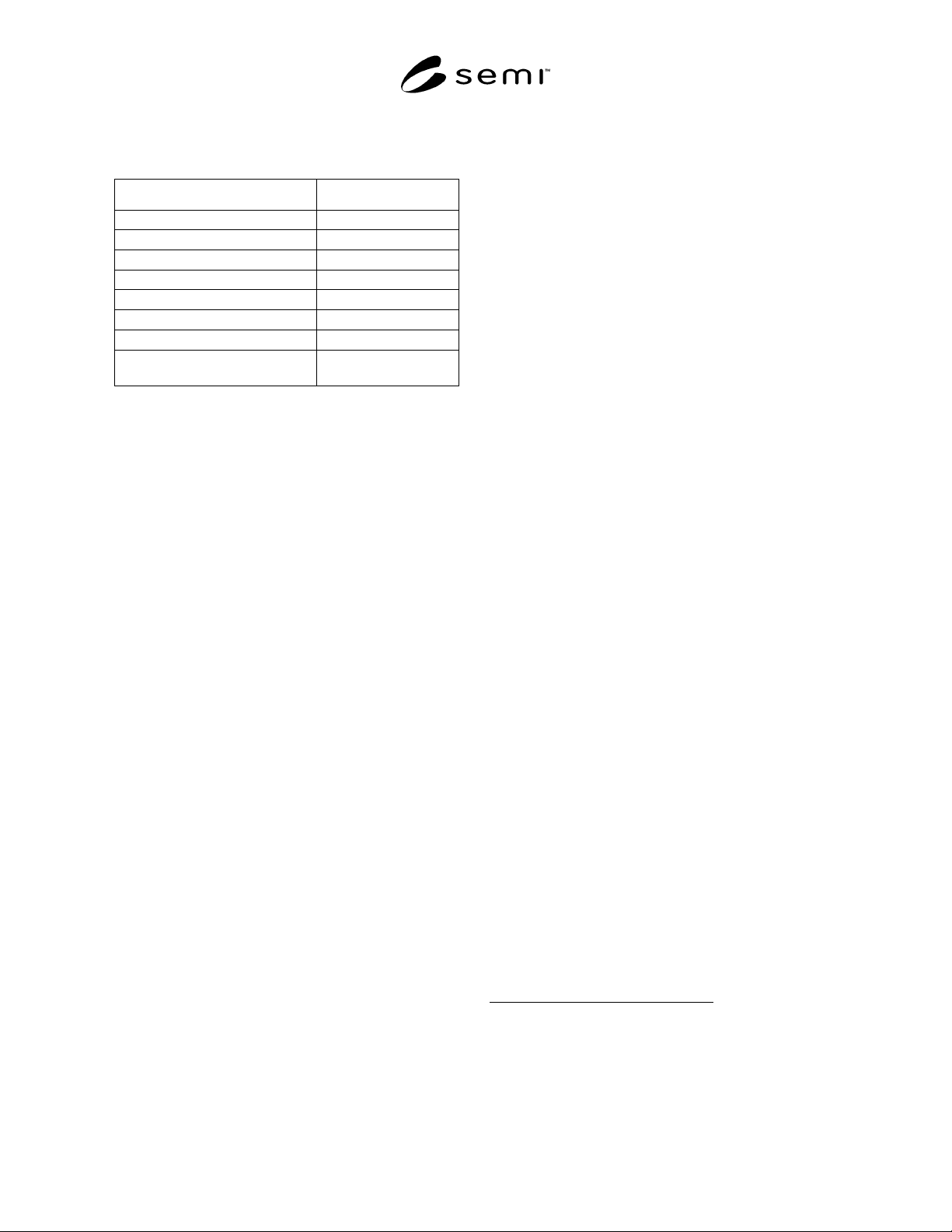
type of energy being isolated. See Table 1,
“Recommended Identifying Color Matrix”.
SEMI S20-0303 © SEMI 2003 5
NOTE 17: Supplier standard color coding may be any colors
including black and white.
Table 1 Recommended Identifying Color Matrix
Type of Energy Text/Background
Electrical Black/Orange
Compressed Gases White/Blue
Pressurized Liquids White/Green
Chemical Black/Yellow
Mechanical White/Black
Thermal Red/White
Ionizing Radiation Purple/Yellow
Non-Ionizing Radiation (Laser,
RF, UV, IR, etc.)
Black/Red
NOTE 18: Recommended color shades may be found in
standards such as ANSI Z535.1, Colors for Safety Labels ISO
3864 Safety Colours & Safety Signs or other international
equivalent for uniformity.
9.3.1 Colors (whether from the recommended list or
from the suppliers’ standard color coding) should be
assigned depending on the type of energy being
isolated, not the hazard being controlled. For example,
a circuit breaker that removes power from a robot
should have a unique identifier on the graphical
representation color-coded as Electrical, not
Mechanical energy.
9.4 Graphical reference guides should be either
electronic media or made from clean room compatible
materials that can be located at the equipment or can be
carried there during the performance of the tasks.
9.4.1 The supplier may offer optional media as part of
the purchase.
NOTE 19: Certain types of electronic devices (e.g.,
broadcasting handheld computers) may be restricted from use
in clean rooms due to system interference issues.
9.4.1.1 If the reference guide is intended to be
displayed electronically, the display device should be
conveniently available to personnel while they perform
the particular task.
9.4.1.2 The supplier may also specify that users have
the option to convert the guides to clean room
compatible, color printed versions.
9.5 Each graphical reference guide should be designed
so that it is clearly cross-referenced with its related
maintenance task(s).
9.5.1 Text instructions for operating and verifying the
isolation of each LOTO EID should be in the same field
of view as the graphical representation of that LOTO
EID on the graphical reference guide.
EXCEPTION: In an electronic file, the field of view is
controlled by the screen size and therefore text
instructions and graphics may not be in the same field
of view or may even be connected via hyperlink to each
other.
NOTE 20: One possible design is where the graphical
reference guides each consists of a card or page (perhaps in a
bound collection of reference guides) that can be placed near
the computer or manual and show the steps of the task.
Another possibility is to provide the ability to produce a split
screen display on a computer.
10 Related Documents
10.1 SEMI Standards
SEMI F34 Guide for Liquid Chemical Pipe Labeling
10.2 NFPA Standards
4
NFPA 70E Standard for Electrical Safety
Requirements for Employee Workplaces
NFPA 79 Electrical Standard for Industrial
Machinery
10.3 ANSI Standards
5
ANSI Z244.1 Personnel Protection, Lockout/Tagout
of Energy Sources – Minimum Safety Requirements
10.4 United States Code of Federal Regulations
6
29 CFR 1910.333b Working on or Near Exposed
De-energized Parts
OSHA STD 1-7.3 — 29 CFR 1910.147, the Control of
Hazardous Energy (Lockout/Tagout) - Inspection
Procedures and Interpretive Guidance
OSHA document 3120 — Control of Hazardous Energy
(Lockout/Tagout) - 1997 (Revised)
NOTICE: Unless otherwise indicated, all documents
cited shall be the latest published versions.
4 National Fire Protection Association, 1 Batterymarch Park, PO Box
9101, Quincy, MA 02269-9101
5 American National Standards Institute, New York Office: 11 West
42nd Street, New York, NY 10036, USA. Telephone: 212.642.4900;
Fax: 212.398.0023 Website: www.ansi.org
6 Available from Occupational Safety and Health Administration,
U.S. Department of Labor, http://www.osha.gov