semi合集-English.pdf - 第7877页
SEMI T13.1-1104 © SEMI 2004 1 SEMI T13.1-1104 SPECIFICATION FOR SECS PROT OCOL FOR DEVICE TRACKING This specificati on was technically approved by the Global Trac eability Committee and is the direct responsibility of th…
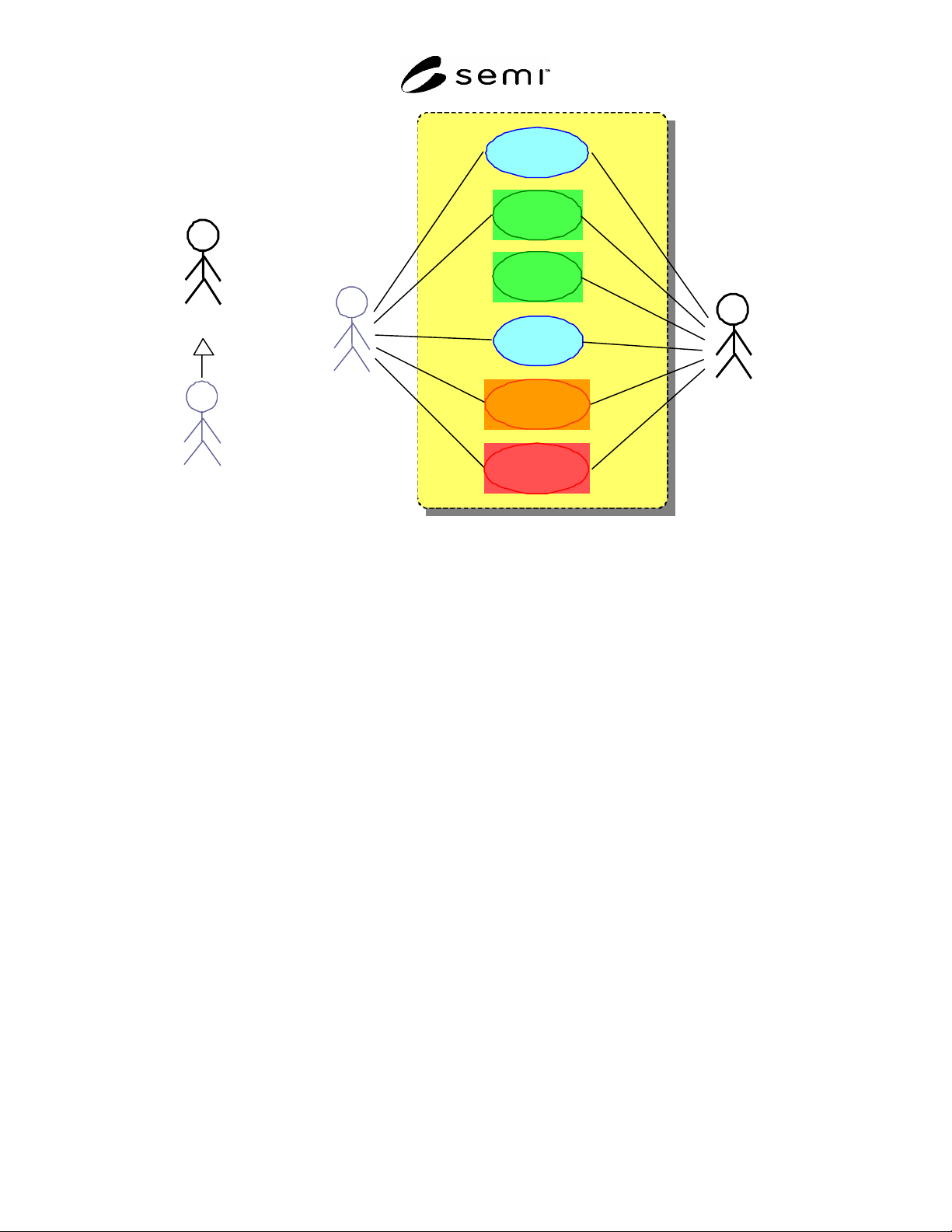
SEMI T13-1104 © SEMI 2004 36
Update
History
Consumer
Producer
(
Fab, Eqp.
)
Check
History
Back
Track
Notify
Trace
Consumer
Producer
(
Fab, Eqp.
)
A
lert
Figure R4-1
Use Case Diagram for Device Tracking
NOTICE: SEMI makes no warranties or representations as to the suitability of the standards set forth herein for any
particular application. The determination of the suitability of the standard is solely the responsibility of the user.
Users are cautioned to refer to manufacturer's instructions, product labels, product data sheets, and other relevant
literature, respecting any materials or equipment mentioned herein. These standards are subject to change without
notice.
By publication of this standard, Semiconductor Equipment and Materials International (SEMI) takes no position
respecting the validity of any patent rights or copyrights asserted in connection with any items mentioned in this
standard. Users of this standard are expressly advised that determination of any such patent rights or copyrights, and
the risk of infringement of such rights are entirely their own responsibility.
Copyright by SEMI® (Semiconductor Equipment and Materials
International), 3081 Zanker Road, San Jose, CA 95134. Reproduction of
the contents in whole or in part is forbidden without express written
consent of SEMI.
SEMI T13.1-1104 © SEMI 2004 1
SEMI T13.1-1104
SPECIFICATION FOR SECS PROTOCOL FOR DEVICE TRACKING
This specification was technically approved by the Global Traceability Committee and is the direct
responsibility of the Japanese Traceability Committee. Current edition approved by the Japanese Regional
Standards Committee on July 23, 2004. Initially available at www.semi.org September 2004; to be published
November 2004.
1 Purpose
1.1 The purpose of this document is to map services and data in SEMI T13 into SECS protocol.
2 Scope
2.1 This document is applied to SECS implementation of semiconductor device traceability with some
interoperability with semiconductor Manufacturing Execution System (MES).
NOTICE: This standard does not purport to address safety issues, if any, associated with its use. It is the
responsibility of the users of this standard to establish appropriate safety and health practices and determine the
applicability of regulatory or other limitations prior to use.
3 Referenced Standards
3.1 SEMI Standards
SEMI E5 — SEMI Equipment Communication Standard 2 Message Content (SECS-II)
SEMI E39 — Object Service Standard: Concepts, Behavior and Services
SEMI G84 — Specification for Strip Map Protocol
SEMI T12 — Specification for Tracing Jigs and Implements
SEMI T13 — Specification for Device Tracking: Concepts, Behavior and Services
NOTICE: Unless otherwise indicated, all documents cited shall be the latest published versions.
4 Requirements
4.1 Service Mapping — This specification maps service instructions defined in SEMI T13 into SECS
stream/functions as follows. Supporting Class names specified in the following table are used as OBJSPEC or a part
of OBJSPEC to request services.
Table 1 Service Message Instruction Mapping
Service Message Name Supporting Class Stream, Function SECS-II Message Name
acquireDTD DieTraceMachine S14, F19/F20 Generic Service Request/Response
admit DieTraceManager S14, F19/F20 Generic Service Request/Response
catchDTD DieTracer S14, F19/F20 Generic Service Request/Response
collectDTD DieTracer S14, F19/F20 Generic Service Request/Response
devolve DieTraceManager S14, F19/F20 Generic Service Request/Response
enroll DieTracer S14, F19/F20 Generic Service Request/Response
flush DieTraceMachine S14, F19/F20 Generic Service Request/Response
logException DieTraceManager S14, F19/F20 Generic Service Request/Response
planDTD DieTracer S14, F19/F20 Generic Service Request/Response
registerTracer DieTraceMachine S14, F19/F20 Generic Service Request/Response
resign DieTraceManager S14, F19/F20 Generic Service Request/Response
setAlert DieTraceClient S14, F19/F20 Generic Service Request/Response
setForward DieTracer S14, F19/F20 Generic Service Request/Response
setPlanningItems DieTraceMachine S14, F19/F20 Generic Service Request/Response
SEMI T13.1-1104 © SEMI 2004 2
Service Message Name Supporting Class Stream, Function SECS-II Message Name
showData DieTraceData S14, F19/F20 Generic Service Request/Response
showDaughter CircuitModule S14, F19/F20 Generic Service Request/Response
showDTD DieTracer S14, F19/F20 Generic Service Request/Response
showPhenomena DieTraceClient S14, F19/F20 Generic Service Request/Response
showProperty CircuitModule, DieTraceData S14, F19/F20 Generic Service Request/Response
takeDTD DieTracer S14, F19/F20 Generic Service Request/Response
4.2 Service Parameter Mapping — The following table shows the mapping between service parameters defined by
SEMI T13 and data items defined by SEMI E5. The data item SVCNAME used with S14F19 is the text string
defined in the above table. The data item SPNAME used with S14F19/F20 is also text string defined in following
table. It is recommended but not limited to be case sensitive for both data items for future extension.
Table 2 Service Message Parameter Mapping
Parameter Name SECS-II Data Item Reference SECS-II Format Remarks
Alert L, 2
1. <SPNAME>
2. <SPVAL>
SPNAME = Alert
SPVAL = Item (00)
SPVAL: n-element list of
property item.
Clarifier L, 2
1. <SPNAME>
2. <SPVAL>
SPNAME = Clarifier
SPVAL = (20)
DataName L, 2
1. <SPNAME>
2. <SPVAL>
SPNAME = DataName
SPVAL = (20)
DataNameList L, 2
1. <SPNAME>
2. <SPVAL>
SPNAME = DataNameList
SPVAL = (20)
DataValue L, 2
1. <SPNAME>
2. <SPVAL>
SPNAME = DataValue
SPVAL = (00, 1x, 2x, 3x, 4x, 5x)
“x” is an appropriate octal
defined in SEMI E5.
Designation L, 2
1. <SPNAME>
2. <SPVAL>
SPNAME = Designation
SPVAL = (20)
If SPVAL is null or just
spaces, it means all. Spaces
could be separator.
Exceptions L, 2
1. <SPNAME>
2. <SPVAL>
SPNAME = Exceptions
SPVAL = Item (00)
SPVAL: n-element list of
property item.
MachineType L, 2
1. <SPNAME>
2. <SPVAL>
SPNAME = MachineType
SPVAL = (20)
ManagingTracer L, 2
1. <SPNAME>
2. <SPVAL>
SPNAME = ManagingTracer
SPVAL = (20)
Phenomena L, 2
1. <SPNAME>
2. <SPVAL>
SPNAME = Phenomena
SPVAL = Item (00)
SPVAL: n-element list of
property item.
Property L, 2
1. <SPNAME>
2. <SPVAL>
SPNAME = Property
SPVAL = Item (00)
SPVAL: n-element list of
property item.