YSM40 Mainte_E.pdf - 第98页
3-30 3 Periodic maintenance items 2.4 Conveyor (and other areas) T hissectionexplainsthecleaningproceduresfortheboardconveyorarea. T hisareaincludestheboard detectionsensorsattransitpositions,theboa…
3-29
3
Periodic maintenance items
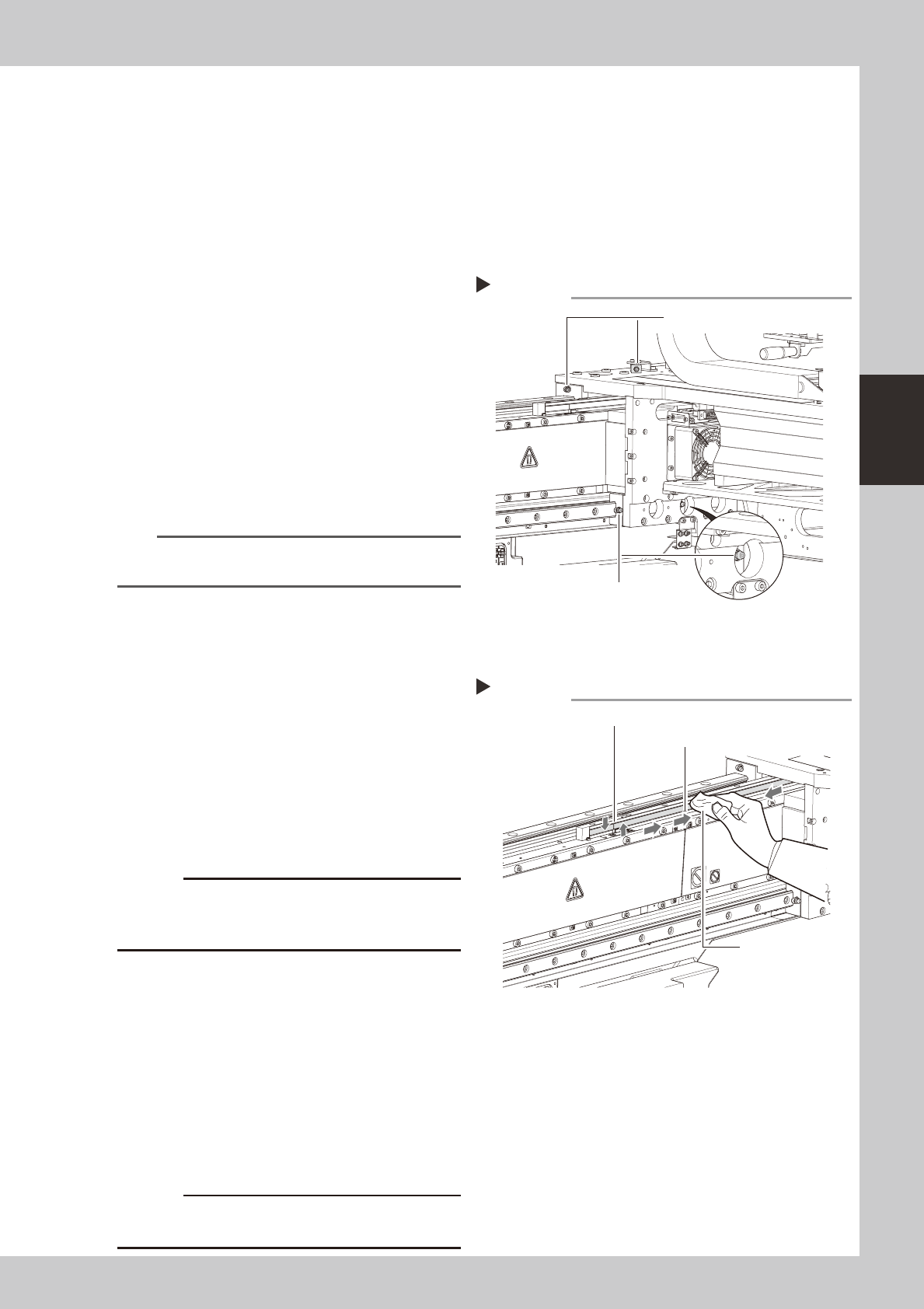
2.3.2 Cleaning and lubricating the Y-axis guide (2-beam type)
1
Make the preparations for the cleaning and greasing work.
1. Take off all accessories susceptible to the magnetic fields, such as a wristwatch and/or magnetic ID
card.
e
2. Press the emergency stop button to put the machine in the emergency stop state.
3. Using the carriage UP/DOWN switch, lower the carriage then detach it.
4. Place a square cloth on the push-up plate.
2
Clean the guide.
1. Move the Y-axis to one end, then use a
paper cloth which produces no lint, etc.,
(clean room type) to wipe the entire
guide.
2. Next, move the Y-axis to the opposite
side, then wipe the opposite-side guide.
3
Inject the grease.
Using a grease gun (standard type), inject
the prescribed grease (NSL) at the Y-axis
guide's grease nipples (4 nipples).
53397-N5-00
n
NOTE
Inject until the grease begins to seep out from the gap
when the X-axis is pressed.
4
Wipe off the excess grease.
Rotate the axis several times by hand and
wipe off the excess grease.
5
Check the grease condition.
1. Close the cover, attach the batch
change carriage, then release the
"Emergency Stop" status.
e
2. Open the Warm-up screen, and perform
the warm-up operation for approximately
8 minutes. After the machine stops, wipe
off grease which has collected on the
guide and the guide end face.
c
Repeat Step 5 until grease accumulations no longer
present could cause the grease to spatter.
6
Clean the linear scale.
1. Using a cleaning cloth moistened with
IPA, wipe the linear scale horizontally as
shown in the figure at right. Then, use a
dry cloth to dry-wipe the linear scale.
2. Using a cleaning cloth moistened with
IPA, wipe the area near the origin
position mark at least 3 times back and
forth vertically. Then, use a dry cloth to
dry-wipe that area.
53398-N5-00
c
rubbing it with excessive force.
Injecting the grease
Step 3
Grease nipple for upper guide
Grease nipple for lower guide
Cleaning the linear scale
Step 6
Cloth
Linear scale
Origin position mark (Vertical line)
3-30
3
Periodic maintenance items
2.4 Conveyor (and other areas)
Thissectionexplainsthecleaningproceduresfortheboardconveyorarea.Thisareaincludestheboard
detectionsensorsattransitpositions,theboarddetectionsensorsattheINandOUTports,andthefeederlift
sensor.
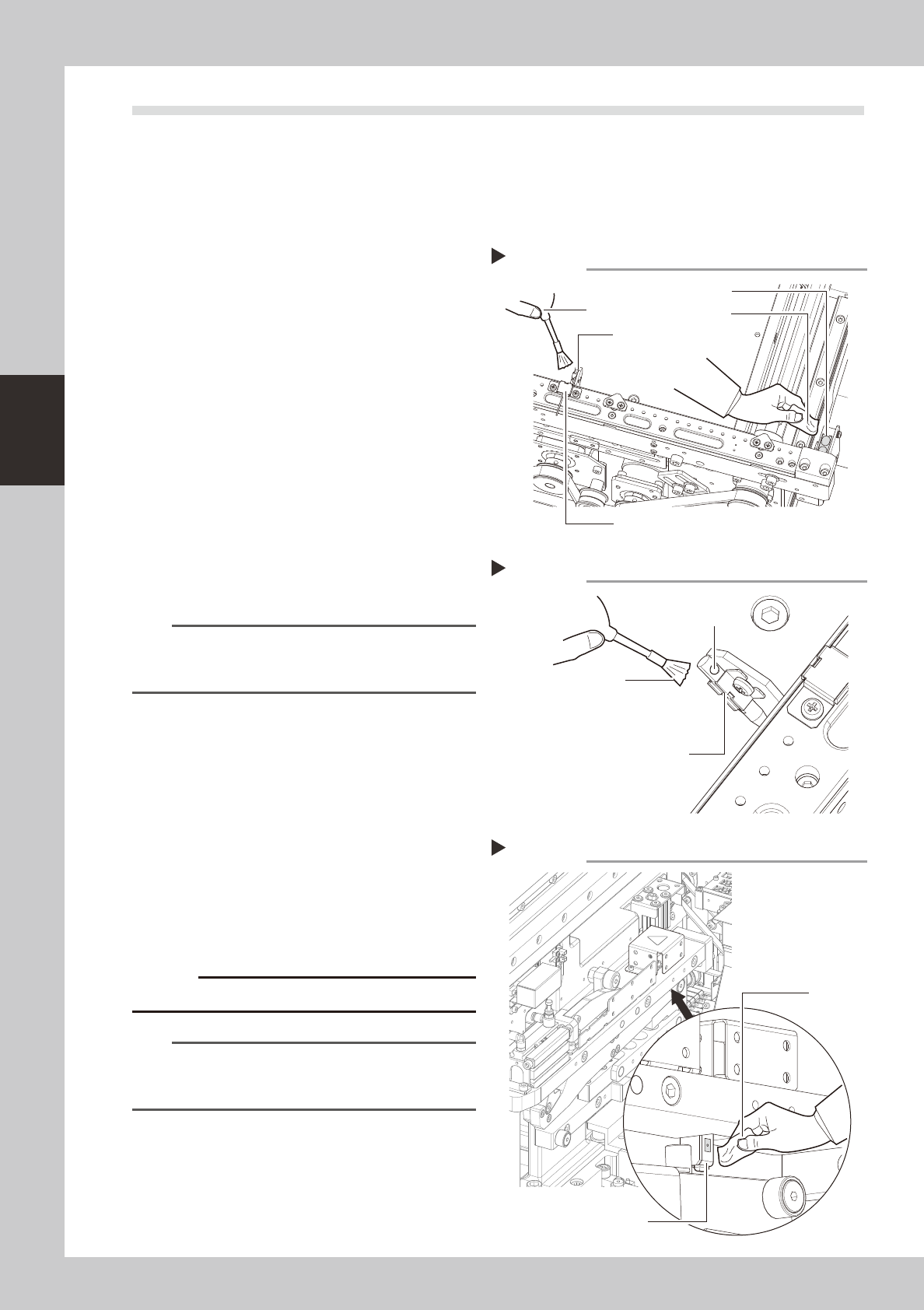
2.4.1 Board sensors
1
Clean the board detection sensors
at the IN and OUT ports.
1. Use an optical brush to clean the dust
from the top faces of the sensors.
2. Use either a cotton swab or a cloth
dampened with a small amount of IPA to
clean the top faces of the sensors.
53380-N5-00
2
Clean the transit position sensor
beam receiver.
Use an optical brush to clean the transit
position sensor beam receiver.
3
Clean the transit position sensor
beam emitter.
Use an optical brush to clean the end hole
of the transit position sensor beam emitter.
53381-N5-00
n
NOTE
If foreign matter other than dust is lodged inside the
laser beam emitter's end hole, use the vacuum
assembly (optional) to suck it out.
2.4.2 Feeder lift sensor
1
Detach the batch change carriage.
2
Wipe the dust from the sensor.
Use an optical brush to remove any dust
from the sensor area.
53382-N5-00
3
Clean the sensor.
Clean the sensor's surface using a cotton
swab or a cloth dampened with a small
amount of IPA.
c
Avoid using excessive force when cleaning the sensors.
n
NOTE
The cATS is also equipped with a feeder float sensor.
Clean that sensor with the same procedure as used for
the feeder exchange cart.
Cleaning the board sensors
Step 1
IN (OUT) port sensor
Optical brush
Cloth
Transit position sensor (laser beam receiver)
Transit position sensor
(laser beam emitter)
Cleaning the board sensor (laser beam emitter)
Step 3
Optical brush
End hole
Transit position sensor
(laser beam emitter)
Cleaning the feeder lift sensor
Step 2, 3
Feeder lift sensor
Cloth
3-31
3
Periodic maintenance items
3. Three-month inspection
n
When carrying out inspection without removing the head
e
Takethefollowingprecautionstocarryoutinspection.
1.Takeoffthewristwatch,magneticIDcards,andanyitemssusceptibletomagneticfields.
2.Presstheemergencystopbuttontostopthemachine.
3.Placeasquareclothunderthelocationwhereinspectionistobecarriedout.
3.1 MU head
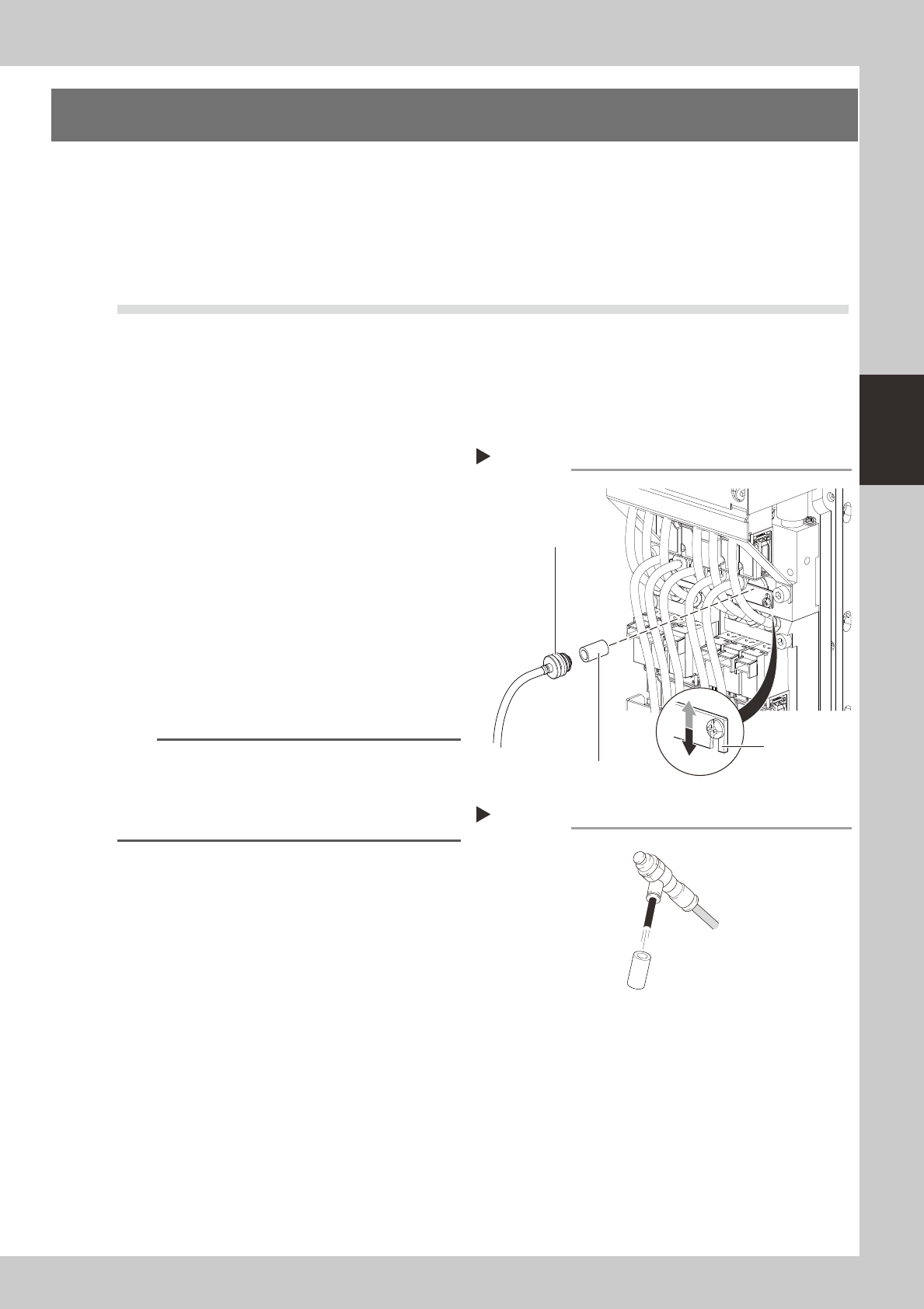
3.1.1 Cleaning and replacing the air filter
Asageneralguideline,thefiltershouldbeinspectedonceevery3months,althoughthismayvarysomewhat
dependingontheairsupplyconditionsandtheoperatingtime.Iflightlysoiled,thefiltercanbecleanbyusing
theairblowtool.Thefiltershouldbereplacedwhenitcannolongerbeadequatelycleanedbyair-blowing.
1
Loosen the filter securing plate.
Use a Phillips screwdriver to loosen the filter
securing plate.
2
Remove the filter cap.
The filter cap and filter can be removed
after the filter securing plate has been
loosened and lowered.
53331-N5-00
3
Clean the filter.
If the filter is only lightly soiled, it can be
cleaned by the air blow tool, and then
reused.
53332-N5-00
n
NOTE
If there are heavy dust deposits in the filter or the filter
has discolored, replace it with a new filter (KLF-M7156-
00X). As a general guide, filters should be replaced
once every 3 months, although this depends on the
actual operating time.
4
Reattach the filter cap.
1. Reattach the filter cap to the filter, and
return the filter to its original position.
2. Place the filter securing plate over the
filter and use a Phillips screwdriver to
secure it.
5
Clean the bottom filter in the same
manner.
Because there are filters at the top and
bottom, clean the bottom filter in the same
manner as described above.
Removing the filter cap
Step 1, 2
Filter cap
Filter
Filter securing
plate
Lock
Release
Cleaning the filter
Step 3
Filter
Air blow tool