xp141-241-341-5.0E.pdf - 第95页
FK-9F98- 29 XP Series Training Text for Service Engineers Edition 5.0 XP241 – Chapter 1 Initial Adjustment Page 4 of 8 Fuji Machine Mfg. Co., Ltd. Okazaki. SMT Equipment Quality Assurance Dept . 1 – 4 CS Section 1.5 Comp…
FK-9F98-29 XP Series Training Text for Service Engineers
Edition 5.0 XP241 – Chapter 1 Initial Adjustment Page 3 of 8
Fuji Machine Mfg. Co., Ltd. Okazaki.
SMT Equipment Quality Assurance Dept.
1 – 3 CS Section
1.4 Belt tension measurement
• Measuring equipment: Tension meter (U-505)
1. Use tension meter (U-505) to check the belt tension of the Y, Z, T and U axes.
2. Move each of the axes to the Minus (-) mechanical stopper.
Note: make sure that the servo is OFF when moving the axes to the minus (-) mechanical
stoppers.
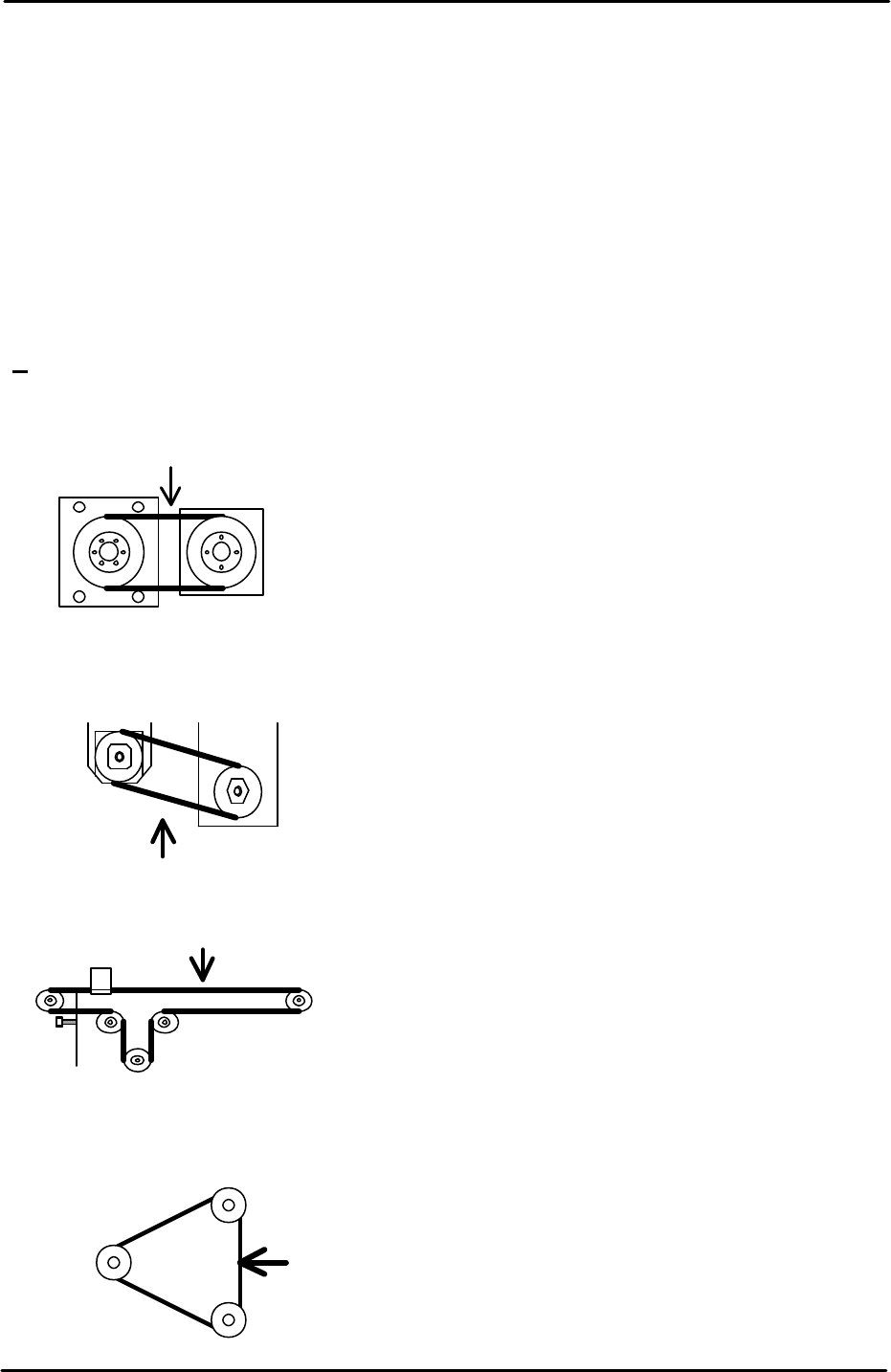
3. Refer to the following illustrations and check that the belt tension frequency for each axis
is within the specified range:
Y-axis measuring point
Tension meter setting
Belt unit amount: 0.4gf/mm Target Frequency
Belt width:15mm 165~183 Hz
Span length:130mm
U-axis measuring point
Tension meter setting
Belt unit amount: 0.25gf/mm Target Frequency
Belt width: 9mm 39~43Hz
Span length: 543mm
Z-axis measuring point
Tension meter setting
Belt unit amount: 0.25gf/mm Target Frequency
Belt width: 9mm 396~438Hz
Span length: 566mm
T-axis measuring point
Tension meter setting
Belt unit amount: 0.25gf/mm Target Frequency
Belt width: 15mm 140~154Hz
Span length: 151mm
Motor
Mid pulley
Ball screw

FK-9F98-29 XP Series Training Text for Service Engineers
Edition 5.0 XP241 – Chapter 1 Initial Adjustment Page 4 of 8
Fuji Machine Mfg. Co., Ltd. Okazaki.
SMT Equipment Quality Assurance Dept.
1 – 4 CS Section
1.5 Computer connection
MCS/X
1. Connect the LAN cable to the PC.
2. Remove the bottom left cover at the front of the machine, and connect the LAN cable to
the dedicated LAN port.
3. At the PC select [Start] – [Programs] – [MCSX] – [MCSX].
4. Click on the [File Manager] tab to bring up the "File Exchange" window.
5. To add a line, click on [Add Line], then enter a new line name, and click on [OK].
6. To add a machine, click on [Add M/C]:
Line Name: Choose an available line.
Machine nick name: For example XP241A
Machine type: Input the machine type.
IP Address: Input an IP address.
When finished click on [OK].
7. At the machine select [Maintenance B] – [Start Up Settings]:
Target: Input the "Machine nick name" registered in MCSX.
Ethernet Address: Input the same IP address as the one registered in MCSX.
Subnet Mask: If necessary input the subnet mask.
8. Click on the [Update] tab to save the new settings, then reboot the machine in order for
them to take effect.
9. Finally confirm that the PC and machine are communicating.
F4G
1. At the PC select [Start] – [Programs] – [Windows NT Explorer] – [Winnt] – [System
32] – [drivers] – [etc] – [hosts] and open the hosts file with notepad, a text file similar to
the one below will then open:
127.0.0.1 localhost
192.168.33.190 italy
192.168.39.2 pascal
192.168.39.10 uk
192.168.33.154 XP241A
Make a new entry, and in the first column input the machine's IP address, then a "host
name" in the next column. Close and save the file.
2. Select [Start] – [Programs] – [F4G] – [F4G] – [Line Config] and a text file will open. In
the MC Name column input the same hosts name as that registered in the hosts file, then
in the HOSTNAME column also input the same host name as that registered in the hosts
file, in this case XP241A. Under the MCTYPE column input the machine type, for

FK-9F98-29 XP Series Training Text for Service Engineers
Edition 5.0 XP241 – Chapter 1 Initial Adjustment Page 5 of 8
Fuji Machine Mfg. Co., Ltd. Okazaki.
SMT Equipment Quality Assurance Dept.
1 – 5 CS Section
example XP241. Close and save the file.
3. At the PC select [Start] – [Programs] – [Windows NT Explorer] – [F4G] – [CC] –
[Passwd] and open the passwd file with notepad, a text file similar to the one below will
then open:
# C/C OS User-ID PassWord
#cc1, OS9, super, user
italy, WINDOWSNT, Administrator,
XP241A, WINDOWSNT, anonymous,
Make a new entry, and in the first column of the new entry input the same host name as
that registered in the hosts file. In the OS column input WINDOWSNT, and in the User-ID
column input, anonymous. Close and save the file.
4. The settings are now complete, restart the computer in order for them to take effect.
5. To confirm that the machine and PC are communicating, enter the F4G Operator Module
and open up the Transmit Engine and then the Transmitter.
FujiCam
1. At the PC select [Start] – [Programs] – [Windows NT Explorer] – [Winnt] – [System
32] – [drivers] – [etc] – [Hosts] and open the hosts file with notepad, a text file similar to
the one below will then open:
127.0.0.1 localhost
192.168.33.190 italy
192.168.39.2 pascal
192.168.39.10 uk
192.168.33.154 XP241A
Make a new entry, and in the first column input the machine's IP address, then a "host
name" in the next column. Close and save the file.
2. At the PC select [Start] - [Programs] - [FujiCam] - [Line Editor] - [Edit] - [Add
Machine], then fill out the new machine information as described below:
Machine Nickname: input the same host name as that registered in the hosts file.
Machine Type: Select the appropriate machine type from the pull down list.
GEM Not Use: No.
Get Production Data: No.
Recipe Name, Top: input the top recipe name for the machine.
Recipe Name, Bottom: input the bottom recipe name for the machine.
Host Name: Input the name of the FujiCam license holding server.
PPS Exist: No.
Use HELPS: No.
Cell Status: Unit.
Termination Type: Manual.
Use KIT: No.
C/C: No need to fill out this information as the XP uses F.T.P.
SECS/GEM: No need to fill out this information as the XP uses F.T.P.
2. Finally confirm that the PC and machine are communicating.