MIL- STD-883F 2004 TEST METHOD STANDARD MICROCIRCUITS.pdf - 第219页
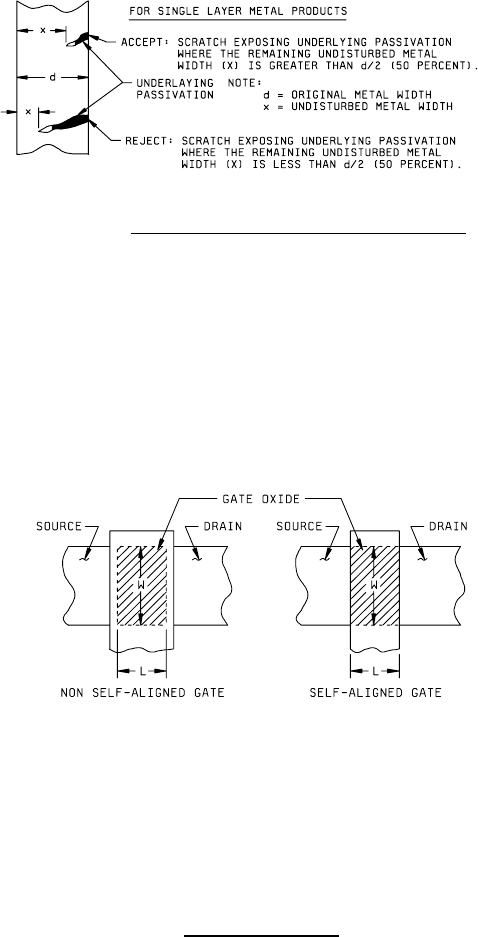
MIL-STD-883F METHOD 2010.11 18 June 2004 9 Condition A Conditi on B Class le vel S Class lev el B FIGURE 2010-6. MOS s cr atch c riter ia - Conti nued. c. Scratch in m ultilaye red meta llization , exclu ding c. Scratch …
MIL-STD-883F
METHOD 2010.11
18 June 2004
8
Condition A Condition B
Class level S Class level B
FIGURE 2010-5. Metallization scratch criteria for class level B
.
b. For condition A, see 3.1.1.1a above. b. For condition B only. Scratch that completely
crosses a metallization path and damages the
surface of the surrounding passivation, glassivation,
or substrate on either side (for MOS devices, the
path shall be the (L) dimension) (see figure 2010-6).
NOTE: When standard metallization scratch criterion
is applied to the gate area, the dimensions (W) and (L)
shall be considered as the original channel width and
length respectively.
FIGURE 2010-6. MOS scratch criteria
.
MIL-STD-883F
METHOD 2010.11
18 June 2004
9
Condition A Condition B
Class level S Class level B
FIGURE 2010-6. MOS scratch criteria
- Continued.
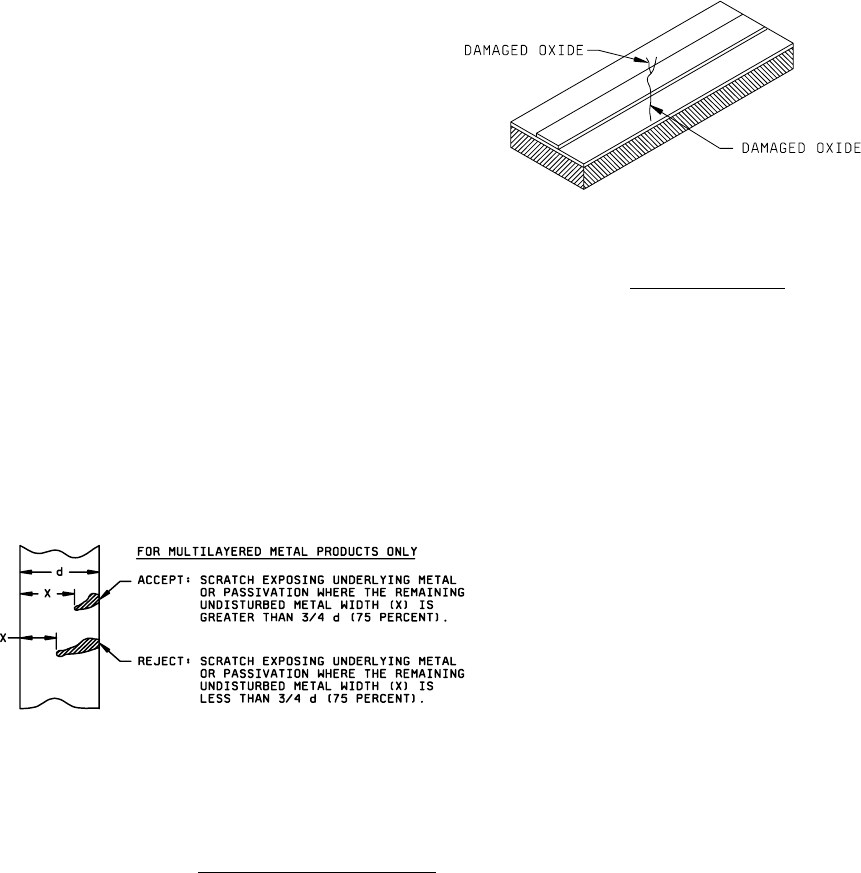
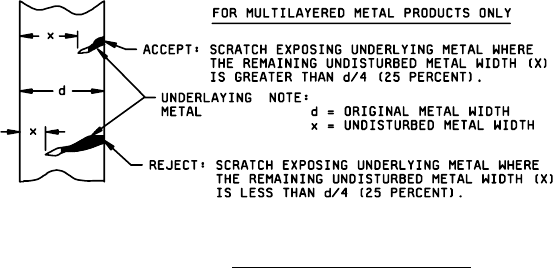
c. Scratch in multilayered metallization, excluding c. Scratch in multilayered metallization, excluding
bonding pads and beam leads that exposes bond pads and beam leads that exposes the
underlying metal or passivation anywhere underlying metal anywhere along its length
along its length and leaves less than 75 and leaves less than 25 percent of the original
percent of the original metal width metal width undisturbed (see figure 2010-8).
undisturbed (see figure 2010-7).
FIGURE 2010-7. Scratch criteria for class level S
.
MIL-STD-883F
METHOD 2010.11
18 June 2004
10
Condition A Condition B
Class level S Class level B
FIGURE 2010-8 Scratch criteria for class level B
.
NOTE: For condition B only. Criteria 3.1.1.1a, b, and c
can be excluded for peripheral power or ground
metallization where parallel paths exist such that an open
at the scratch would not cause an unintended isolation of
the metallization path.
d. Scratch in the metallization over a passivation step that leaves less than 75 percent of the original metal width at
the step undisturbed.
NOTE: For condition B only. Criteria 3.1.1.1a, b, c, and
d can be excluded for the last 25 percent of the linear
length of the contact cut and all metal beyond, on the
termination end(s) of the metallization runs. In these
cases there shall be at least 50 percent of the contact
opening area covered by metallization and at least a
continuous 40 percent of the contact opening perimeter
covered by undisturbed metallization (see figure 2010-9).