MIL- STD-883F 2004 TEST METHOD STANDARD MICROCIRCUITS.pdf - 第224页
MIL-STD-883F METHOD 2010.11 18 June 2004 14 Condition A Conditi on B Class le vel S Class lev el B b. Voi d(s) in the met allizat ion over a pas sivat ion st ep that l eaves les s than 75 per cent of the ori ginal met al…
MIL-STD-883F
METHOD 2010.11
18 June 2004
13
Condition A Condition B
Class level S Class level B
f. Scratch in the metallization that exposes the dielectric material of a thin film capacitor or crossover. (Not
applicable to air bridges.)
g. Scratch in the bonding pad or fillet area that g. Scratch in the bonding pad or fillet area that
reduces the metallization path width connecting exposes underlying passivation or substrate
the bond to the interconnecting metallization and reduces the metallization path width
to less than 50 percent of the narrowest connecting the bond to the interconnecting
entering interconnect metallization stripe metallization to less than 50 percent of the
width. If two or more stripes enter a bonding narrowest entering interconnect metallization
pad, each shall be considered separately. stripe width. If two or more stripes enter
a bonding pad, each shall be considered
separately.
h. Scratch(es) (probe mark(s), etc.) in the bonding pad area that exposes underlying passivation or substrate and
leaves less than 75 percent of the unglassivated metallization area undisturbed.
i. For GaAs devices only, any tears, peeling, gaps, and lateral displacement of metal.
3.1.1.2 Metallization voids
;
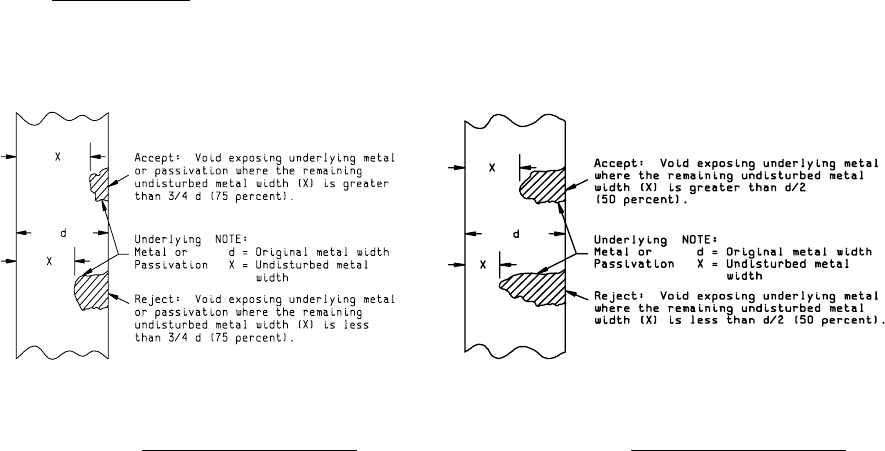
a. Void(s) in the metallization that leaves less than a. Void(s) in the metallization that leaves less than
75 percent of the original metal width undisturbed 50 percent of the original metal width undisturbed
(see figure 2010-12). (see figure 2010-13).
FIGURE 2010-12. Void criteria for class level S
. FIGURE 2010-13. Void criteria for class level B.
NOTE: For condition B only. Criteria can be excluded
for peripheral power or ground metallization where
parallel paths exist so that an open at the void(s) would
not cause an unintended isolation of the metallization
path.
MIL-STD-883F
METHOD 2010.11
18 June 2004
14
Condition A Condition B
Class level S Class level B
b. Void(s) in the metallization over a passivation step that leaves less than 75 percent of the original metal width at
the step undisturbed.
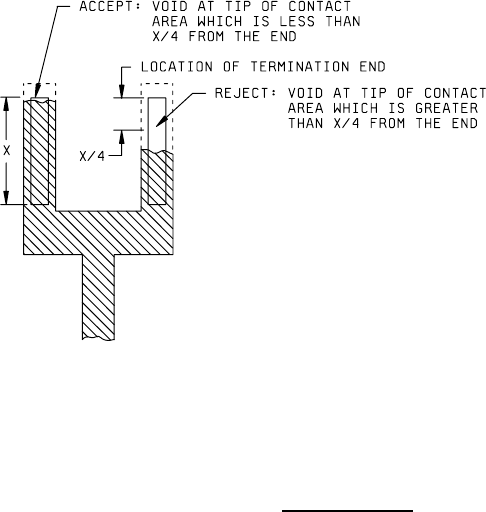
NOTE: For condition B only. Criteria of 3.1.1.2a and b
can be excluded for the last 25 percent of the linear
length of the contact cut and all metal beyond on the
termination end(s) of metallization runs. In these cases
there shall be at least 50 percent of the contact opening
perimeter covered by undisturbed metallization (see
figure 2010-14).
FIGURE 2010-14. Termination ends
.
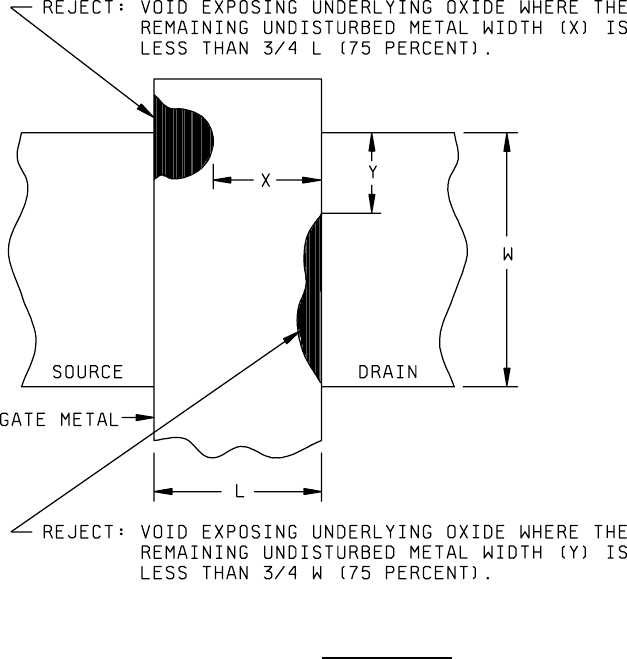
c. Void(s) in the metallization over the gate oxide that leaves less than 75 percent of the metallization length (L) or
width (W) between source and drain diffusions undisturbed (applicable to MOS structures only) (see figure
2010-15).
MIL-STD-883F
METHOD 2010.11
18 June 2004
15
Condition A Condition B
Class level S Class level B
d. Void(s) that leave less than 75 percent of the d. Void(s) that leave less than 60 percent of the
metallization area over the gate oxide undisturbed metallization area over the gate oxide undisturbed
(applicable to MOS structures only). (applicable to MOS structures only).
e. Void(s) that leaves less than 75 percent of the metallization width coincident with the source or drain diffusion
junction line undisturbed (applicable to MOS structures only) (see figure 2010-15).
FIGURE 2010-15. MOS void criteria
.
f. Void(s) in the bonding pad area that leaves less than 75 percent of its original unglassivated metallization area
undisturbed (see figure 2010-16).
g. Void(s) in the bonding pad or fillet area that reduces g. Void(s) in the bonding pad or fillet area that
the metallization path width connecting the bond to reduces the metallization path width connecting
the interconnecting metallization to less than 75 the bond to the interconnecting metallization
percent of the narrowest entering metallization stripe to less than 50 percent of the narrowest entering
width. If two or more stripes enter a bonding pad, metallization stripe width. If two or more
each shall be considered separately. (see figure stripes enter a bonding pad, each shall be
2010-16). considered separately (see figure 2010-16).