MIL- STD-883F 2004 TEST METHOD STANDARD MICROCIRCUITS.pdf - 第228页
MIL-STD-883F METHOD 2010.11 18 June 2004 18 Condition A Conditi on B Class le vel S Class lev el B 3.1.1. 9 Coupling (ai r) br idge defec ts "hi gh magnifi cati on" . For GaAs devices only. No el ement shal l b…

MIL-STD-883F
METHOD 2010.11
18 June 2004
17
Condition A Condition B
Class level S Class level B
3.1.1.6 Metallization bridging
.
NOTE: For SOS devices, exclude the insulator scribe lines.
a. Any metallization bridging where the separation a. Any metallization bridging where a
between metallization paths is reduced to less line of separation is not visible
than 50 percent of the original design. between metallization paths.
b. Any metal that is displaced, as a result of NOTE: For GaAs microwave devices,
bonding, from its original position on the metallization bridging across spacings
bonding pad (shooting metal) that reduces of less than 1 µm shall be inspected
the separation between unglassivated only in accordance with 3.2 and table I
operating metallization or scribe line at 400X to 1,000X. If a clear line of
and the bonding pad to less than 0.25 mils separation is not discernible,
or 50 percent design separation, device functional testing at the
whichever is less. wafer level shall suffice.
b. Any metal that is displaced, as a result
of bonding, from its original position
on the bonding pad (shooting metal) that
reduces the separation between
unglassivated operating metallization or
scribe line and the bonding pad such
that a line of separation is not
visible.
3.1.1.7 Metallization alignment
.
a. Contact window that has less than 75 percent of a. Contact window that has less than 50 percent
its area covered by metallization. of its area covered by metallization.
b. Contact window that has less than a continuous 50 b. Contact window that has less than 40 percent
percent of its perimeter covered by metallization. of its perimeter covered by metallization.
c. Contact window that has less than 75 percent of its perimeter on two adjacent sides covered by metallization
(applicable to MOS structures only).
NOTE: When, by design, metal is completely contained in a contact window or does not cover the entire contact
perimeter, criteria 3.1.1.7a, b, or c can be deleted, provided the design criteria is satisfied.
d. A metallization path not intended to cover a contact window that is not separated from the contact window by a
line of separation.
e. Any exposure of the gate oxide (i.e., oxide not covered by gate electrode in the area between source and drain
diffusions, applicable to MOS structures only) (see figure 2010-17).
3.1.1.8 Via hole metallization
. For GaAs devices only,
a. Overetched via hole or misaligned via visible around the pad.
b. Poor adhesion (lifting, peeling or blistering).
c. Any cracks originating at the via hole.
d. Evidence of bulging metal over a via hole.
e. Evidence of solder coming up through via hole pad, when die is mounted on a carrier.

MIL-STD-883F
METHOD 2010.11
18 June 2004
18
Condition A Condition B
Class level S Class level B
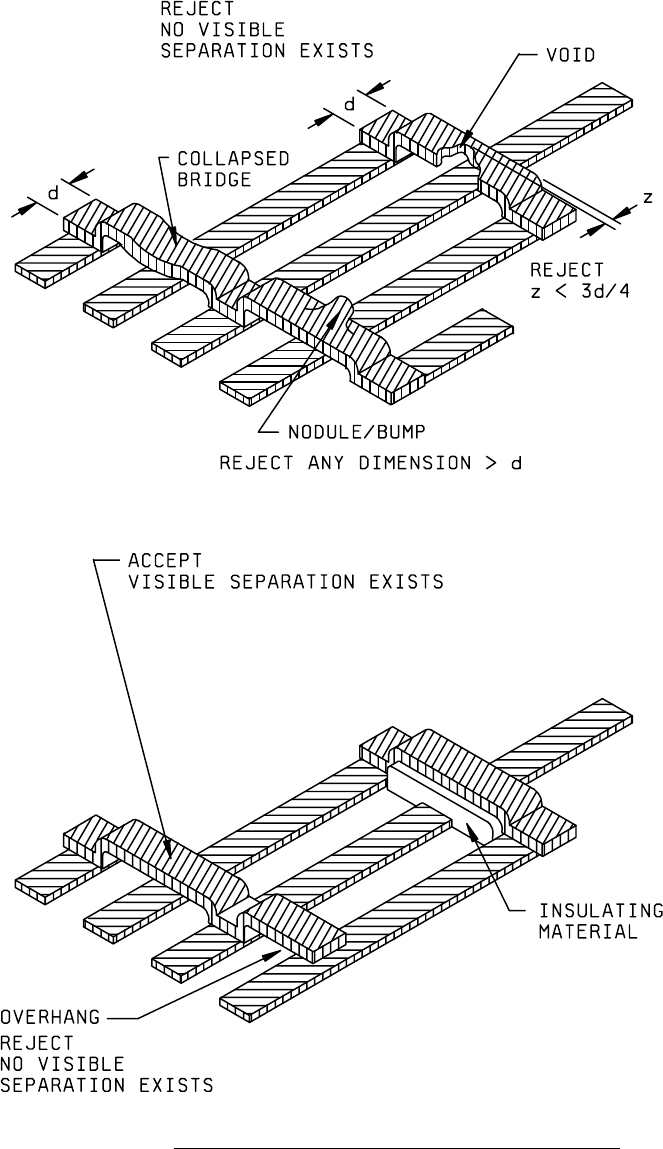
3.1.1.9 Coupling (air) bridge defects "high magnification"
. For GaAs devices only. No element shall be acceptable that
exhibits:
a. A void in the coupling (air) bridge metallization that leaves less than 75 percent of the original metallization width
undisturbed. (see figure 2010-17A).
b. Nodules or bumps that are greater, in any dimension, than the original coupling (air) bridge metallization width.
(See figure 2010-17A)
c. Coupling (air) bridge that contacts underlying operating metallization. (See figure 2010-17A)
d. Attached, conductive foreign material that is greater, in any dimensions, than 50% of the original coupling (air)
bridge metallization width.
e. No visible separation between the coupling (air) bridge and the underlying operating metallization.
NOTE: This criterion is not applicable when an insulating material is used between the coupling (air) bridge and the
underlying metallization. (See figure 2010-17A)
f. Coupling (air) bridge metallization overhang over adjacent operating metallization, not intended by design, that
does not exhibit a visible separation. (See figure 2010-17A)
g. Mechanical damage to a coupling (air) bridge that results in depression (lowering) of coupling (air) bridge
metallization over underlying operating metallization.
NOTE: Air bridges which are depressed, over operating metallization, due to normal backside processing are not
considered mechanically damaged. A visual line of separation still applies in accordance with 3.1.1.9e.
MIL-STD-883F
METHOD 2010.11
18 June 2004
19
FIGURE 2010-17A. Class level S and Class level B coupling (air) bridge criteria
.