MIL- STD-883F 2004 TEST METHOD STANDARD MICROCIRCUITS.pdf - 第229页
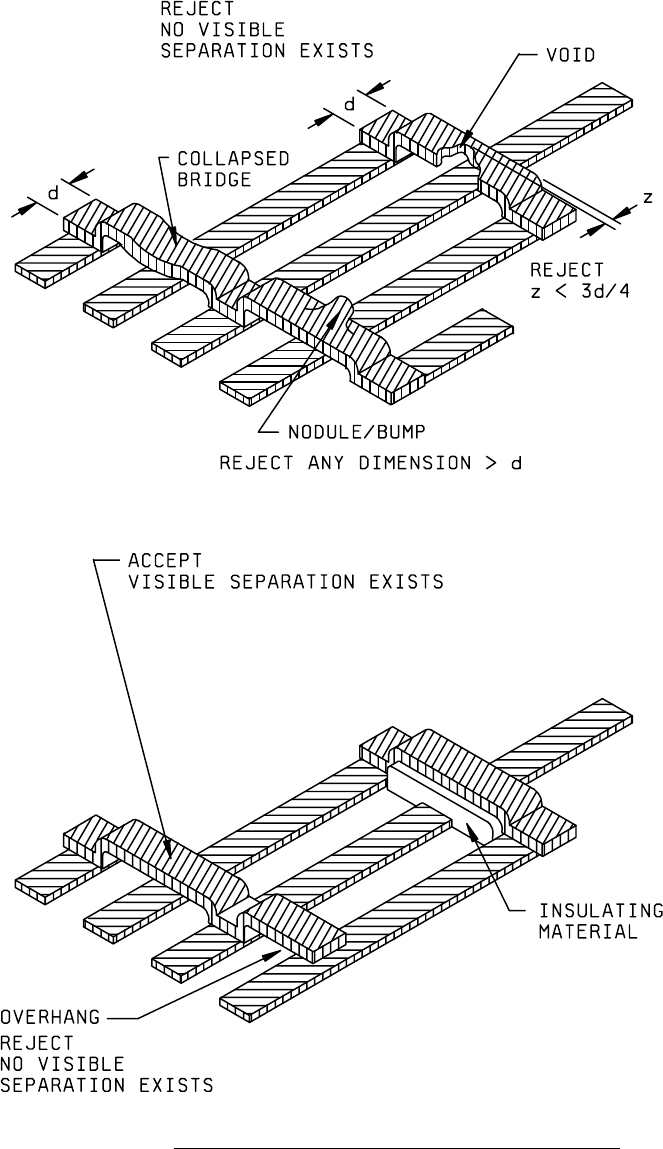
MIL-STD-883F METHOD 2010.11 18 June 2004 19 FIGURE 2010-17A. Class level S and Clas s level B coupli ng (air ) bridge c rit eria .

MIL-STD-883F
METHOD 2010.11
18 June 2004
18
Condition A Condition B
Class level S Class level B
3.1.1.9 Coupling (air) bridge defects "high magnification"
. For GaAs devices only. No element shall be acceptable that
exhibits:
a. A void in the coupling (air) bridge metallization that leaves less than 75 percent of the original metallization width
undisturbed. (see figure 2010-17A).
b. Nodules or bumps that are greater, in any dimension, than the original coupling (air) bridge metallization width.
(See figure 2010-17A)
c. Coupling (air) bridge that contacts underlying operating metallization. (See figure 2010-17A)
d. Attached, conductive foreign material that is greater, in any dimensions, than 50% of the original coupling (air)
bridge metallization width.
e. No visible separation between the coupling (air) bridge and the underlying operating metallization.
NOTE: This criterion is not applicable when an insulating material is used between the coupling (air) bridge and the
underlying metallization. (See figure 2010-17A)
f. Coupling (air) bridge metallization overhang over adjacent operating metallization, not intended by design, that
does not exhibit a visible separation. (See figure 2010-17A)
g. Mechanical damage to a coupling (air) bridge that results in depression (lowering) of coupling (air) bridge
metallization over underlying operating metallization.
NOTE: Air bridges which are depressed, over operating metallization, due to normal backside processing are not
considered mechanically damaged. A visual line of separation still applies in accordance with 3.1.1.9e.
MIL-STD-883F
METHOD 2010.11
18 June 2004
19
FIGURE 2010-17A. Class level S and Class level B coupling (air) bridge criteria
.
MIL-STD-883F
METHOD 2010.11
18 June 2004
20
Condition A Condition B
Class level S Class level B
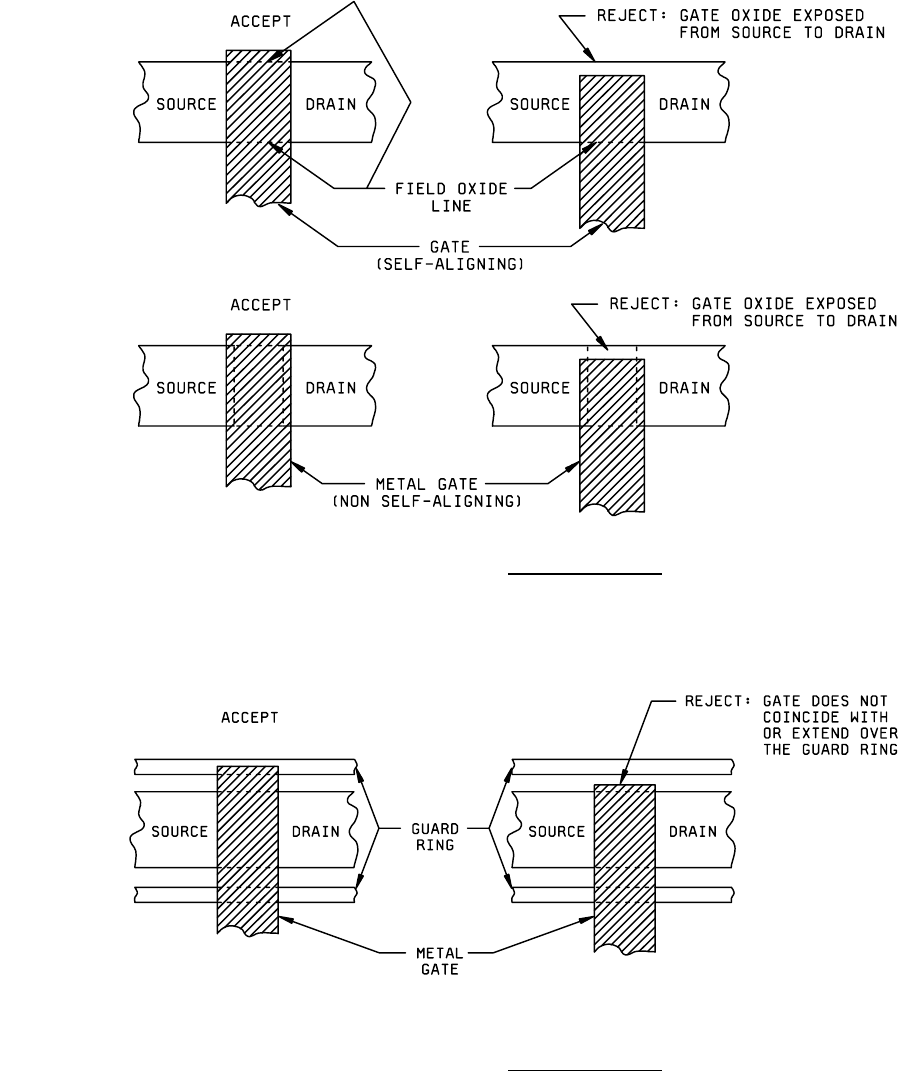
FIGURE 2010-17. MOS gate alignment
.
h. For MOS structures containing a diffused guard ring, gate metallization not coincident with or not extending over
the diffused guard ring (see figure 2010-18).
FIGURE 2010-18. MOS gate alignment
.
*