MIL- STD-883F 2004 TEST METHOD STANDARD MICROCIRCUITS.pdf - 第231页
MIL-STD-883F METHOD 2010.11 18 June 2004 21 Condition A Conditi on B Class le vel S Class lev el B 3.1.2 Di ffus ion and pass ivati on layer faul ts . No devic es shal l be acc eptable t hat exhibits the fol lowing: 3.1.…
MIL-STD-883F
METHOD 2010.11
18 June 2004
20
Condition A Condition B
Class level S Class level B
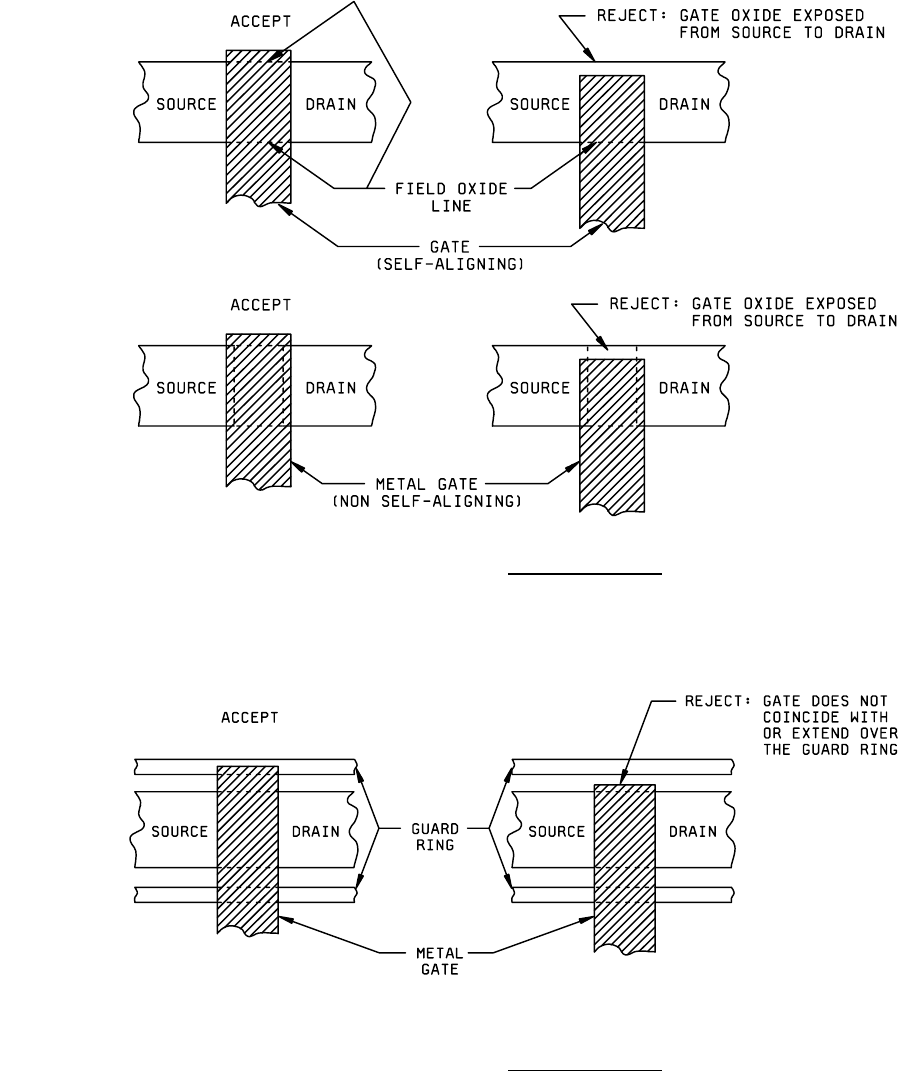
FIGURE 2010-17. MOS gate alignment
.
h. For MOS structures containing a diffused guard ring, gate metallization not coincident with or not extending over
the diffused guard ring (see figure 2010-18).
FIGURE 2010-18. MOS gate alignment
.
*
MIL-STD-883F
METHOD 2010.11
18 June 2004
21
Condition A Condition B
Class level S Class level B
3.1.2 Diffusion and passivation layer faults
. No devices shall be acceptable that exhibits the following:
3.1.2.1 Diffusion faults
.
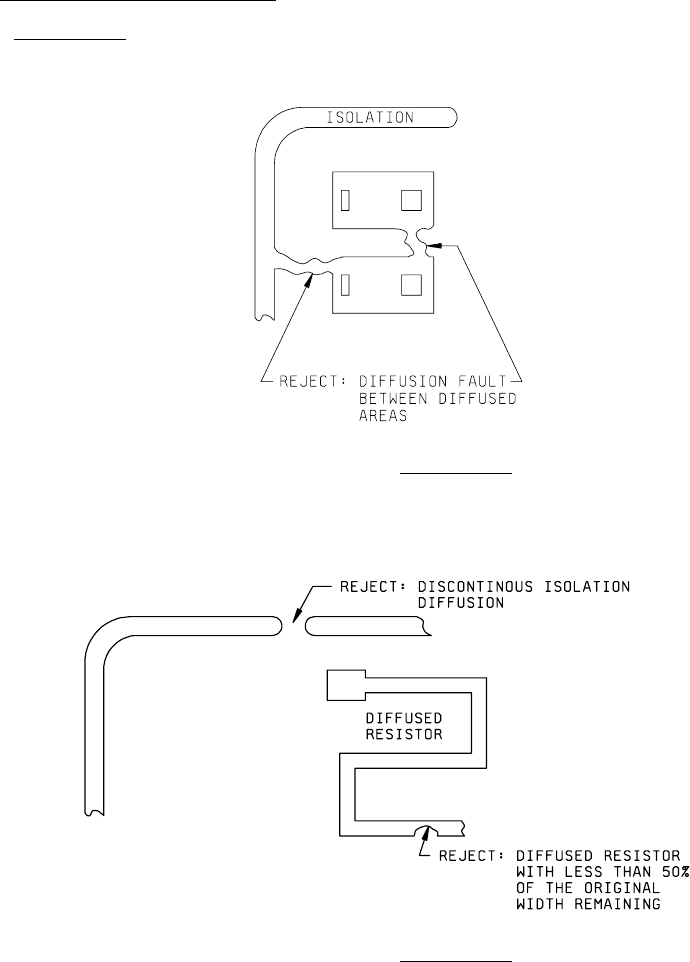
a. Diffusion fault that allows bridging between diffused areas (see figure 2010-19).
FIGURE 2010-19. Diffusion faults
.
b. Any isolation diffusion that is discontinuous (except isolation walls around unused areas or unused bonding pads)
or any other diffused area with less than 25 percent (50 percent for resistors) of the original diffusion width
remaining (see figure 2010-20).
FIGURE 2010-20. Diffusion faults
.
MIL-STD-883F
METHOD 2010.11
18 June 2004
22
Condition A Condition B
Class level S Class level B
3.1.2.2 Passivation faults
.
NOTE: For SOS devices, exclude defects between first-level conductive interconnect (metallization, polysilicon, ect.) and
sapphire areas of the die, where no active circuit elements are present.
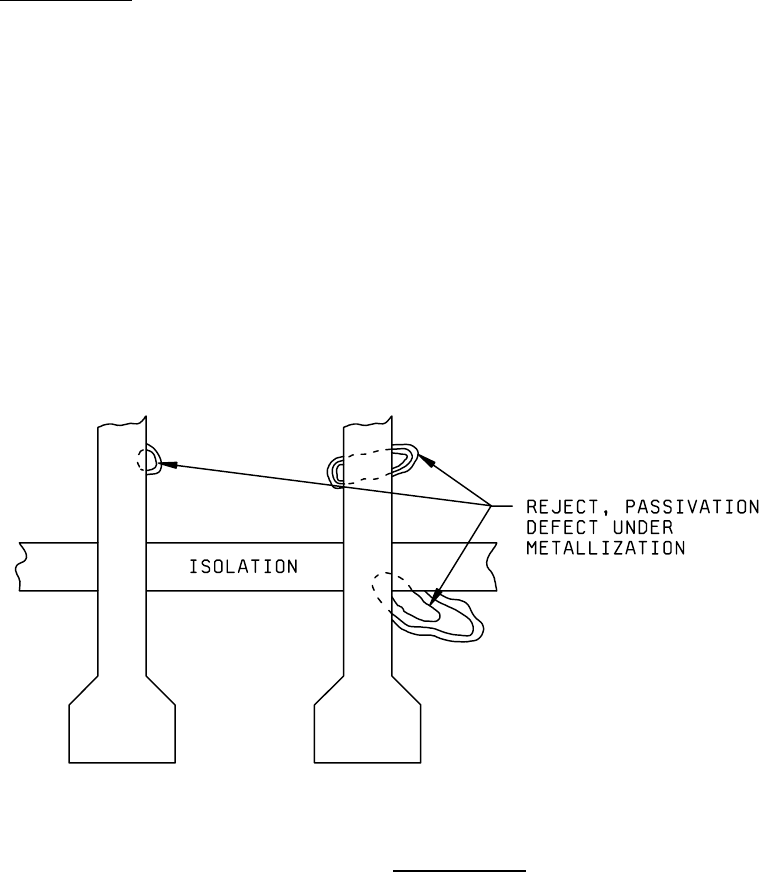
a. Either multiple lines or a complete absence of passivation visible at the edge and continuing under the
metallization unless by design for GaAs devices. Multiple lines indicate that the fault can have sufficient depth to
penetrate down to bare semiconductor material.
NOTE: The multiple line criteria can be excluded when a second passivation layer is applied in a separate operation
prior to metallization deposition or for bond pads located in isolated tubs.
NOTE: For condition B only. Should the absence
of glassivation in the defect area or the
characteristics of the glassivation present
allow verification of the presence or absence of
passivation by color or color comparisons
respectively, then these techniques may be used
(see figure 2010-21).
FIGURE 2010-21. Passivation faults
.
b. Active junction line not covered by passivation, unless by design.
c. Contact window that extends across a junction line, unless by design.