MIL- STD-883F 2004 TEST METHOD STANDARD MICROCIRCUITS.pdf - 第237页
MIL-STD-883F METHOD 2010.11 18 June 2004 27 Condition A Conditi on B Class le vel S Class lev el B h. Sc ratc h(es ) in t he glass ivati on that dis turbs metal and br idges met alli zation pat hs. i. Crac k(s ) (not cra…
MIL-STD-883F
METHOD 2010.11
18 June 2004
26
Condition A Condition B
Class level S Class level B
3.1.4 Glassivation defects
. No device shall be acceptable that exhibits (see figure 2010-24):
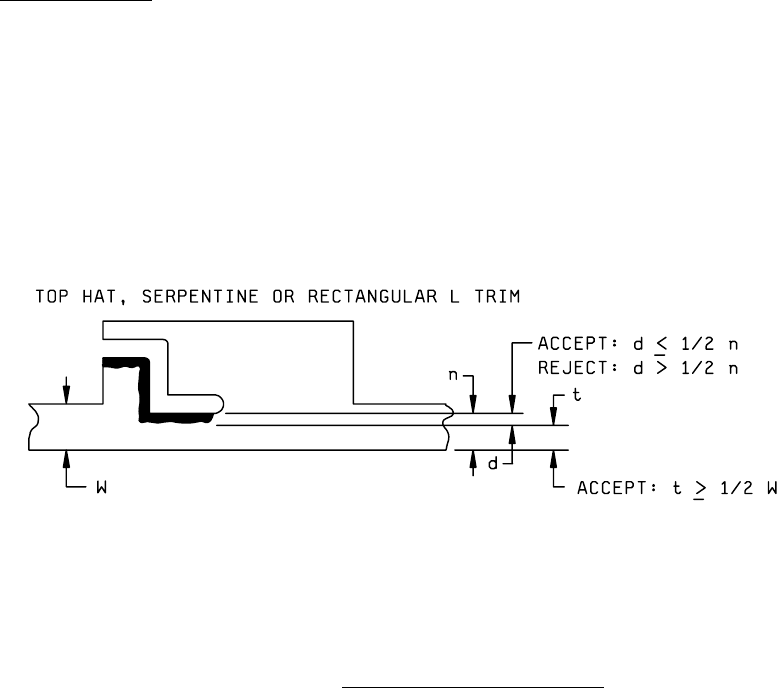
NOTE: For condition B only. Criteria of 3.1.4 can be
excluded when the defect(s) is due to laser trimming. In
this case, the defects outside the kerf due to laser
trimming shall not be more than one half the remaining
resistor width and shall leave a primary resistor path
free of glassivation defects, equal to or greater than one
half times the narrowest resistor width.
FIGURE 2010-24. Laser trimmed glassivation defects
.
a. Glass crazing or glass damage that prohibits the detection of visual criteria contained herein.
b. Any lifting or peeling of the glassivation in the active areas or which extends more than 1.0 mil distance from the
designed periphery of the glassivation.
c. A glassivation void that exposes two or more active metallization paths, except by design.
d. Unglassivated areas greater than 5.0 mils in any dimension, unless by design.
e. Unglassivated areas at the edge of bonding pad exposing bare semiconductor material, except by design.
f. Glassivation covering more than 25 percent of the designed open contact bonding area.
g. Crazing over a film resistor.
MIL-STD-883F
METHOD 2010.11
18 June 2004
27
Condition A Condition B
Class level S Class level B
h. Scratch(es) in the glassivation that disturbs metal and bridges metallization paths.
i. Crack(s) (not crazing) in the glassivation that forms a closed loop over adjacent metallization paths.
j. Glassivation void(s) that exposes any portion of a thin film resistor or fusible link except where the glassivation is
opened by design.
k. For GaAs devices, voids in the glassivation that extends over the gate channel of the FET.
l. For GaAs devices, scratches in the glassivation over the gate channel of the FET.
m. For GaAs devices, scratches in the glassivation over the gate insertion of the FET.
n. For GaAs devices, cracks in the glassivation which are more than 1.0 mil inside the scribe line, or are more than
50 percent of the distance between the scribe line and any functional or active element (e.g., capacitor, resistor,
FET) and which point toward any functional or active element unless the crack terminates at a device feature
(e.g., transmission line or dc line).
3.1.5 Dielectric isolation
. No device shall be acceptable that exhibits:
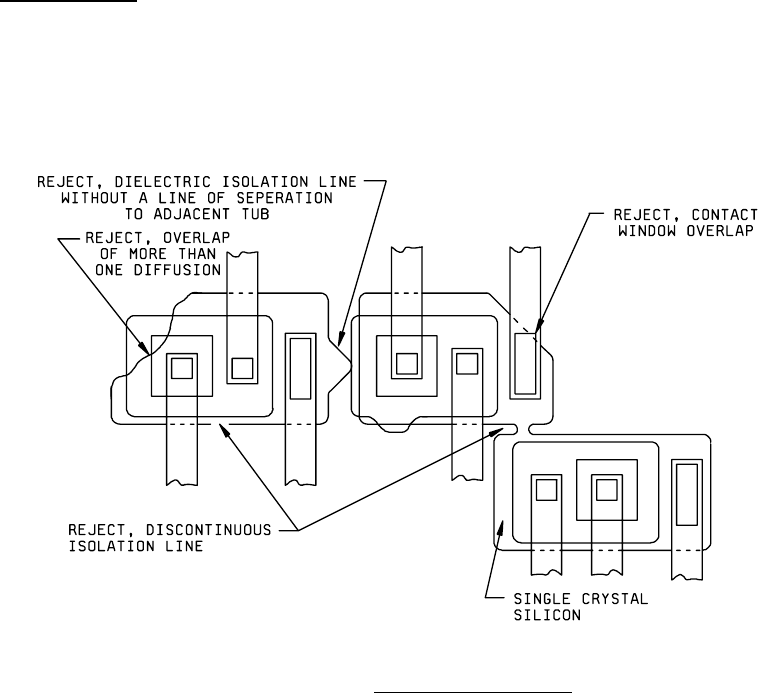
a. A discontinuous isolation line (typically a black line) around each diffusion tub containing functional circuit
elements (see figure 2010-25).
b. Absence of a continuous isolation line between any adjacent tubs, containing functional circuit elements (see
figure 2010-25).
FIGURE 2010-25. Dielectric isolation defects
.
MIL-STD-883F
METHOD 2010.11
18 June 2004
28
Condition A Condition B
Class level S Class level B
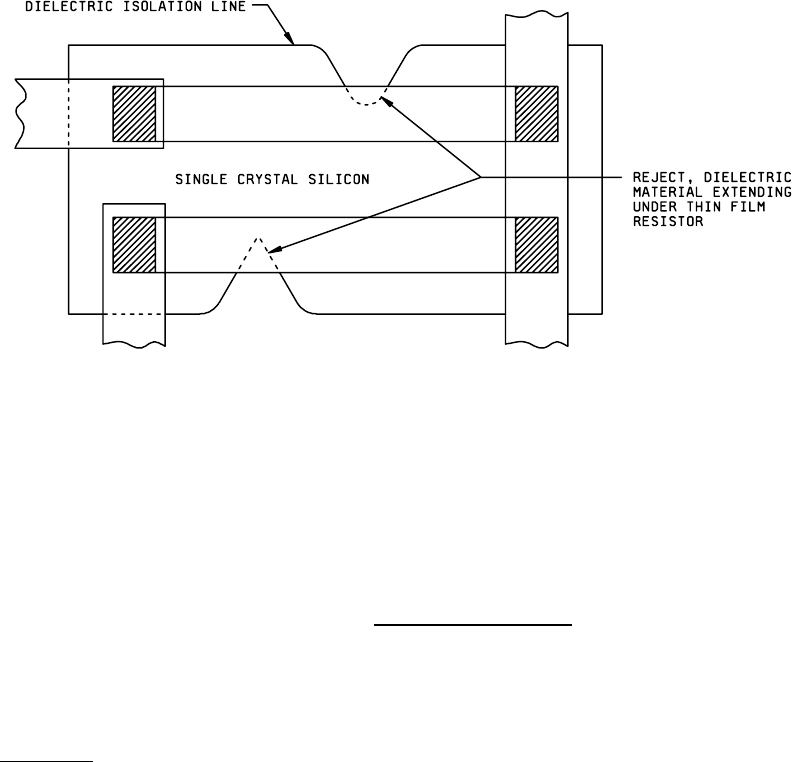
c. A diffused area which overlaps dielectric isolation material and does not exhibit a line of separation to an adjacent
tub, or an overlap of more than one diffusion area into the dielectric isolation material (see figure 2010-25).
FIGURE 2010-26. Dielectric isolation defects
.
d. A contact window that touches or overlaps dielectric material, except by design.
NOTE: Metallization scratch and void defects over a dielectric isolation step shall be rejected in accordance with
criteria contained in 3.1.1.1d and 3.1.1.2b.
3.1.6 Film resistor
. Rejection shall be based on defects found within the actively used portions of the film resistor.
Metallization defect criteria of 3.1.1 shall apply as applicable. No device shall be acceptable that exhibits: