MIL- STD-883F 2004 TEST METHOD STANDARD MICROCIRCUITS.pdf - 第394页
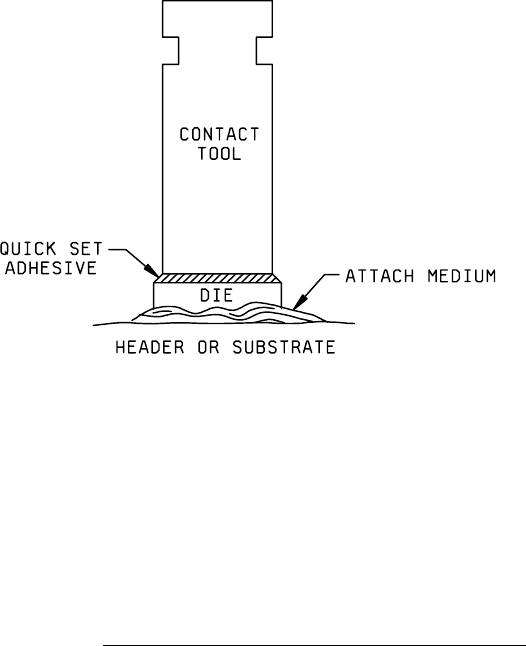
MIL-STD-883F METHOD 2027.2 22 March 1989 2 FIGURE 2027-1. Die cont act t ool adhered to di e top sur face pr ior t o lif t off .

MIL-STD-883F
METHOD 2027.2
22 March 1989
1
METHOD 2027.2
SUBSTRATE ATTACH STRENGTH
1. PURPOSE
. The purpose of this test is to determine the strength of the element attachment system when subjected to
force in the Y1 axis. This method is applicable to semiconductor die attached to headers or substrates by means of organic
materials. Uses include material evaluations and process control.
2. APPARATUS
. The test equipment shall consist of a tensile strength tester capable of applying a force equal to 1,000
psi (6895 kpa) times the area of the largest die to be tested with an accuracy of ±5 percent or 1.75 ounces (50 gm) force,
whichever is less. The test equipment shall have the following capabilities.
a. A range of replaceable die contact tools such that each contacting surface shall be 60 to 100 percent of the area of
the die under test.
b. Provision to assure that the die contact tool is held perpendicular to the die mounting plane of the header or
substrate.
c. A rotational capability between the die contact tool and the header/ substrate holding fixture.
3. PROCEDURE
. The test shall be conducted by placing a small amount of a quick setting adhesive on the contacting
tool which is then attached to the die surface (figure 2027-1). After sufficient adhesive curing the sample is subjected to a
vertical pull force as defined herein.
3.1 Force applied
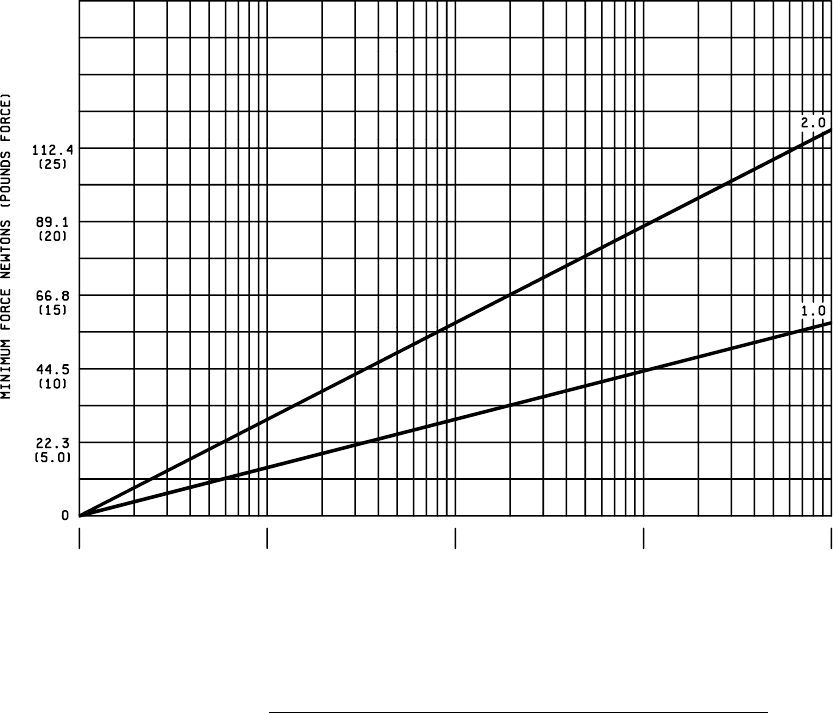
. A force sufficient to lift the die from its mounting or equal to twice the minimum specified tensile
strength (figure 2027-2) whichever occurs first, shall be applied to the die using the apparatus of 2 above.
3.2 Failure criteria
. If the separation occurs between the die surface and the die contacting tool at less than twice the
minimum specified tensile strength, the particular die pull test will not be counted in the sample as either passing or failing.
The following criteria constitute a failure when the die is lifted from the header/substrate:
a. Separation at less than the minimum die tensile strength (1.0X) as shown on figure 2027-2).
b. Separation at less than 200 percent of the minimum die attach strength (2.0X) as shown on figure 2027-2 and no
evidence of attachment at the interface between the die attach medium and the die or header/substrate.
3.2.1 Recording
. When specified, the force required to achieve separation will be recorded with the failure category.
4. SUMMARY
. The following details shall be specified in the applicable acquisition document:
a. Minimum die pull strength if other than that shown on figure 2027-2.
b. Number of die to be tested and the acceptance number.
c. Requirements for data recording.
MIL-STD-883F
METHOD 2027.2
22 March 1989
2
FIGURE 2027-1. Die contact tool adhered to die top surface prior to lift off
.
MIL-STD-883F
METHOD 2027.2
22 March 1989
3
1 x 10
-4
sq in 1 x 10
-3
sq in 1 x 10
-2
sq in 1 x 10
-1
sq in 1 sq in
100 sq mils 1,000 sq mils 10,000 sq mils 100,000 sq mils 1,000,000 sq mils
6.5 x 10
-4
sq cm 6.5 x 10
-3
sq cm 6.5 x 10
-2
sq cm 6.5 x 10
-1
sq cm 6.5 sq cm
NOTE: The X-axis is a log scale and intermediate points not shown must be calculated based on the formulas,
(1.0 X: y = 3.32 logX + 13.3, 2.0 X: y = 6.63 logX + 26.6) not extrapolated from the graph.
FIGURE 2027-2. Die attach strength criteria (minimum force versus die attach area)
.