MIL- STD-883F 2004 TEST METHOD STANDARD MICROCIRCUITS.pdf - 第411页
MIL-STD-883F METHOD 2032.2 18 June 2004 5 (34) Resist or ladder rung is that por tion of a resi stor ladder s truc ture i ntended to be l aser t rimmed t o resul t in an incr emental c hange in res ist ance. (35) Resist …

MIL-STD-883F
METHOD 2032.2
18 June 2004
4
(16) Mar is a nontearing surface disturbance such as an indentation or a buff mark.
(17) Metallization, multilevel (conductors)
is alternate layers of metallization, or other material used for
interconnection, that are isolated from each other by a grown or deposited insulating material. The term
"overlaying metallization" refers to any metallization layer on top of the insulating material.
(18) Metallization, multilayered (conductors)
is two or more layers of metallization, or other material used for
interconnection, that are not isolated from each other by a grown or deposited insulating material. The term
"underlying metallization" refers to any metallization layer below the top layer of metallization.
(19) Metallization, operating (conductors)
is all metallization (gold, aluminum, or other material) used for
interconnection. Bonding pads are considered to be operating metallization. Alignment markers, test
patterns, and identification markings are not considered to be operating metallization.
(20) Narrowest resistor width
is the narrowest portion of a given resistor prior to trimming; however, the
narrowest resistor width for a block resistor may be specified in the approved manufacturer's design
documentation.
(21) Neck-down
is tapering of a resistor line at a metallization interface. Resistor material taper is typically equal
on both sides of the line and is less abrupt than a void.
(22) Nicking (partial cut)
is incomplete or inadvertent trimming of a resistor adjacent to the one being trimmed or
of the next ladder rung of the same resistor.
(23) Nonplanar element
is one that is essentially three-dimensional.
(24) Original separation
is the separation dimension or space that is intended by design.
(25) Original width
is the width dimension that is intended by design.
(26) Oxide defect
is an irregularly shaped defect in the oxide characterized by two or three colored fringes at it
edges.
(27) Passivation
is the silicon oxide, silicon nitride, or other insulating material, that is grown or deposited directly
on the element prior to the deposition of metal.
(28) Passivation step
is a change in thickness of the passivation layer by design.
(29) Passive elements
are planar resistors, capacitors, inductors, and patterned substrates (both single-layer
and multilayer), and nonplanar chip capacitors, chip resistors, chip inductors, and transformers.
(30) Patterned substrate
is a substrate on which conductors, and components such as resistors or capacitors,
are formed using thick or thin film manufacturing techniques.
(31) Planar element
is one that is essentially two-dimensional with all points in a common plane.
(32) Protrusion
is a jutting-out of a circuit feature. Protrusion is typically caused by a photolithographic or
screening defect.
(33) Resistor ladder
is a resistor structure resembling a ladder in appearance that can be trimmed in incremental
steps. A coarse ladder structure is one in which trimming of a rung results in a large incremental resistance
change (one that can cause an out-of-tolerance condition to occur). A fine ladder structure is one in which
trimming of a rung results in a small incremental resistance change (one that can not cause an
out-of-tolerance condition to occur).

MIL-STD-883F
METHOD 2032.2
18 June 2004
5
(34) Resistor ladder rung is that portion of a resistor ladder structure intended to be laser trimmed to result in an
incremental change in resistance.
(35) Resistor loop
is a resistor structure resembling a loop in appearance that can be trimmed. A coarse loop
structure is one in which trimming results in a large resistance change (one that can cause an
out-of-tolerance condition to occur). A fine loop structure is one in which trimming results in a small
resistance change (one that cannot cause an out-of-tolerance condition to occur).
(36) Resistor material, self passivating
is one on which a conformal insulating layer can be thermally grown (such
as tantalum nitride on which tantalum pentoxide is grown).
(37) Scorching
is discoloration of laser trimmed thin film resistor material without alteration of its physical form.
(38) Scratch, metallization
is any tearing defect, including probe marks, in the surface of the metallization. A mar
on the metallization surface is not considered to be a scratch.
(39) Scratch, resistor
is any tearing defect in the resistor film. A mar on the resistor surface is not considered to
be a scratch.
(40) Sidebar
is that portion of a resistor ladder structure to which rungs are attached. Sidebars are not intended
to be laser trimmed.
(41) Substrate
is the supporting structural material into or upon which, or both, functional circuits are formed.
(42) Surface Acoustic Wave (SAW) element
is a planar element fabricated typically using thin film manufacturing
techniques on various substrate materials. Size varies as a function of frequency and design features
include interdigitated fingers.
(43) Terminal
is a metal area used to provide an electrical access point to functional circuitry.
(44) Thick film
is conductive, resistive or dielectric material screen printed onto a substrate and fired at
temperature to fuse into its final form.
(45) Thin film
is conductive, resistive or dielectric material, usually less than 50,000Å in thickness, that is
deposited onto a substrate by vacuum evaporation, sputtering, or other means.
(46) Underlying material
is any layer of material below the top-layer metallization. This includes metallization,
resistor, passivation or insulating layers, or the substrate itself.
(47) Via
is an opening in the insulating material in which a vertical conductive electrical connection from one
metallization layer to another is made.
(48) Vitrification
is conversion into glass or a glassy substance by heat and fusion.
(49) Void, metallization
is any missing metallization where the underlying material is visible (exposed). Voids
typically are caused by photolithographic, screen, or mask related defects, not by scratches.
(50) Void, resistor
is any missing resistor material where the underlying material is visible (exposed). Voids
typically are caused by photolithographic, screen, or mask related defects, not by scratches.
MIL-STD-883F
METHOD 2032.2
18 June 2004
6
(51) Wraparound conductor is one which extends around the edge of the substrate by design.
(52) Coupling (air) bridge
is a raised layer of metallization used for interconnection that is isolated from the
surface of the element by an air gap or other insulating material.
(53) Pit
is a depression produced in a substrate surface typically by nonuniform deposition of metallization or by
nonuniform processing such as excessively powered laser trim pulses.
(54) Substrate, hard
is the inorganic, rigid material into or upon which or both, functional circuits are formed.
Typical materials are alumina and silicon.
(55) Blister, metallization
is a hollow bump that can be flattened.
(56) Nodule, metallization
is a solid bump that cannot be flattened.
(57) Substrate plug via
is a cylinder-like volume in the substrate material filled with conductive material which
makes electrical connection from contact areas on the top surface to the back surface of the substrate..
3.1 Thin film element inspection
. Inspection for visual defects described in this section shall be conducted on each planar
thin film passive element. The "high magnification" inspection shall be within the range of 100X to 200X for both class H and
class K. The "low magnification" inspection shall be within the range of 30X to 60X for both class H and class K. When
inspection is performed prior to mounting, then elements utilizing ceramic or glass type substrates, without backside
metallization, shall be inspected using backlighting for conditions of hair-line voiding or bridging. Patterned substrates that
have geometries of 2.0 mils or greater shall be inspected at 10X to 60X magnification.
Class H
Class K
3.1.1 Operating metallization defects "high
magnification"
. No element shall be acceptable
that exhibits:
NOTE: The metallization defect criteria contained
in this section apply to operating metallization
only.
3.1.1.1 Metallization scratches
.
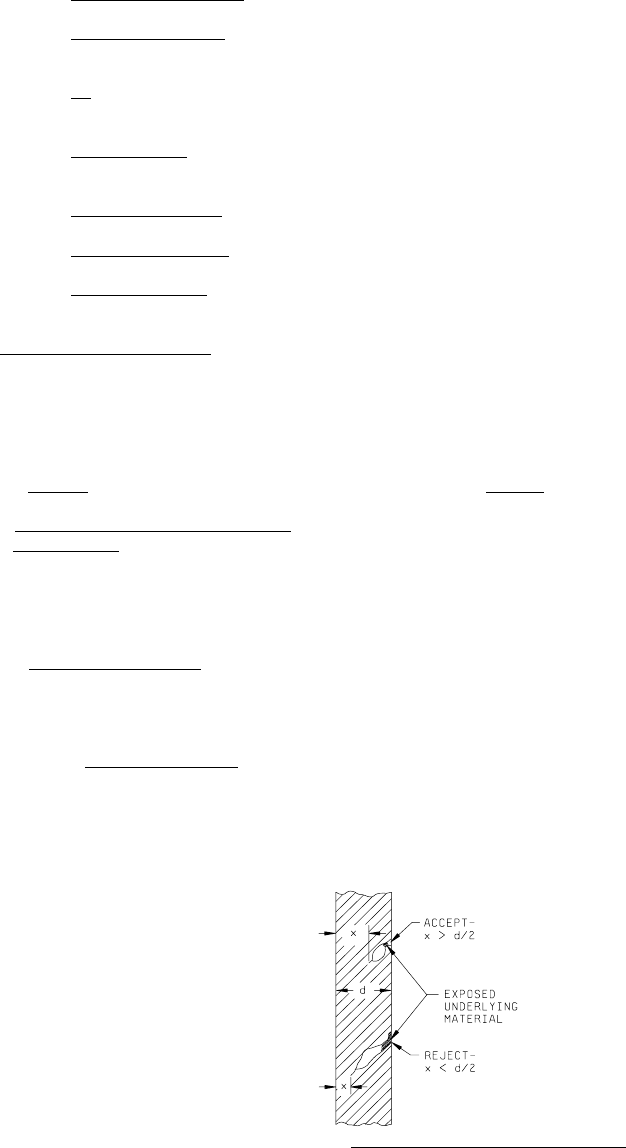
a. A scratch or probe mark in the metallization, a. Same as Class H.
excluding bonding pads, that both exposes
under-lying material anywhere along its length and
leaves less than 50 percent
of the original
metallization width undisturbed (see 2032-1h).
NOTE: These criteria do not apply to
capacitors (see 3.1.1.1e).
NOTE: Underlying material does not have to be
exposed along the full length of the scratch.
FIGURE 2032-1h. Class H metallization scratch criteria
.