MIL- STD-883F 2004 TEST METHOD STANDARD MICROCIRCUITS.pdf - 第417页
MIL-STD-883F METHOD 2032.2 18 June 2004 11 Cla ss H Class K 3.1.1. 5 b. For inter digitat ed capac itors only, 3.1.1.5 b. Same as cl ass H. protru sion of me tallizatio n that r educes the ori ginal s eparati on by great…
MIL-STD-883F
METHOD 2032.2
18 June 2004
10
Class H Class K
3.1.1.3 Metallization corrosion
.
a. Any metallization corrosion. a. Same as class H.
NOTE: Metallization having any localized discolored
area shall be closely examined and rejected unless
it is demonstrated to be a harmless film, glassivation
interface, or other obscuring effect.
3.1.1.4 Metallization adherence
.
a. Any metallization lifting, peeling, a. Same as class H.
or blistering.
NOTE: Nodules are acceptable. In
order to determine if a bump in the
metallization is a blister or a
nodule, attempt to flatten the bump
with a nonmetallic instrument. If
the bump flattens, then it is a blister.
NOTE: These criteria are not applicable
to undercutting or separation induced
anomalies (for example, metallization
lifting due to scribe and break or diamond
sawing) since these are not indicative of
adhesion problems.
3.1.1.5 Metallization protrusion
.
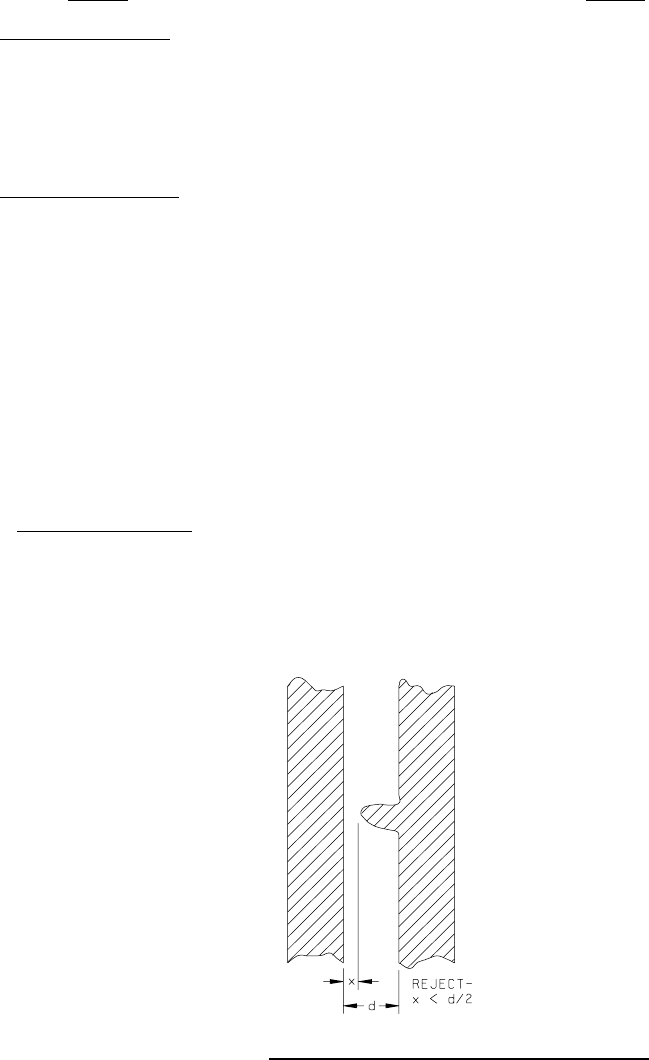
a. Protrusion of metallization that reduces a. Same as class H.
the original separation between adjacent
operating metallization by greater than
50 percent (see figure 2032-5h).
FIGURE 2032-5h. Class H operating metallization protrusion criterion
.
MIL-STD-883F
METHOD 2032.2
18 June 2004
11
Class H Class K
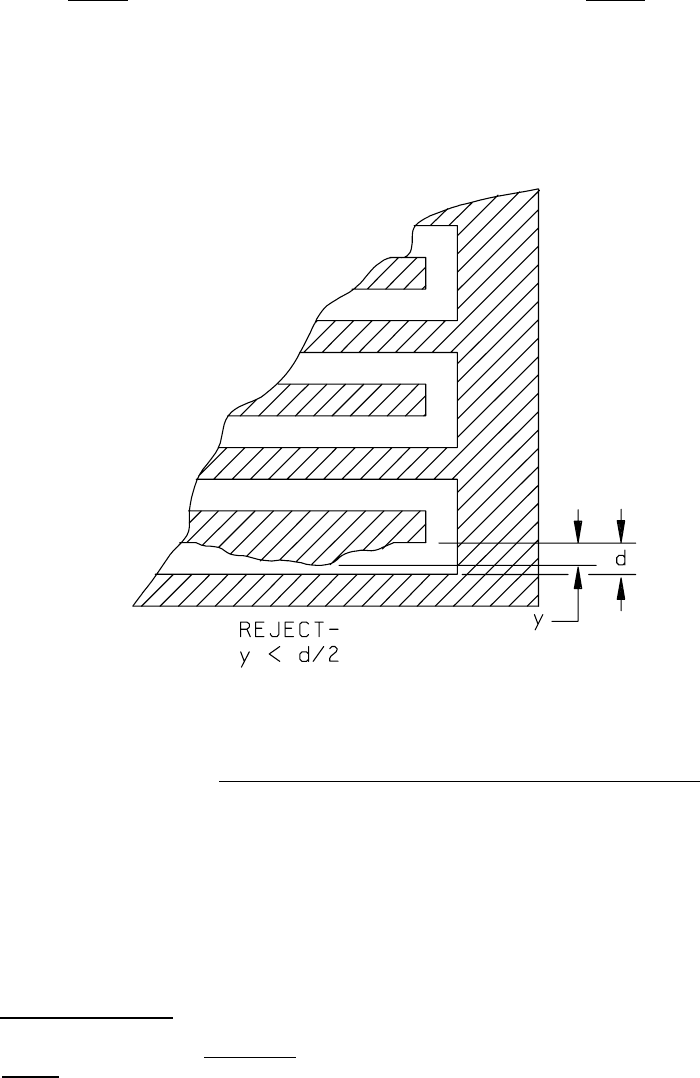
3.1.1.5 b. For interdigitated capacitors only, 3.1.1.5 b. Same as class H.
protrusion of metallization that reduces
the original separation by greater than
50 percent (see figure 2032-6h).
FIGURE 2032-6h. Class H interdigitated capacitor metallization protrusion criterion
.
3.1.1.6 Metallization alignment
.
a. A contact window that has less than 50
a. Less than 75 percent.
percent
of its area covered by metallization.
MIL-STD-883F
METHOD 2032.2
18 June 2004
12
Class H Class K
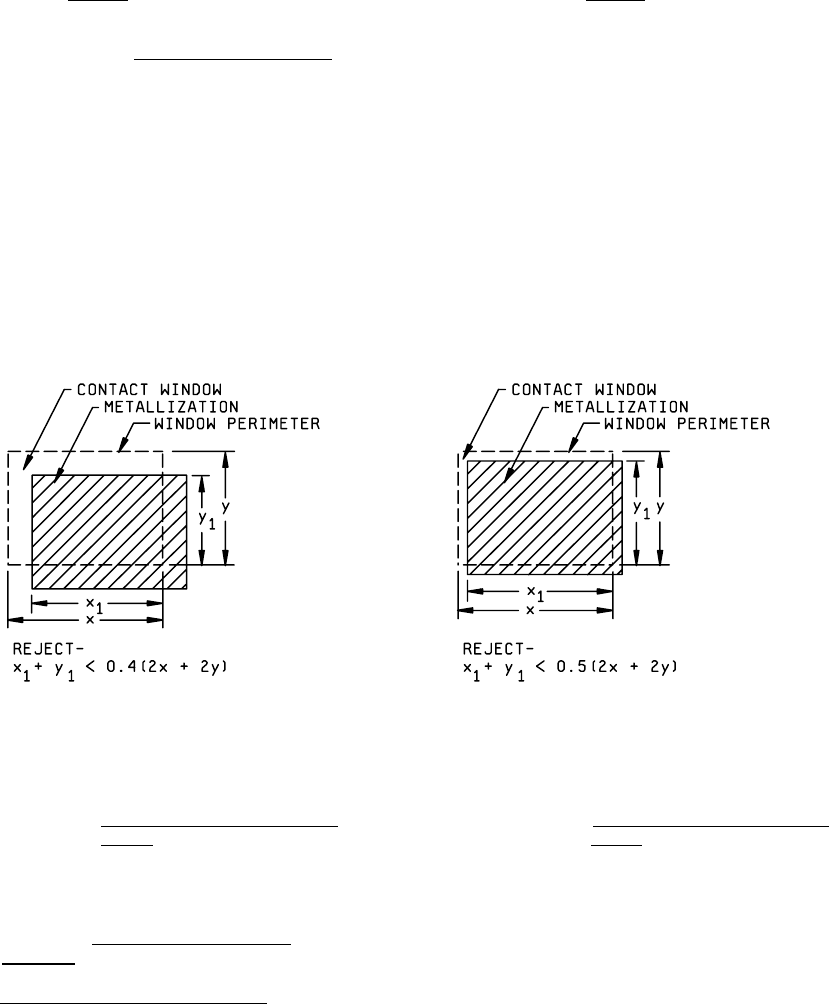
3.1.1.6 b. A contact window that has less than a 3.1.1.6 b. 50 percent of its perimeter
continuous 40 percent of its perimeter
(see figure 2032-7k).
covered by metallization (see figure
2032-7h).
NOTE: When, by design, metallization
is completely contained in a contact
window, or does not cover the entire
contact perimeter, 3.1.1.6a, area
coverage, or 3.1.1.6b, perimeter
coverage, can be deleted as applicable
provided that the design criteria are
satisfied.
FIGURE 2032-7h. Class H metallization alignment
FIGURE 2032-7k. Class K metallization alignment
criteria
. criteria.
c. A metallization path not intended to cover c. Same as Class H.
a contact window that is separated from
the window by less than 0.1 mil unless
by design
.
3.1.1.7 Metallization bumps or indentations
.
a. For capacitors only, a bump or indentation a. Same as class H.
in the overlaying metallization.