MIL- STD-883F 2004 TEST METHOD STANDARD MICROCIRCUITS.pdf - 第445页
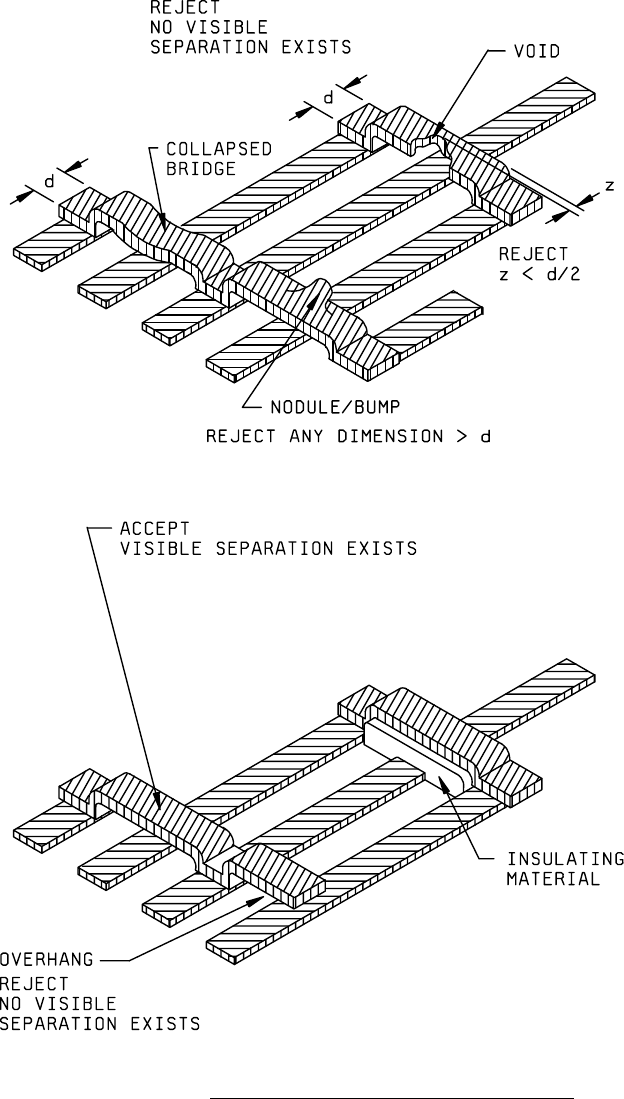
MIL-STD-883F METHOD 2032.2 18 June 2004 39 FIGURE 2032-37Ah. Class H and clas s K coupl ing (ai r) br idge cri teri a .

MIL-STD-883F
METHOD 2032.2
18 June 2004
38
Class H Class K
3.1.8 b. Voids in the insulating material. 3.1.8 b. Same as class H.
c. A bump or indentation in the upper c. Same as class H.
(overlaying) metallization.
NOTE: This criteria is not applicable to
coupling (air) bridges.
d. Scratch that completely crosses the d. Same as class H.
metallization and damages the
insulating material surface on
either side.
3.1.9 Coupling (air) bridge defects "high magnification"
. No element shall be
acceptable that exhibits:
Class H
Class K
a. A void in the coupling (air) bridge a. Same as class H.
metallization that leaves less than 50
percent of the original metallization
width undisturbed. (See figure 2032-37Ah).
b. Nodules or bumps that are greater, in any b. Same as class H.
dimension, than the original coupling (air)
bridge metallization width. (See figure
2032-37Ah).
c. Coupling (air) bridge that contacts under- c. Same as class H.
lying operating metallization. (See figure
2032-37Ah).
d. Attached, conductive foreign material that is d. Same as class H.
greater, in any dimension, than 50 percent
of the original coupling (air) bridge
metallization width.
e. No visible separation between the coupling e. Same as class H.
air) bridge and the underlying operating
metallization.
NOTE: This criterion is not applicable
when an insulating material is used between
the coupling (air) bridge and the underlying
metallization. (See figure 2032-37Ah).
f. Coupling (air) bridge metallization overhang f. Same as class H.
over adjacent operating metallization, not
intended by design, that does not exhibit a
visible separation. (See figure 2032-37Ah).
g. Mechanical damage to a coupling (air) bridge g. Same as class H.
that results in depression (lowering) of
coupling (air) bridge metallization over
underlying operating metallization.
MIL-STD-883F
METHOD 2032.2
18 June 2004
39
FIGURE 2032-37Ah. Class H and class K coupling (air) bridge criteria
.
MIL-STD-883F
METHOD 2032.2
18 June 2004
40
3.2 Planar thick film element inspection. Inspection for visual defects described in this section shall be
conducted on each planar thick film passive element. All inspection shall be performed at "low
magnification" within the range of 10X to 60X magnification for both class H and class K.
Class H
Class K
3.2.1 Operating metallization defects "low
magnification"
. No element shall be acceptable
that exhibits:
NOTE: The metallization defect criteria
contained in this section apply to operating
metallization only.
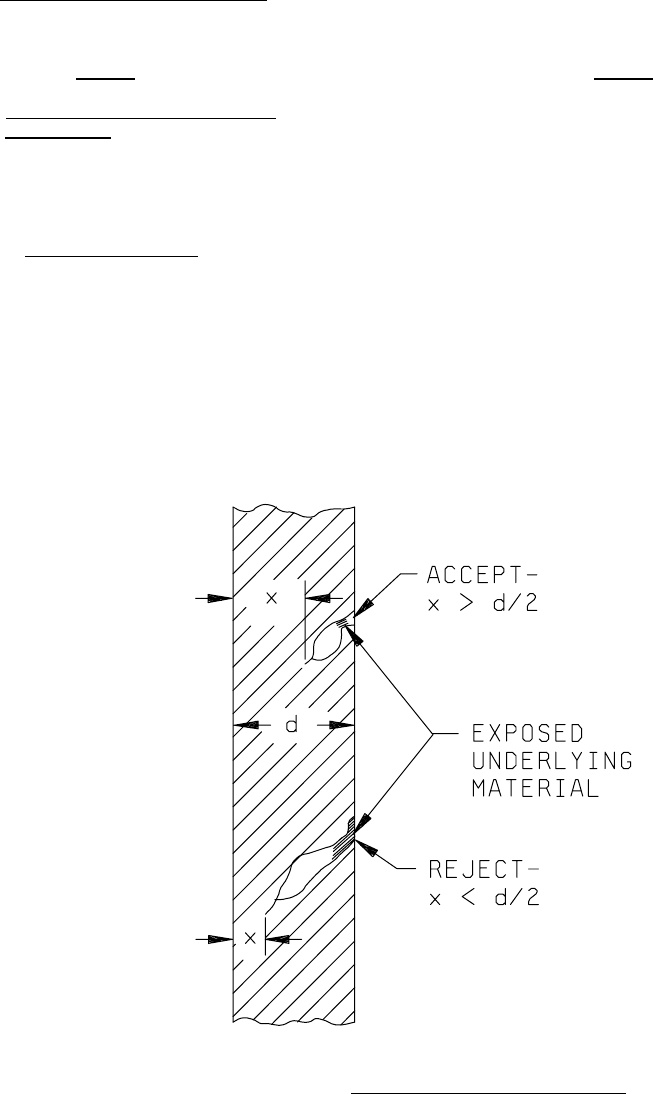
3.2.1.1 Metallization scratches
a. A scratch or probe mark in the metallization, a. Same as Class H.
excluding bonding pads, that both exposes
underlying material anywhere along its
length and leaves less than 50 percent of
the original metallization width undisturbed
(see figure 2032-38h).
NOTE: Underlying material does not have to be
exposed along the full length of the scratch.
NOTE: This criteria does not apply to
capacitors.
FIGURE 2032-38h. Class H metallization scratch criteria
.