MIL- STD-883F 2004 TEST METHOD STANDARD MICROCIRCUITS.pdf - 第450页
MIL-STD-883F METHOD 2032.2 18 June 2004 44 Cla ss H Class K 3.2.1 .6 Metalliz ation ov erlap . a. Cont act over lap between t he upper and lower a. Same as clas s H. metalliz ations th at is less t han 50 percent of the …
MIL-STD-883F
METHOD 2032.2
18 June 2004
43
Class H Class K
3.2.1.3 Metallization corrosion
.
a. Any metallization corrosion. a. Same as class H.
3.2.1.4 Metallization adherence
.
a. Any metallization lifting, peeling, or a. Same as class H.
blistering.
NOTE: Nodules are acceptable. In order
to determine if a bump in the metallization
is a blister or a nodule, attempt to
flatten the bump with a nonmetallic
instrument. If the bump flattens, then
it is a blister.
NOTE: These criteria are not applicable to
separation induced anomalies (for example,
metallization lifting due to scribe and
break or diamond sawing) since these are not
indicative of adhesion problems.
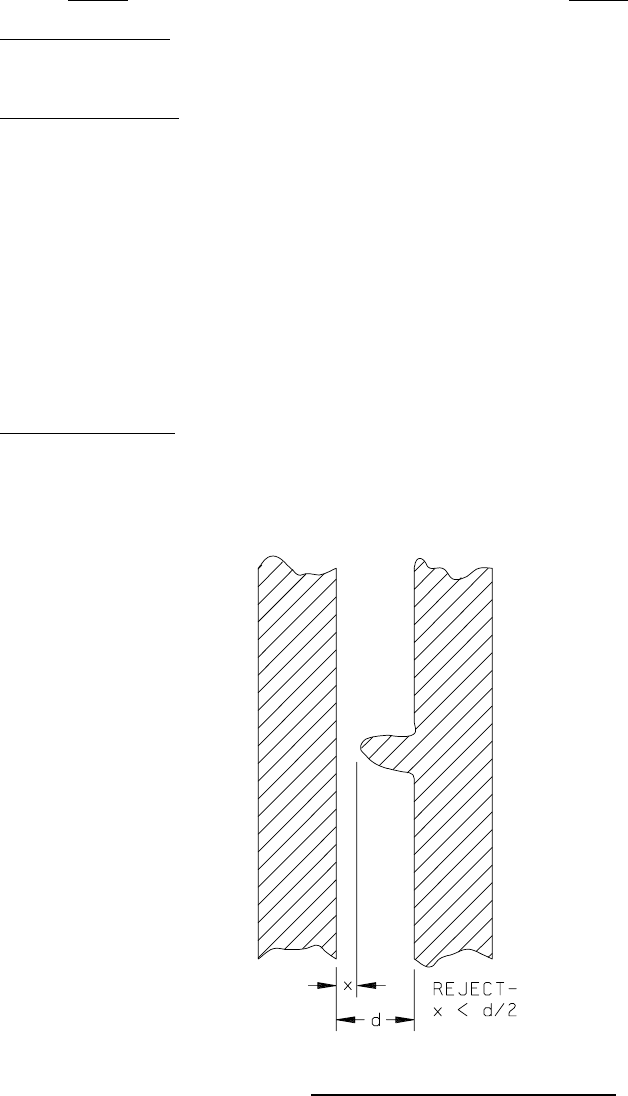
3.2.1.5 Metallization protrusion
.
a. More than 50 percent reduction of the original a. Same as class H.
design separation, between any protruding
metallization and adjacent metallization paths
(see figure 2032-41h).
FIGURE 2032-41h. Class H metallization protrusion criterion
.
MIL-STD-883F
METHOD 2032.2
18 June 2004
44
Class H Class K
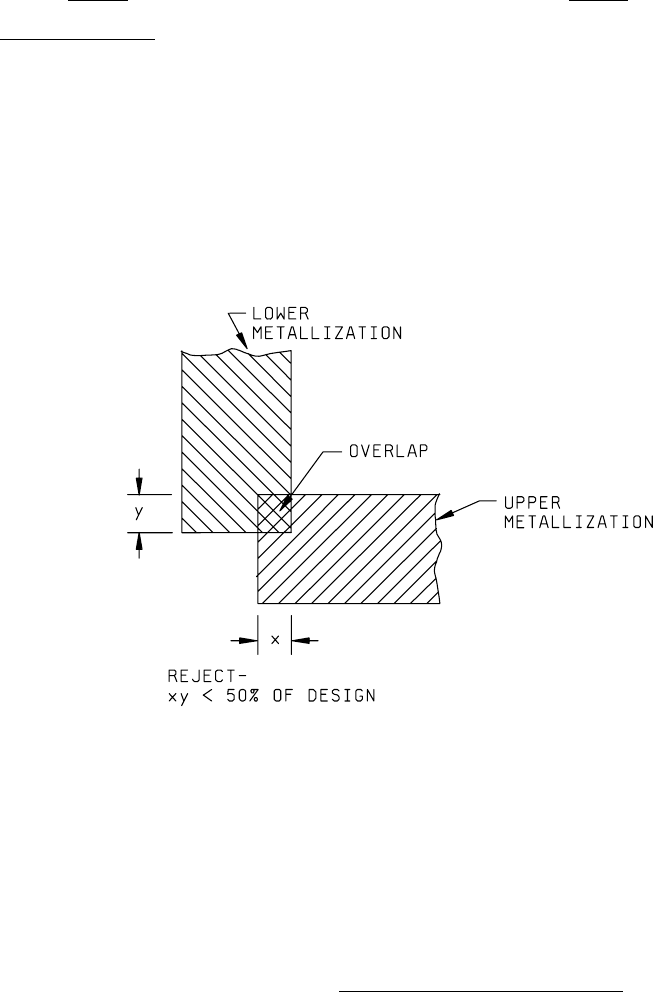
3.2.1.6 Metallization overlap
.
a. Contact overlap between the upper and lower a. Same as class H.
metallizations that is less than 50 percent
of the designed contact overlap area (see
figure 2032-42h).
NOTE: The overlap area is that area in which
the upper metallization actually contacts
the lower metallization.
FIGURE 2032-42h. Class H metallization overlap criterion
.
MIL-STD-883F
METHOD 2032.2
18 June 2004
45
Class H Class K
3.2.1.7 Metallized through-hole defects, "low magnification"
.
No element shall be acceptable that exhibits:
a. Through-hole metallization that is not a. Same as class H.
vertically continuous or that does not cover
at least a continuous 50 percent of the inside,
circumferential surface area unless by design.
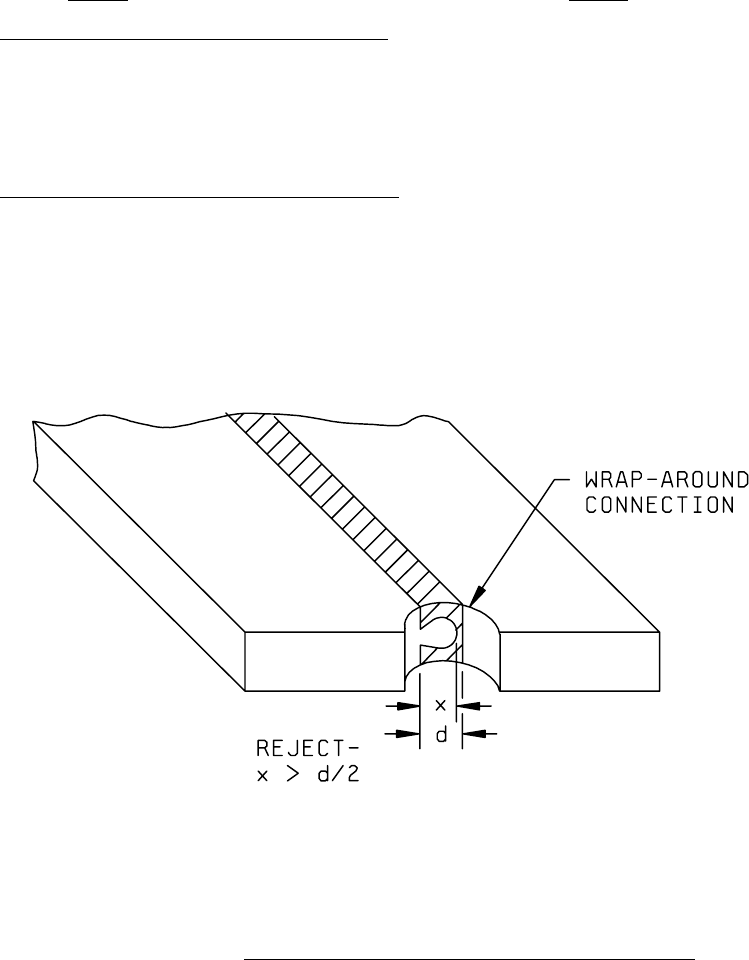
3.2.1.8 Wrap-around connection defects, "low magnification"
.
No element shall be acceptable that exhibits:
a. Unmetallized area in the edges of wrap-around a. Same as class H.
connections greater than 50 percent of the
largest dimension of the edge metallization
(see figure 2032-43Ah).
FIGURE 2032-43Ah. Class H wrap-around connection unmetallized area criterion
.