MIL- STD-883F 2004 TEST METHOD STANDARD MICROCIRCUITS.pdf - 第456页
MIL-STD-883F METHOD 2032.2 18 June 2004 50 Cla ss H Class K 3.2.3 Thic k f ilm r esis tor def ects , "low magnif icat ion" . No element s hall be ac ceptabl e that exhibit s: a. A r educti on of the r esis tor …

MIL-STD-883F
METHOD 2032.2
18 June 2004
49
Class H Class K
3.2.2 g. An attached portion of a circuit 3.2.2 g. Same as class H.
area from an adjacent element.
h. Any crack that does not originate at an h. Same as class H.
edge.
i. Holes through the substrate, unless by i. Same as class H.
design.
j. Patterned substrates having a section broken j. Same as class H.
out around a substrate mounting hole
(intended for substrate-to-post attachment)
that is greater than 25 percent of the
mounting hole circumference.
MIL-STD-883F
METHOD 2032.2
18 June 2004
50
Class H Class K
3.2.3 Thick film resistor defects, "low magnification"
.
No element shall be acceptable that exhibits:
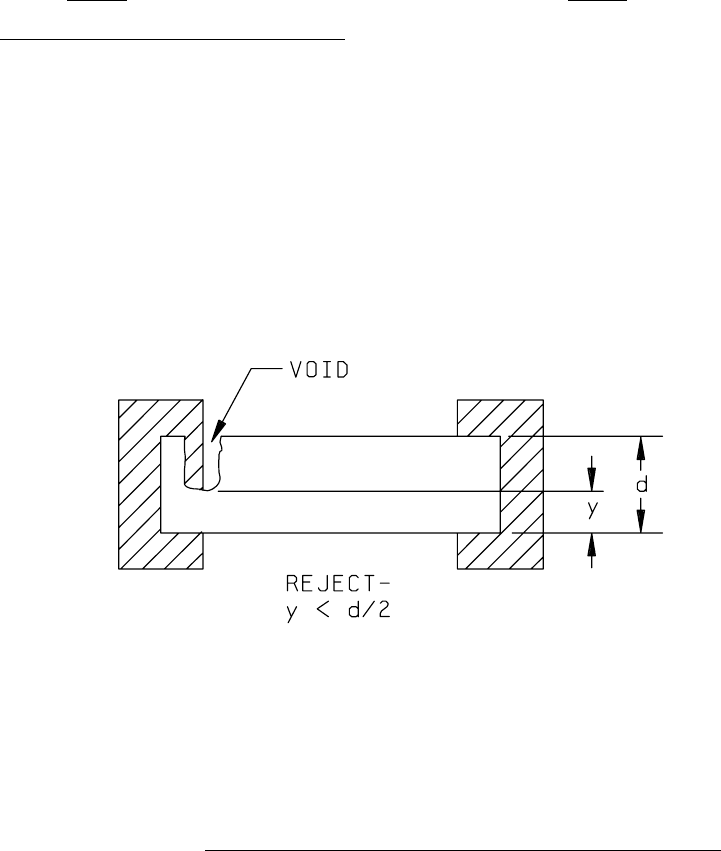
a. A reduction of the resistor at the terminal a. Same as Class H.
due to voids to less than 50 percent of the
original resistor width (see figure 2032-46h).
FIGURE 2032-46h. Class H resistor width reduction at terminal caused by voids criterion
.
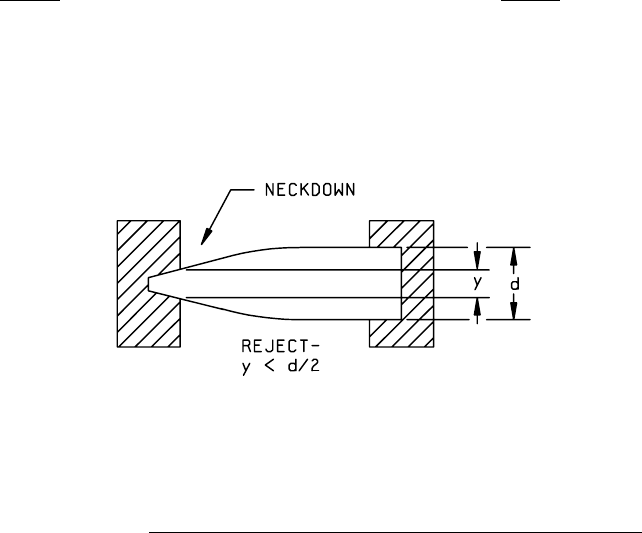
b. Reduction of the resistor at the terminal, b. Same as Class H.
due to neckdown less than 50 percent, to
of the original resistor width (see figure
2032-47h).
MIL-STD-883F
METHOD 2032.2
18 June 2004
51
Class H Class K
FIGURE 2032-47h. Class H resistor width reduction at terminal by neckdown criterion
.
3.2.3 c. Any resistor film lifting, peeling, or 3.2.3 c. Same as class H.
blistering.
d. Crack in the resistor greater than 1.0 mil d. Same as class H.
in length.
NOTE: Irregularities such as fissures in
resistor material that are created during
firing, and that do not expose the
underlying material, are not considered
to be cracks.
e. Evidence of resistor repair by overprinting e. Same as class H.
or any other means.
f. Separation between any two resistors that is f. Same as class H.
less than 50 percent of the original separation.
g. Separation between any resistor and conductor g. Same as class H.
combination that is less than 50 percent of
the original separation.
h. Increase in resistor width greater than 25 h. Same as class H.
percent of the original design width.
i. Resistor that is closer than 1.0 mil to the i. Same as class H.
edge of the substrate.