MIL- STD-883F 2004 TEST METHOD STANDARD MICROCIRCUITS.pdf - 第459页
MIL-STD-883F METHOD 2032.2 18 June 2004 53 Cla ss H Class K 3.2.3 l . Cont act over lap between t he meta llization and 3.2. 3 l. Same as c las s H. the res ist or in whi ch the l ength dimensi on "x" is less t…
MIL-STD-883F
METHOD 2032.2
18 June 2004
52
Class H Class K
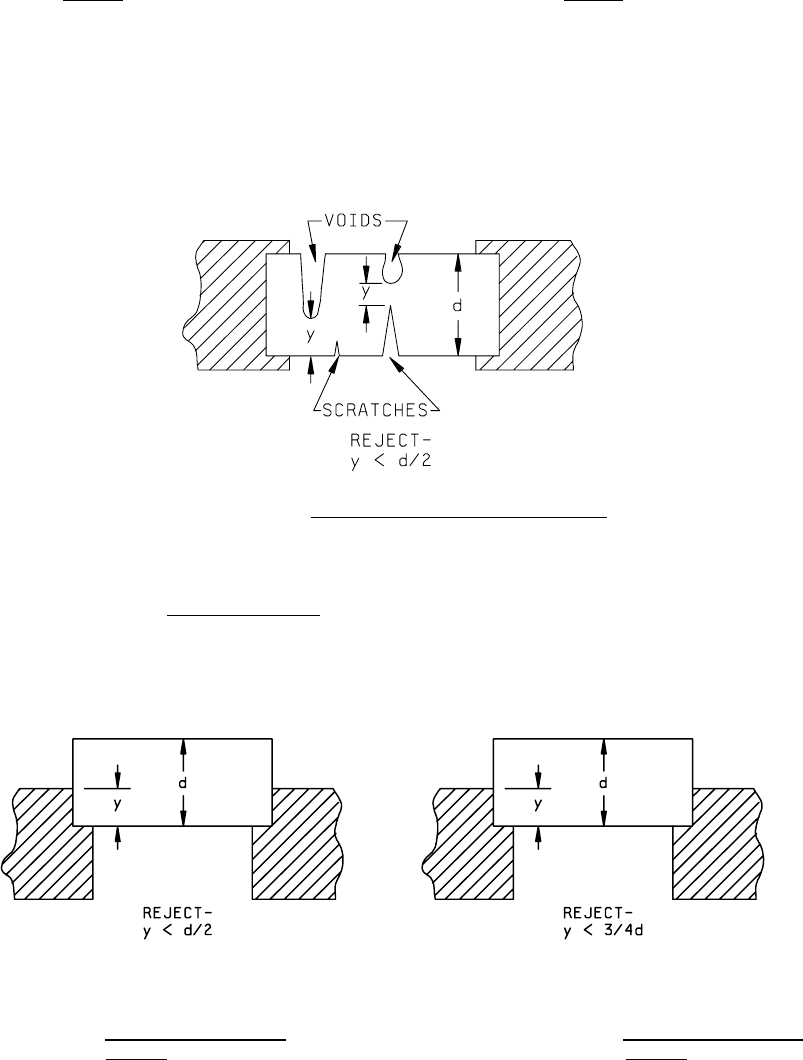
3.2.3 j. Reduction of resistor width resulting from 3.2.3 j. Same as class H.
voids, scratches, or chipouts, or a
combination of these, that leaves less
than 50 percent of the narrowest resistor
width (see figure 2032-48h).
PRECAUTIONARY NOTE: The maximum allowable
current density requirement shall not
be exceeded.
FIGURE 2032-48h. Class H resistor width reduction criteria
.
k. Contact overlap between the metallization k. Less than 75 percent (see
and the resistor in which the actual width figure 2032-49k).
dimension "y" is less than 50 percent
of the
original resistor width (see figure 2032-49h).
FIGURE 2032-49h. Class H resistor overlap
FIGURE 2032-49k. Class K resistor overlap
criterion
. criterion.
MIL-STD-883F
METHOD 2032.2
18 June 2004
53
Class H Class K
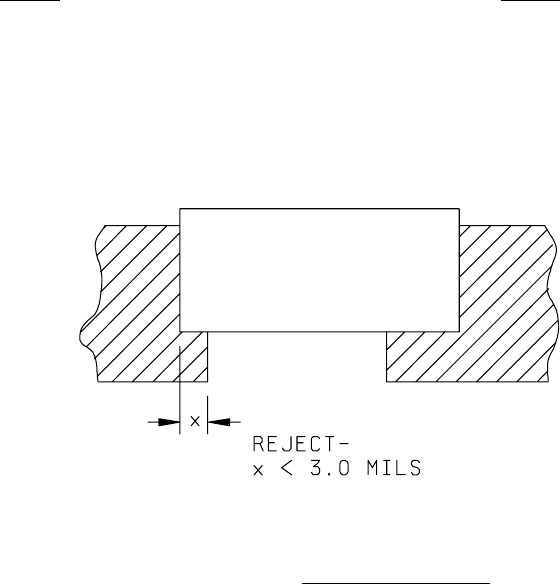
3.2.3 l. Contact overlap between the metallization and 3.2.3 l. Same as class H.
the resistor in which the length
dimension "x" is less than 3.0 mils (see
figure 2032-50h).
FIGURE 2032-50h. Resistor overlap criterion
.
m. Voids or misalignment of glassivation m. Same as class H.
that results in less than 90 percent
coverage of the resistor area, unless
by design.
n. Crazing of glassivation over a resistor. n. Same as class H.
o. Glassivation scratches, lifting, or o. Same as class H.
peeling that expose any portion of a resistor.
MIL-STD-883F
METHOD 2032.2
18 June 2004
54
Class H Class K
3.2.4 Trimmed thick film resistor defects, "low
magnification"
. No element shall be acceptable that
exhibits:
NOTE: The trim defect criteria contained in this
section apply to active resistor areas only.
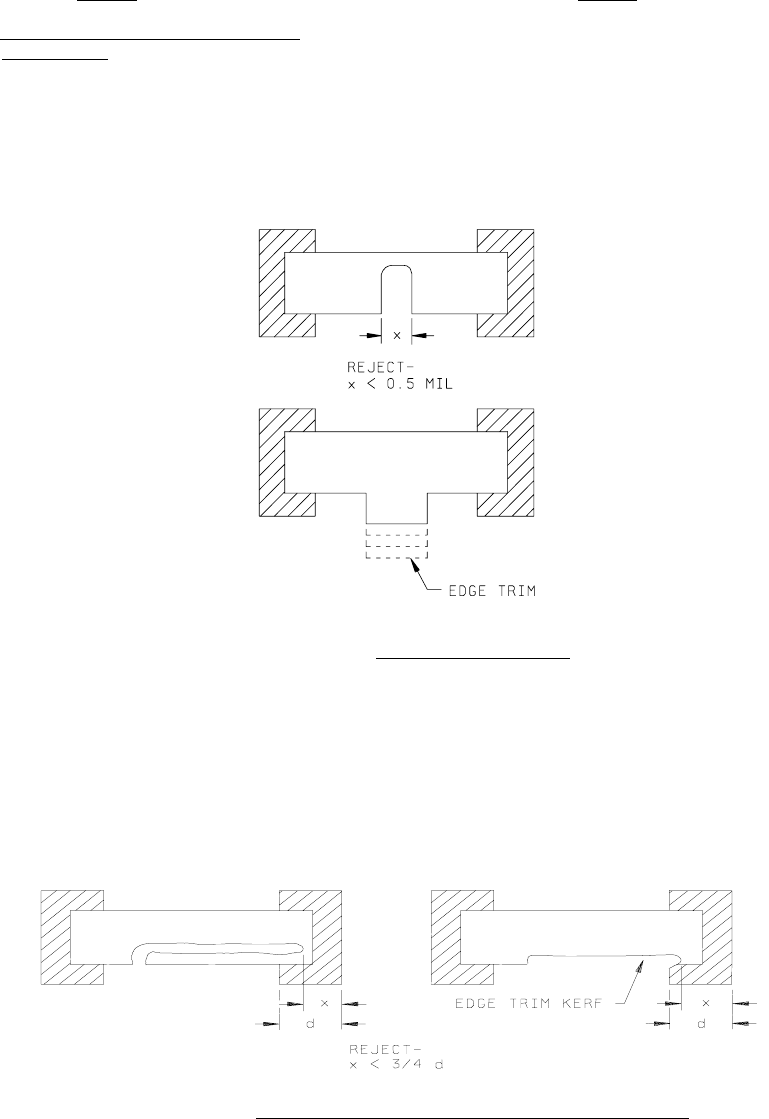
a. A kerf width less than 0.5 mil (see figure a. Same as class H.
2032-51h).
NOTE: This does not apply to edge trimming.
FIGURE 2032-51h. Class H kerf width criteria
.
b. A kerf containing detritus. b. Same as class H.
c. A kerf which extends into metallization c. Same as class H.
and leave less than 75 percent of
the metallization width undisturbed
(see figure 2032-52h).
NOTE: Opening a metallization link by
design is acceptable.
FIGURE 2032-52h. Class H laser trim kerf extension into metallization criteria
.