MIL- STD-883F 2004 TEST METHOD STANDARD MICROCIRCUITS.pdf - 第463页
MIL-STD-883F METHOD 2032.2 18 June 2004 57 Cla ss H Class K 3.3.1 c. Lift ing, bl ist ering, or peeling 3.3. 1 c . Same as clas s H. of ins ulati on. d . Voids in m etallize d termina ls that d. Same as class H. expose u…
MIL-STD-883F
METHOD 2032.2
18 June 2004
56
Class H Class K
3.2.5 b. Voids in the insulating material 3.2.5 b. Same as class H.
that expose underlying metallization.
c. Vias that are less than 50 percent of the c. Same as class H.
original design area.
d. Scratch that completely crosses the d. Same as class H.
metallization and damages the
insulating material surface on either
side.
3.2.6 All thick film capacitors and those overlay capacitors used in GaAs microwave devices,"low
magnification"
. No element shall be acceptable that exhibits:
a. Scratches that expose an underlying material.
b. Any peeling or lifting of the metallization.
c. Excess top metal which extend beyond the capacitor bottom metal.
d. Voids in the capacitor bottom metal which extend under the capacitor top metal.
e. Voids in the top metallization which leaves less than 75% of the metallization area undisturbed.
3.3 Nonplanar element inspection
. Inspection for visual defects described in this section shall be conducted on each
nonplanar passive element. The "low magnification" inspection shall be within the range of 10X to 60X.
Class H
Class K
3.3.1 General nonplanar element defects,
"low magnification"
. No element shall be acceptable that exhibits:
a. Peeling or lifting of any metallization. a. Same as class H.
b. Protrusion between metallization terminals b. Same as class H.
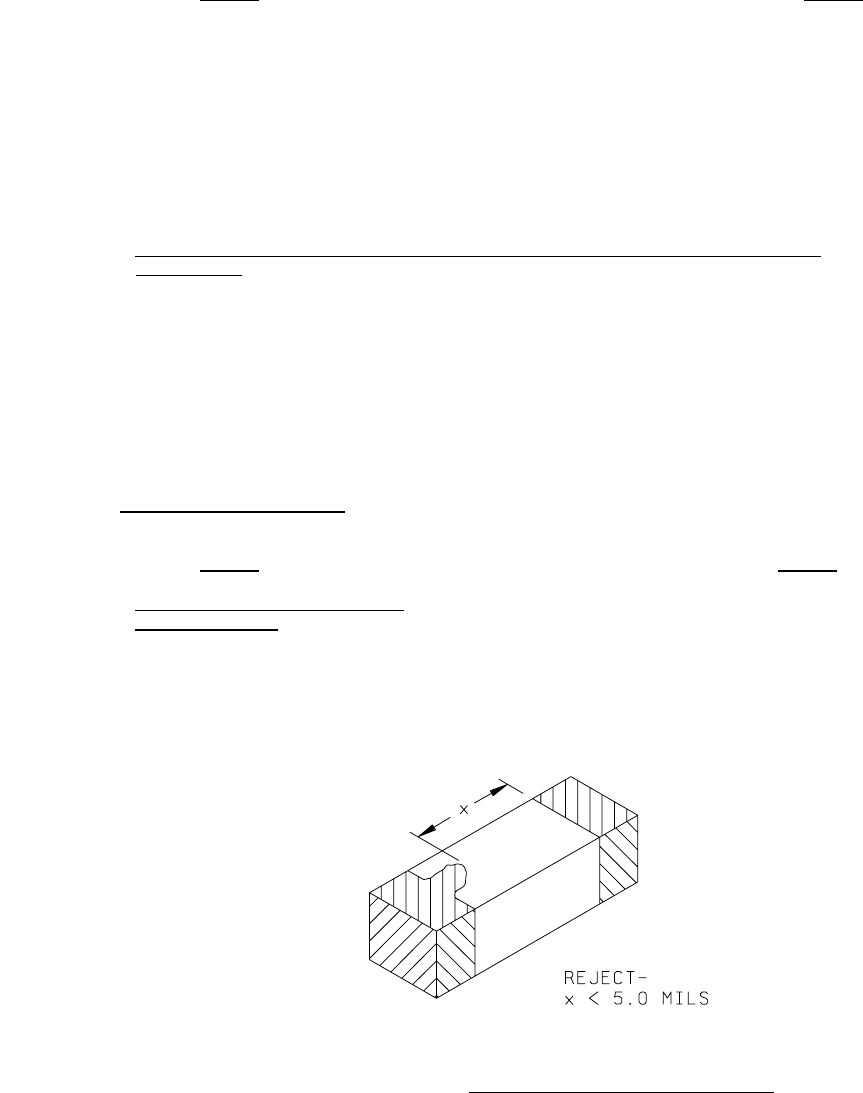
that leaves less than 5.0 mils separation
(see figure 2032-54h).
FIGURE 2032-54h. Class H metallization protrusion criterion
.
*

MIL-STD-883F
METHOD 2032.2
18 June 2004
57
Class H Class K
3.3.1 c. Lifting, blistering, or peeling 3.3.1 c. Same as class H.
of insulation.
d. Voids in metallized terminals that d. Same as class H.
expose underlying material over
greater than 25 percent of any side
of the metallized terminal area.
3.3.2 Foreign material defects "low magnification"
.
No element shall be acceptable that exhibits:
a. For mounted elements, unattached, conductive a. Same as class H.
foreign material on the surface of the
element. For unmounted elements, unattached,
conductive foreign material on the surface of
the element that is large enough to bridge
operating metallization path, active circuitry,
or any combination of these.
NOTE: If an element has an insulating layer
(such as glassivation) that covers operating
metallization paths, active circuitry, or any
combination of these, then the presence of
unattached conductive foreign material that is
large enough to bridge these features is
acceptable since the features are protected by
the insulating layer.
NOTE: All foreign material shall be considered
to be unattached unless otherwise verified to
be attached. Verification of attachment shall
be accomplished by a light touch with an
appropriate mechanical device (i.e., needle,
probe, pick, etc.) by a suitable cleaning
process approved by the acquiring activity,
or by a blow-off with a nominal gas blow
(approximately 20 psig).
NOTE: Semiconductor particles are
considered to be foreign material.
NOTE: Removal of unattached foreign
material may be attempted using the
techniques for verification of
attachment discussed above.
b. Attached, conductive foreign material that b. Same as class H.
bridges metallization paths, active circuitry,
or any combination of these.
c. Liquid droplets, inkdrops, or any chemical c. Same as class H.
stain that appear to bridge any
unglassivated active circuit areas.
d. Attached foreign material that covers more d. Same as class H.
than 25 percent of a bonding pad area.
MIL-STD-883F
METHOD 2032.2
18 June 2004
58
Class H Class K
3.3.3 Ceramic chip capacitor defects "low
magnification". No element shall be acceptable that
exhibits:
a. Crack, chip or void in the body that exposes a. Same as class H.
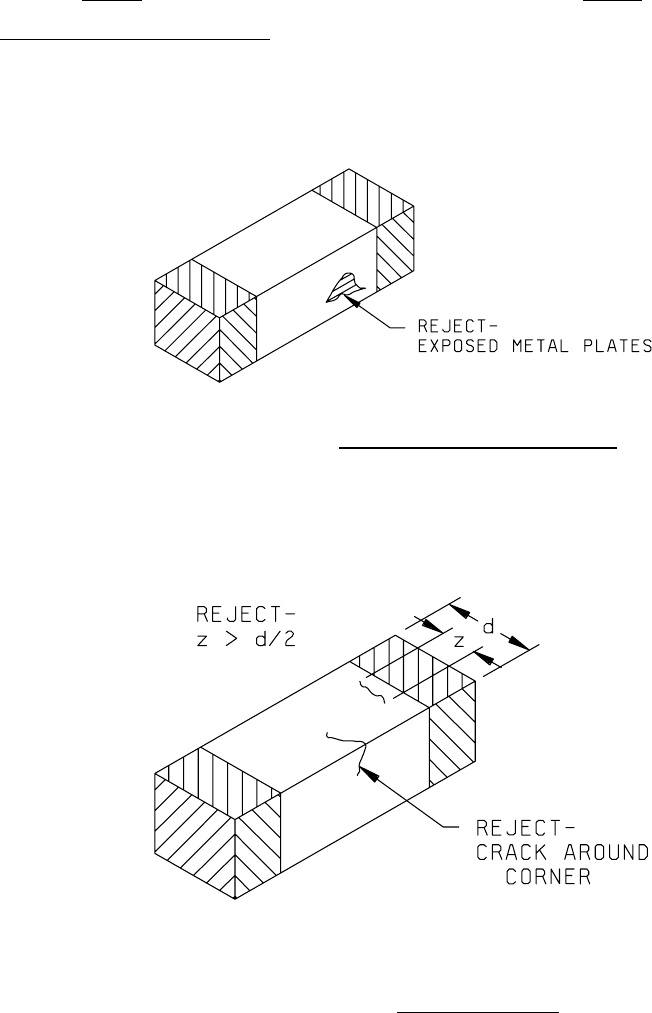
metal plates, (see figure 2032-55h).
FIGURE 2032-55h. Class H metal plate exposure criteria
.
b. Crack that is greater than 50 percent of the b. Crack.
width of the unmetallized sides, top, or NOTE: No cracks are allowed.
bottom, or that extends around a corner (see
figure 2032-56h).
FIGURE 2032-56h. Class H crack criteria
.