MIL- STD-883F 2004 TEST METHOD STANDARD MICROCIRCUITS.pdf - 第464页
MIL-STD-883F METHOD 2032.2 18 June 2004 58 Class H Class K 3.3.3 Cer amic c hip capac itor def ects "low magnific ation". No element s hall be ac ceptabl e that ex hibits: a. Cr ack , chip or void in t he body …

MIL-STD-883F
METHOD 2032.2
18 June 2004
57
Class H Class K
3.3.1 c. Lifting, blistering, or peeling 3.3.1 c. Same as class H.
of insulation.
d. Voids in metallized terminals that d. Same as class H.
expose underlying material over
greater than 25 percent of any side
of the metallized terminal area.
3.3.2 Foreign material defects "low magnification"
.
No element shall be acceptable that exhibits:
a. For mounted elements, unattached, conductive a. Same as class H.
foreign material on the surface of the
element. For unmounted elements, unattached,
conductive foreign material on the surface of
the element that is large enough to bridge
operating metallization path, active circuitry,
or any combination of these.
NOTE: If an element has an insulating layer
(such as glassivation) that covers operating
metallization paths, active circuitry, or any
combination of these, then the presence of
unattached conductive foreign material that is
large enough to bridge these features is
acceptable since the features are protected by
the insulating layer.
NOTE: All foreign material shall be considered
to be unattached unless otherwise verified to
be attached. Verification of attachment shall
be accomplished by a light touch with an
appropriate mechanical device (i.e., needle,
probe, pick, etc.) by a suitable cleaning
process approved by the acquiring activity,
or by a blow-off with a nominal gas blow
(approximately 20 psig).
NOTE: Semiconductor particles are
considered to be foreign material.
NOTE: Removal of unattached foreign
material may be attempted using the
techniques for verification of
attachment discussed above.
b. Attached, conductive foreign material that b. Same as class H.
bridges metallization paths, active circuitry,
or any combination of these.
c. Liquid droplets, inkdrops, or any chemical c. Same as class H.
stain that appear to bridge any
unglassivated active circuit areas.
d. Attached foreign material that covers more d. Same as class H.
than 25 percent of a bonding pad area.
MIL-STD-883F
METHOD 2032.2
18 June 2004
58
Class H Class K
3.3.3 Ceramic chip capacitor defects "low
magnification". No element shall be acceptable that
exhibits:
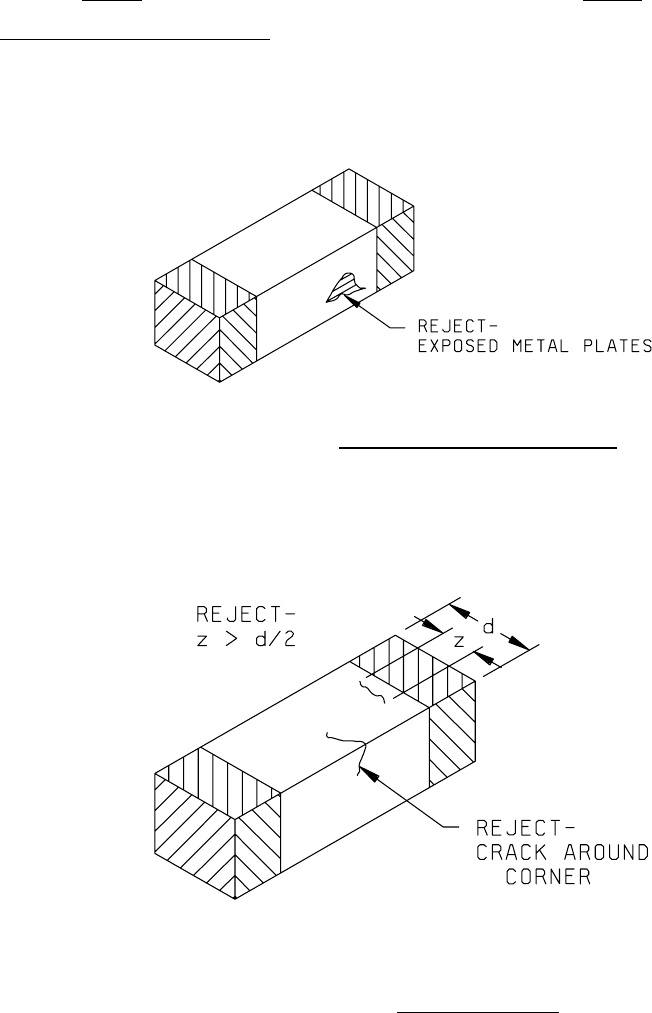
a. Crack, chip or void in the body that exposes a. Same as class H.
metal plates, (see figure 2032-55h).
FIGURE 2032-55h. Class H metal plate exposure criteria
.
b. Crack that is greater than 50 percent of the b. Crack.
width of the unmetallized sides, top, or NOTE: No cracks are allowed.
bottom, or that extends around a corner (see
figure 2032-56h).
FIGURE 2032-56h. Class H crack criteria
.
MIL-STD-883F
METHOD 2032.2
18 June 2004
59
Class H Class K
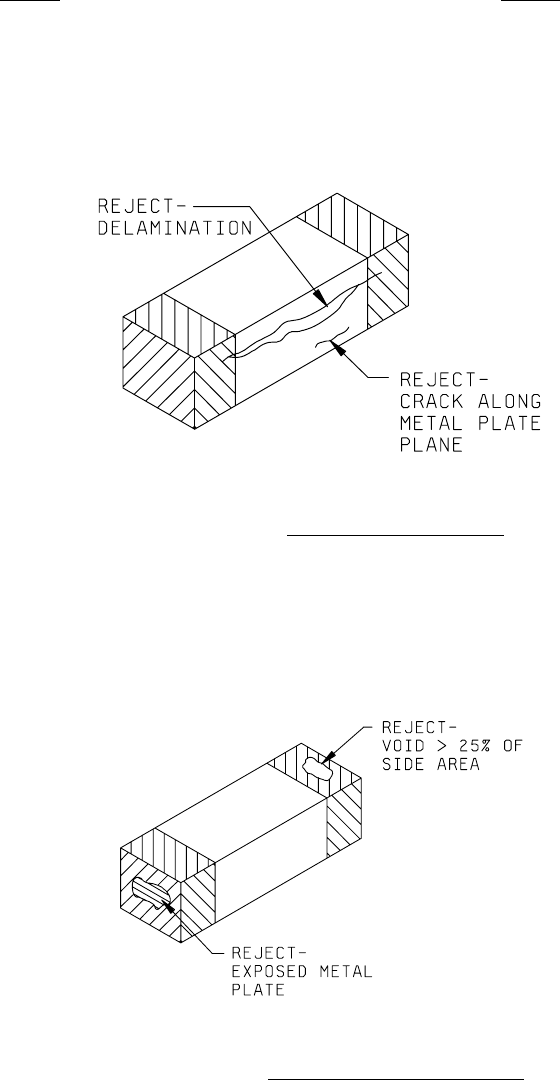
3.3.3 c. Evidence of separation (delamination) of 3.2.3 c. Delamination.
metal plates or cracks along the plane of
the metal plates (see figure 2032-57h).
NOTE: Narrow grooves or channel less than NOTE: No delamination is allowed.
1.0 mil wide that exhibit a glass-like
appearance and do not expose metal
plates are acceptable.
FIGURE 2032-57h. Class H delamination criteria
.
d. Crack or void in the metallization d. Same as class H.
that exposes metal plates,
or voids that are greater than 25 percent
of the area of the metallized
terminal (see figure 2032-58h).
FIGURE 2032-58h. Class H termination defect criteria
.