MIL- STD-883F 2004 TEST METHOD STANDARD MICROCIRCUITS.pdf - 第479页
MIL-STD-883F METHOD 3001.1 15 November 1974 1 METHOD 3001.1 DRIVE SOURCE, DYNAMIC 1. PURPOSE . This method est ablis hes a dri ve sourc e to be used i n measuri ng dynamic per form ance of di gital micr oelect ronic devi…
MIL-STD-883F
METHOD 2035
19 August 1994
6
This page intentionally left blank

MIL-STD-883F
METHOD 3001.1
15 November 1974
1
METHOD 3001.1
DRIVE SOURCE, DYNAMIC
1. PURPOSE
. This method establishes a drive source to be used in measuring dynamic performance of digital
microelectronic devices, such as TTL, DTL, RTL, ECL, and MOS.
2. APPARATUS
. The drive source shall supply a smooth transition between specified voltage levels. The signal
characteristics shall not vary outside of their prescribed tolerances when interfaced with the device under test (device in the
test socket).
3. PROCEDURE
. The drive source shall be measured at the input terminal of the test socket (no device in the test
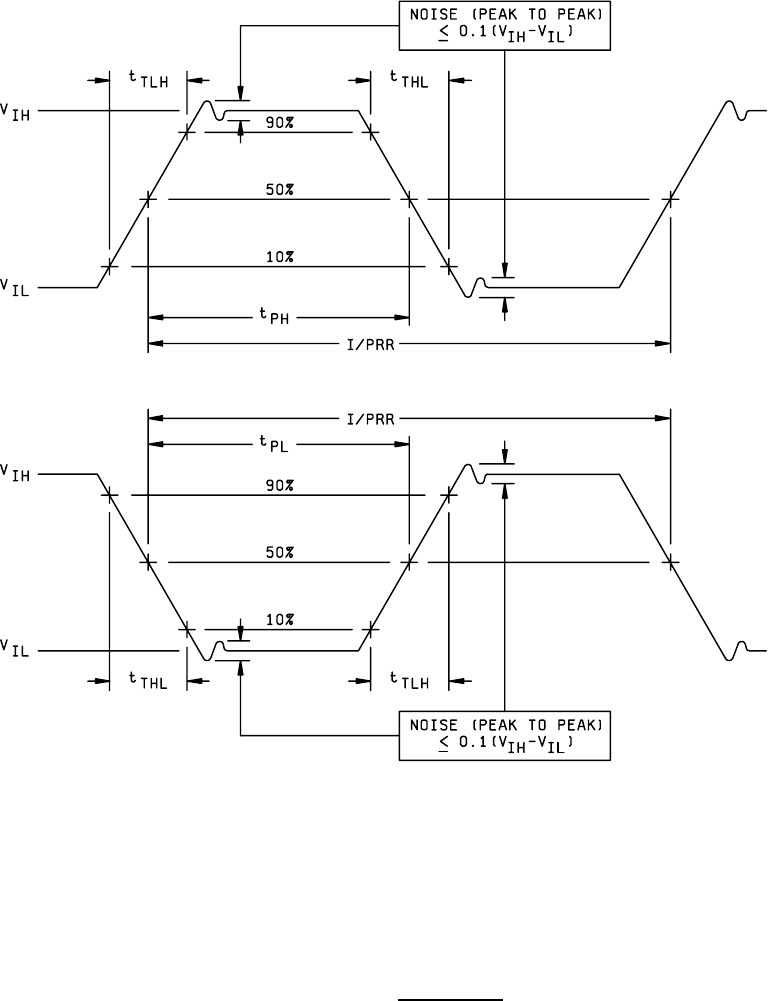
socket). Figure 3001-1 shows typical driving source waveforms and should be used specifying the parameters shown,
unless otherwise stated in the applicable acquisition document.
3.1 Pulse amplitude
. The specified HIGH level of the driving source shall be greater than the V
OH
of the device. The
specified LOW level of the driving source shall be less than V
OL
of the device.
3.2 Transition times
. The transition times of the driving source (t
THL
and t
TLH
) shall be faster than the transition time of the
device being tested, unless otherwise stated in the acquisition document. The transition times shall normally be measured
between the 10 percent and 90 percent levels of the specified pulse.
3.3 Pulse repetition rate (PRR)
. Unless the pulse repetition rate is the parameter being tested, it shall be chosen so that
doubling the rate or reducing by a half will not affect the measurement results.
3.4 Duty factors (duty cycles)
. The duty cycles of the driving source shall be chosen so that a 10 percent variation in the
duty cycle will not affect the measurement results. The duty cycle shall be defined with respect to either a positive or
negative pulse. The pulse width (t
p
) of the input pulses shall be measured between the specified input measurement levels.
When more than one pulse input is needed to test a device, the duty cycle of the prime input (i.e., clock, etc.) shall be
specified. The phase relationship of all other input pulses shall be referenced to the prime input pulse.
4. SUMMARY
. The following details, when applicable, shall be specified in the applicable acquisition document:
a. Levels V
IL
and V
IH
.
b. Driving signal transition times.
c. Pulse repetition rate.
d. Duty factors.
e. Recommended pulse generator, if required.
f. Input measurement levels, if other than those shown in figure 3001-1.
MIL-STD-883F
METHOD 3001.1
15 November 1974
2
FIGURE 3001-1. Drive sources
.