MIL- STD-883F 2004 TEST METHOD STANDARD MICROCIRCUITS.pdf - 第48页
MIL-STD-883F METHOD 1008.2 25 August 1993 2 TABLE I. St abilizat ion bake t ime temper ature regr ess ion . Minimum temper ature Minimum ti me (hours ) °C Equivalent t est c onditi on C durati on 1 / 100 2/ 1,000 125 2/ …

MIL-STD-883F
METHOD 1008.2
25 August 1993
1
METHOD 1008.2
STABILIZATION BAKE
1. PURPOSE
. The purpose of this test is to determine the effect on microelectronic devices of storage at elevated
temperatures without electrical stress applied. This method may also be used in a screening sequence or as a
preconditioning treatment prior to the conduct of other tests. This test shall not be used to determine device failure rates for
other than storage conditions. It may be desirable to make end point and, where applicable, intermediate measurements on
a serialized device basis or on the basis of a histogram distribution by total sample in order to increase the sensitivity of the
test to parameter degradation or the progression of specific failure mechanisms with time and temperature.
2. APPARATUS
. The apparatus required for this test shall consist of a controlled temperature chamber capable of
maintaining the specified temperature and suitable electrical equipment to make the specified end point measurements.
3. PROCEDURE
. The device shall be stored at the specified ambient conditions for the specified time. The time at high
temperature shall be sufficient to allow the total mass of each device under test to reach the specified temperature before
the specified time duration begins. Within the time interval of 24 hours before (0 hours before test durations less than 250
hours) to 72 hours after the specified duration of the test, the device shall be removed from the specified ambient test
condition and allowed to reach standard test conditions. When specified, end-point measurements shall be completed
within 96 hours after removal of device from the specified ambient test condition. When specified (or at the manufacturer's
discretion, if not specified) intermediate measurements shall be made at intermediate points.
3.1 Test condition
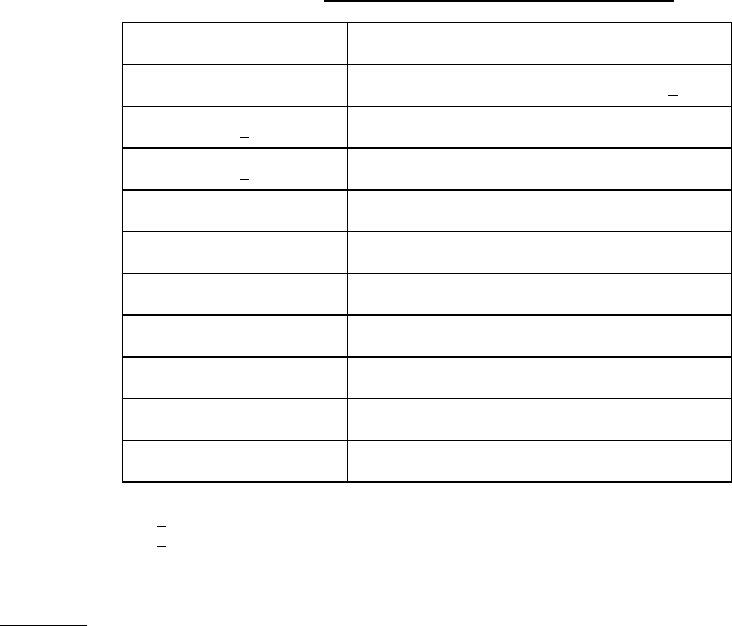
. The ambient test temperature shall be indicated by specifying a test condition letter from the following
table. The specified test temperature is the minimum actual ambient temperature to which all devices in the working area of
the chamber are exposed. This shall be assured by making whatever adjustments are necessary in the chamber profile,
loading, location of control or monitoring instruments, and the flow of air or other chamber atmosphere. Therefore,
calibration, shall be accomplished on the chamber in a fully, loaded, unpowered configuration, and the indicator sensor
located at, or adjusted to reflect, the coldest point in the working area. Unless otherwise specified, test condition C
minimum, with a minimum time duration and temperature as specified in table I, shall apply. Unless otherwise specified, the
test duration for all other test conditions shall be 24 hours minimum.
Test condition
Temperature (minimum)
A 75°C
B 125°C
C See table I
D 200°C
E 250°C
F 300°C
G 350°C
H 400°C
MIL-STD-883F
METHOD 1008.2
25 August 1993
2
TABLE I. Stabilization bake time temperature regression
.
Minimum temperature Minimum time (hours)
°C Equivalent test condition C duration 1/
100 2/ 1,000
125 2/ 168
150 24
155 20
160 16
165 12
170 8
175 6
200 6
1
/ The only allowed conditions are as stated above.
2
/ These time-temperature combinations may be used for
hybrid microcircuits only.
4. SUMMARY
. The following details shall be specified in the applicable acquisition document:
a. Test condition letter if other than test condition C (see 3.1).
b. Test duration if other than 24 hours (see 3.1).
c. End point measurements, if applicable (see 3).
d. Intermediate measurements, if applicable (see 3).
e. Maximum test temperature rating, if applicable.

MIL-STD-883F
METHOD 1009.8
22 March 1989
1
METHOD 1009.8
SALT ATMOSPHERE (CORROSION)
1. PURPOSE
. This test is proposed as an accelerated laboratory corrosion test simulating the effects of seacoast
atmosphere on devices and package elements.
1.1 Terms and definitions
.
1.1.1 Corrosion
. Corrosion is the deterioration of coating or base metal or both by chemical or electrochemical action.
1.1.2 Corrosion site
. A corrosion site is the site at which the coating or base metal or both is corroded. The location of
corrosion.
1.1.3 Corrosion product (deposit)
. The effect of corrosion (i.e., rust or iron oxide, nickel oxide, tin oxide, etc.). The
product of corrosion may be at the corrosion site, or may flow or run (due to action of liquid carrier of salt) so as to cover
noncorroded areas.
1.1.4 Corrosion stain
. Corrosion stain is a semitransparent deposit due to corrosion products.
1.1.5 Blister
. A blister is a localized swelling and separation between the coating(s) and base metal.
1.1.6 Pinhole
. A pinhole is a small hole occurring in the coating as an imperfection which penetrates entirely through the
coating.
1.1.7 Pitting
. Pitting is the localized corrosion of coating or base metal or both, confined to a point or small area, that
takes the form of cavities.
1.1.8 Flaking
. Flaking is the separation of small pieces of coating that exposes the base metal.
2. APPARATUS
. Apparatus used in the salt-atmosphere test shall include the following:
a. Exposure chamber with fixtures for supporting devices. The chamber and all accessories shall be made of
material (glass, plastic, etc.) which will not affect the corrosiveness of the salt atmosphere. All parts within the
test chamber which come in contact with test specimens shall be of materials that will not cause electrolytic
corrosion. The chamber shall be properly vented to prevent pressure build-up and allow uniform distribution of
salt fog.
b. Salt solution reservoir adequately protected from the surrounding ambient. If necessary, auxiliary reservoirs may
be used for long duration tests in accordance with test conditions C and D (see 3.2).
c. Means for atomizing the salt solution, including suitable nozzles and compressed air or a 20 percent oxygen, 80
percent nitrogen mixture (the gas entering the atomizers shall be free from all impurities such as oil and dirt).
d. Chamber-heating means and controls.
e. Means for humidifying the air at temperature above the chamber temperature.
f. Air or inert gas dryer.
g. Magnifier(s) 1X to 3X, 10X to 20X and 30X to 60X.