MIL- STD-883F 2004 TEST METHOD STANDARD MICROCIRCUITS.pdf - 第682页
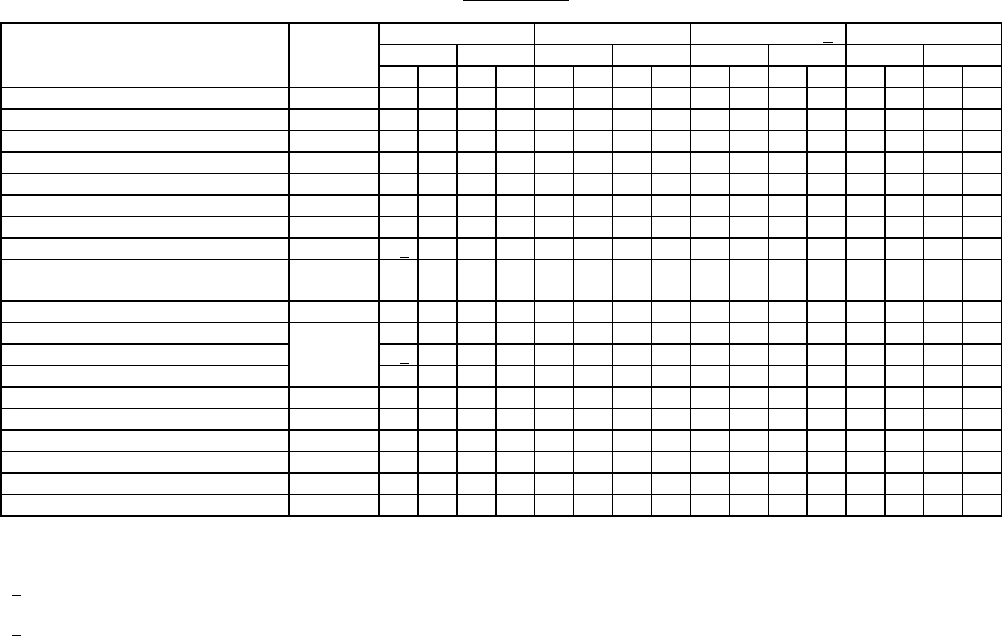
MIL-STD-883F METHOD 5011.4 31 October 1995 2 TABLE I. Requir ement s Test or Conditi on Test Adhesives α Absorbers Fil m Dielec trics 1 / Particle Getters Method Supplier User Suppl ier User Suppl ier User Suppl ier User…

MIL-STD-883F
METHOD 5011.4
31 October 1995
1
METHOD 5011.4
EVALUATION AND ACCEPTANCE PROCEDURES FOR POLYMERIC MATERIALS
1. Purpose
. This method establishes the minimum inspection procedures and acceptance criteria for polymeric materials
used in microcircuit applications. These materials shall be classified in two types as follows:
a. Type I being electrically conductive.
b. Type II being electrically insulative.
1.1 The user may elect to supplement Quality Conformance Inspection (QCI) test data or Qualification Testing data as a
substitute where applicable for user Certification Testing.
2. Apparatus
. Suitable measurement equipment necessary to determine compliance with the requirements of the
applicable acquisition document and other apparatus as required in the referenced test methods.
3. Procedures
.
3.1 Material acquisition specification
. The microcircuit manufacturer shall prepare an acquisition specification describing
the detailed electrical, mechanical, chemical, and thermal requirements for the polymeric material to be acquired. The
requirements shall not be less than those imposed by this method, but may be increased to reflect the specific parameters of
a particular material or the requirements of a particular application.
3.2 Certificate of compliance
. The material supplier shall provide upon the users request a certificate of compliance for
each polymeric material order. This certificate shall contain the actual test data for the supplier's testing as prescribed in this
document.
3.3 Evaluation procedures
. Evaluation procedures for polymeric materials shall be performed as specified in 3.4.1
through 3.5.13 for the type of material being tested.
3.4 Properties of uncured materials
.
3.4.1 Materials
. The components of a polymeric material and/or system shall be examined in accordance with table I and
3.8.1 and shall be uniform in consistency and free of lumps or foreign matter when examined in film, liquid or other
acceptable form. Any filler shall remain uniformly dispersed and suspended during the required pot life (see 3.8.3). The
electrically conductive fillers used in type I materials shall be gold, silver, alloys of gold or silver, or other precious metals.
3.4.1.1 Encapsulating compounds
Encapsulating compounds are liquidous material and are to be tested in accordance
with the requirements in Table I.
3.4.1.2 Molding compounds.
Molding compounds as used in microelectronic devices are normally solidous material and
are to be tested in accordance with MIL-PRF-38535, Appendix H Tables H-IB and H-IIB.
3.4.2 Viscosity
. The viscosity of paste materials shall be determined in accordance with 3.8.2. The viscosity, including an
acceptable range, shall be specified in the material acquisition document.
3.4.3 Pot life
. The pot life when required shall be determined in accordance with 3.8.3 and shall be a minimum of 1 hour.
The polymeric material shall be used within the pot life period after removal from the container, after mixing, or after thawing
to room temperature in the case of premixed frozen polymers.
3.4.4 Shelf life
. The shelf life, defined as the time that the polymeric material continues to meet the requirements of this
specification shall be determined in accordance with 3.8.4. This shelf life shall be a minimum of 12 months at -40°C or
below for one component system and a minimum of 12 months at room temperature (32°C maximum) for two component
systems unless the supplier certifies for some other period of time. For class K devices, no polymeric material shall be used
after the expiration date. Materials in class H devices may be requalified once, with acquiring activity and qualifying activity
approval. Encapsulants shall have a minimum shelf life of 6 months.
MIL-STD-883F
METHOD 5011.4
31 October 1995
2
TABLE I. Requirements
Test or Condition Test Adhesives α Absorbers Film Dielectrics 1
/
Particle Getters
Method Supplier
User Supplier
User Supplier
User Supplier
User
Paragraph
A C A C A C A C A C A C A C A C
Materials (3.4.1) 3.8.1 X X X X X X X X X X X X X X X X
Viscosity (3.4.2) 3.8.2 X X X X X X
Pot Life (3.4.3) 3.8.3 X X X X X X
Shelf Life (3.4.4) 3.8.4 X X X X
Thermogravimetric analysis (3.5.2) 3.8.5 X X X X X X X
Outgassed materials (3.5.3) 3.8.6 X X X X
Ionic impurities(3.5.4) 3.8.7 X X X X X X
Bond strength (3.5.5) 3.8.8 X 2/
X X
Coefficient of linear thermal
expansion (3.5.6)
3.8.9 X
Thermal conductivity (3.5.7) 3.8.10 X
Volume resistivity (3.5.8) 3.8.11 X
Type 1 materials X 2/
X
Type 2 materials X X X X X
Dielectric constant (3.5.9) 3.8.12 X X
Dissipation factor (3.5.10) 3.8.13 X X
Sequential test environment (3.5.11) 3.8.14 X X X
Density (3.5.12) 3.8.15
Mechanical integrity (3.5.13) 3.8.16 X
Operating life test (3.5.14) 3.8.17 X
A= Performed at acceptance testing.
C= Performed at certification testing.
1
/ Film dielectrics are defined as polymeric materials that are used in film form to act as either interlayer dielectrics,
passivation layers, and/or circuit support films.
2
/ Required at 25
o
C test condition only. No high temperature storage required.
MIL-STD-883F
METHOD 5011.4
31 October 1995
3
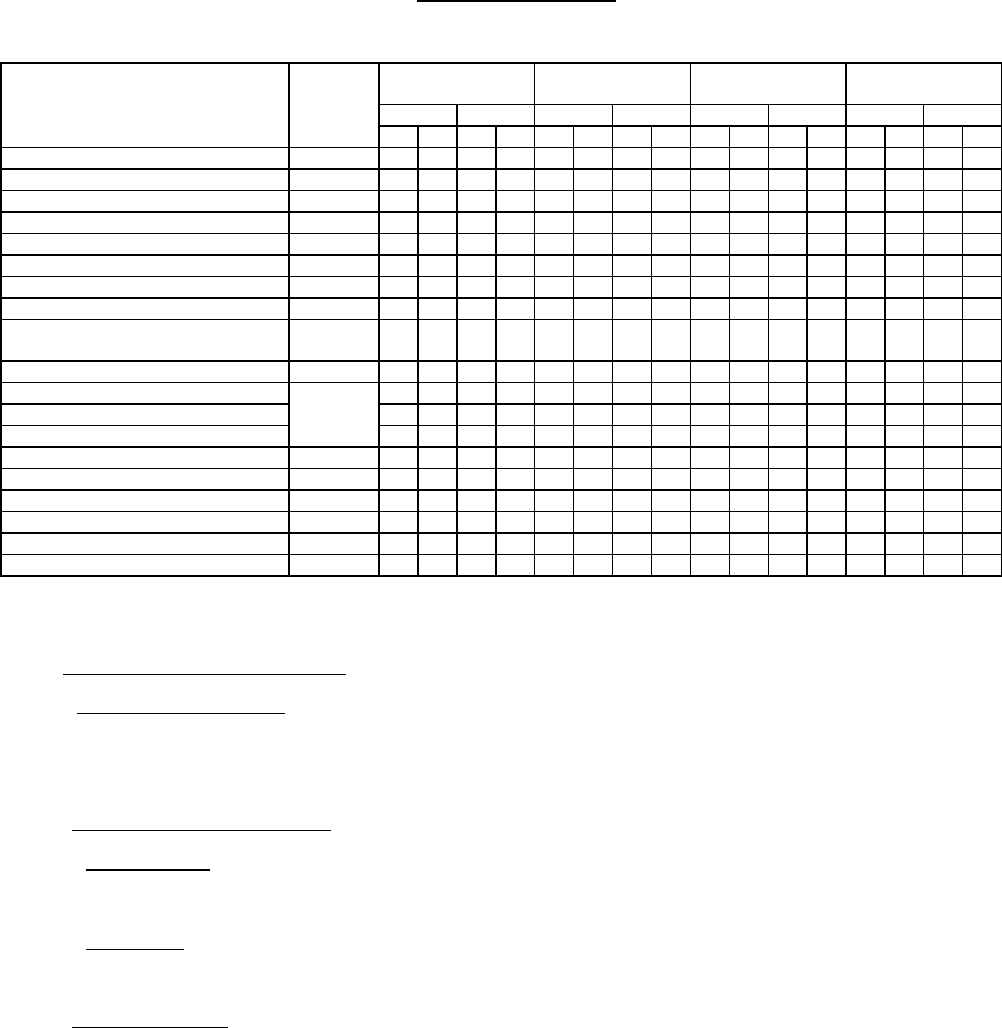
TABLE I. Requirements (Continued)
Test or Condition Test
Method
Dessicants Junction Coatings T-Wave Absorbers
Encapsulating
Compounds
Paragraph
Supplier
User Supplier
User Supplier
User Supplier
User
A C A C A C A C A C A C A C A C
Materials (3.4.1) 3.8.1 X X X X X X X X X X X X X X X X
Viscosity (3.4.2) 3.8.2 X
Pot Life (3.4.3) 3.8.3
Shelf Life (3.4.4) 3.8.4 X X X
Thermogravimetric analysis (3.5.2) 3.8.5 X X X X X
Outgassed materials (3.5.3) 3.8.6 X X X
Ionic impurities(3.5.4) 3.8.7 X X X X X
Bond strength (3.5.5) 3.8.8 X X
Coefficient of linear thermal
expansion (3.5.6)
3.8.9 X
Thermal conductivity (3.5.7) 3.8.10 X
Volume resistivity (3.5.8) 3.8.11 X
Type 1 materials
Type 2 materials X X X
Dielectric constant (3.5.9) 3.8.12 X
Dissipation factor (3.5.10) 3.8.13 X
Sequential test environment (3.5.11) 3.8.14 X X
Density (3.5.12) 3.8.15 X X X X
Mechanical integrity (3.5.13) 3.8.16
Operating life test (3.5.14) 3.8.17 X X
A= Performed at acceptance testing.
C= Performed at certification testing.
3.5 Properties of cured polymer materials
.
3.5.1 Curing of polymer materials
. The material must be capable of meeting the requirements of this document when
cured according to the supplier's instructions. The cure schedule for supplier tests shall be identical for all tests and shall be
reported. The cure schedule for the user tests shall be the minimum cure schedule plus, as a minimum, the pre-seal bake
specified in the user's assembly document and shall be reported. Deviation from the suppliers recommended cure schedule
will require verification by the user of the materials performance.
3.5.2 Thermogravimetric analysis (TGA)
.
3.5.2.1 Thermal stability
. The thermal stability of the cured material shall be determined in accordance with 3.8.5. Unless
otherwise noted, the weight loss at 200°C shall be less than or equal to 1.0 percent of the cured material weight. Equivalent
standard, i.e., "classical analytical techniques" are acceptable.
3.5.2.2 Filler content
. Polymeric materials using a filler to promote properties such as electrical and thermal conductivity
shall be tested in accordance with 3.8.5 to determine the inorganic filler content. For acceptance testing, the percent filler
content shall not differ from the filler content in the certified materials by more than ±2 percent.
3.5.3 Outgassed materials
. Outgassing of the cured material shall be determined in accordance with 3.8.6. Outgassed
moisture, as determined in 3.8.6.1, shall be less than or equal to 5,000 ppmv (0.5 percent V/V) for 3 packages (0 failures) or
5 packages (1 failure). Other gaseous species present in quantities greater than or equal to 100 ppmv (0.01 percent V/V)
shall be reported in ppmv or percent V/V. The data obtained in 3.8.6.2 shall also be reported in the same manner but for
information only. The outgassing of the cured getter shall be determined in accordance with 3.8.6. The vapor content of the
package with getter shall not exceed 2000 ppmv after 24 hours at 150°C and 3000 ppmv after 1000 hours at 150°C.