MIL- STD-883F 2004 TEST METHOD STANDARD MICROCIRCUITS.pdf - 第85页
MIL-STD-883F METHOD 1014.11 18 June 2004 5 TABL E II. Fix ed c onditions for tes t c ondition A 1 . Volume of package ( V) in cm 3 Bomb condit ion R 1 Rej ect limit (atm cc/s He ) Psia ± 2 Minimum exposure ti me hours ( …

MIL-STD-883F
METHOD 1014.11
18 June 2004
4
3. PROCEDURE
. Fine and gross leak tests shall be conducted in accordance with the requirements and procedures of
the specified test condition. Testing order shall be fine leak (condition A or B or C
5
) followed by gross leak (condition C
1
, C
3
,
C
4
, D, or E) except when C
4
is used together with A, B, or C
5
. When specified (see 4), measurements after test shall be
conducted following the leak test procedures. Where bomb pressure specified exceeds the microcircuit package capability,
alternate pressure, exposure time, and dwell time conditions may be used provided they satisfy the leak rate, pressure, time
relationships which apply, and provided a minimum of 30 psia (2 atmospheres absolute) bomb pressure is applied in any
case or for condition C
4
, a minimum of 10 psi differential test pressure is applied in any case. When test condition A
4
is
used, gross leak testing is not required. However A
4
shall not be used in lieu of the required seal testing of lidded packages.
When batch testing (more than one device in the leak detector at one time) is used in performing test condition A or B and a
reject condition occurs it shall be noted as a batch failure. Each device may then be tested individually one time for
acceptance if all devices in the batch are retested within one hour after removal from the tracer gas pressurization chamber.
For condition B only, devices may be batch retested for acceptance providing all retesting is completed within one hour after
removal from the tracer gas pressurization chamber. For condition C
3
only, devices that are batch tested, and indicate a
reject condition, may be retested individually one time using the procedure of 3.3.3.1 herein, except that repressurization is
not required if the devices are immersed in detector fluid within 20 seconds after completion of the first test, and they remain
in the bath until retest. For conditions C
4
and C
5
only, the package must meet lid stiffness requirements defined in 3.6.1.
This includes devices that are conformal coated such as circuit board assemblies.
3.1 Test condition A
1
, A
2
, or A
4
tracer gas (He) fine leak. Test condition A
1
is a "fixed" method with specified conditions in
accordance with table II that will ensure the test sensitivity necessary to detect the required measured leak rate (R
1
) . Test
condition A
2
is a "flexible" method that allows the variance of test conditions in accordance with the formula of 3.1.1.2 to
detect the specified equivalent standard leak rate (L) at a predetermined leak rate (R
1
). Test condition A
4
is a method that
will detect the required measured leak rate (R
1
) of an unsealed package.
3.1.1 Test conditions A
1
and A
2
, procedure applicable to "fixed" and "flexible" methods. The completed device(s), shall be
placed in a sealed chamber which is then pressurized with a tracer gas of 100 +0, -5 percent helium for the required time
and pressure. The pressure shall then be relieved and each specimen transferred to another chamber or chambers which
are connected to the evacuating system and a mass-spectrometer-type leak detector. When the chamber(s) is evacuated,
any tracer gas which was previously forced into the specimen will thus be drawn out and indicated by the leak detector as a
measured leak rate (R
1
). (The number of devices removed from pressurization for leak testing shall be limited such that the
test of the last device can be completed within 60 minutes for test condition A
1
or within the chosen value of dwell time t
2
for
test condition A
2
.)
Note: Flexible Method shall be used unless otherwise specified in the acquisition document, purchase order, or contract.
3.1.1.1 Test condition A
1
, fixed method. The devices(s) shall be tested using the appropriate conditions specified in table
II for the internal cavity volume of the package under test. The time t
1
is the time under pressure and time t
2
is the maximum
time allowed after release of pressure before the device shall be read. The fixed method shall not be used if the maximum
equivalent standard leak rate limit given in the acquisition document is less than the limits specified herein for the flexible
method.
*
*
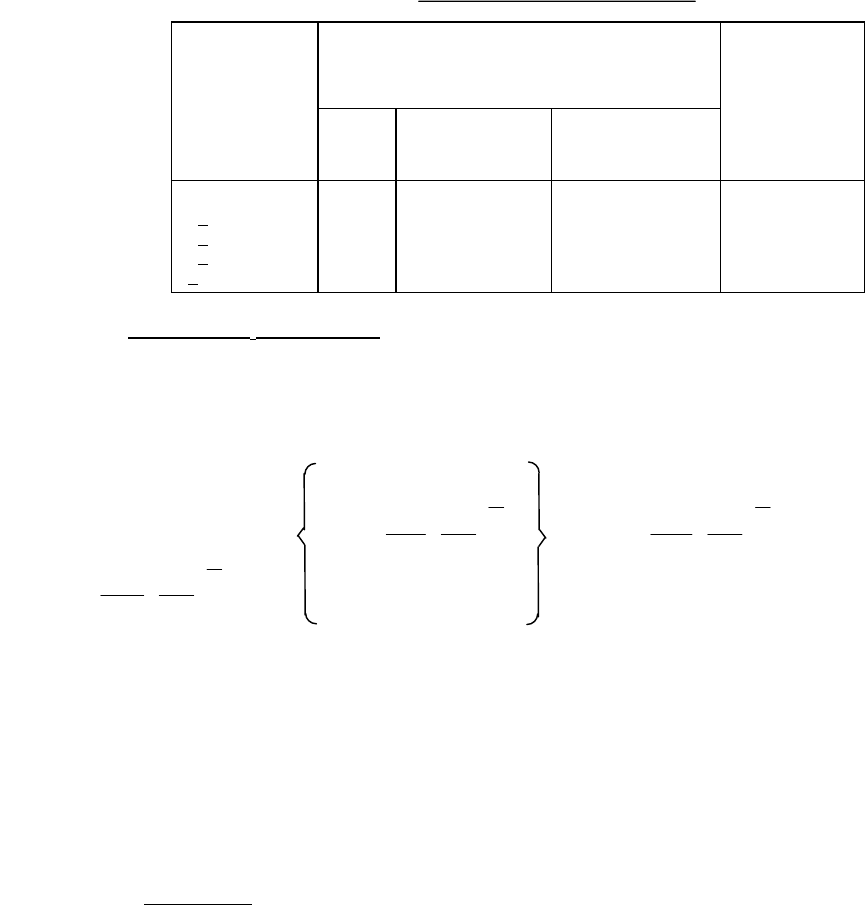
MIL-STD-883F
METHOD 1014.11
18 June 2004
5
TABLE II. Fixed conditions for test condition A
1
.
Volume of
package (V)
in cm
3
Bomb condition
R
1
Reject limit
(atm cc/s He)
Psia
±2
Minimum
exposure time
hours (t
1
)
Maximum dwell
hours (t
2
)
<0.05
>
0.05 - <0.5
>
0.5 - <1.0
>
1.0 - <10.0
>
10.0 - <20.0
75
75
45
45
45
2
4
2
5
10
1
1
1
1
1
5 x 10
-8
5 x 10
-8
1 x 10
-7
5 x 10
-8
5 x 10
-8
3.1.1.2 Test condition A
2
, flexible method. Values for bomb pressure exposure time, and dwell time shall be chosen such
that actual measured tracer gas leak rate (R
1
) readings obtained for the devices under test (if defective) will be greater than
the minimum detection sensitivity capability of the mass spectrometer. The devices shall be subjected to a minimum of 2
atmospheres absolute of helium atmosphere. The chosen values, in conjunction with the value of the internal volume of the
device package to be tested and the maximum equivalent standard leak rate (L) limit (as shown below or as specified in the
applicable acquisition document), shall be used to calculate the measured leak rate (R
1
) limit using the following formula:
R
LP
P
M
M
e
LT
VP
M
M
e
LT
VP
M
M
E
O
A
AA
1
1
0
2
0
1
2
1
1
2
1
2
=
⎛
⎝
⎜
⎞
⎠
⎟ −
−
⎛
⎝
⎜
⎞
⎠
⎟
⎡
⎣
⎢
⎢
⎢
⎢
⎤
⎦
⎥
⎥
⎥
⎥
−
⎛
⎝
⎜
⎞
⎠
⎟
⎡
⎣
⎢
⎢
⎢
⎢
⎤
⎦
⎥
⎥
⎥
⎥
Where:
R
1
= The measured leak rate of tracer gas (He) through the leak in atm cc/s He.
L = The equivalent standard leak rate in atm cc/s air.
P
E
= The pressure of exposure in atmospheres absolute.
P
O
= The atmospheric pressure in atmospheres absolute. (1)
M
A
= The molecular weight of air in grams. (28.7)
M = The molecular weight of the tracer gas (Helium) in grams. (4)
t
1
= The time of exposure to P
E
in seconds.
t
2
= The dwell time between release of pressure and leak detection, in seconds.
V = The internal volume of the device package cavity in cubic centimeters.
3.1.1.2.1 Failure criteria
. Unless otherwise specified, devices with an internal cavity volume of 0.01 cc or less shall be
rejected if the equivalent standard leak rate (L) exceeds 5 x 10
-8
atm cc/s air. Devices with an internal cavity volume greater
than 0.01 cc and equal to or less than 0.4 cc shall be rejected if the equivalent standard leak rate (L) exceeds 1 x 10
-7
atm
cc/s air. Devices with an internal cavity volume greater than 0.4 cc shall be rejected if the equivalent standard leak rate (L)
exceeds 1 x 10
-6
atm cc/s air.
*

MIL-STD-883F
METHOD 1014.11
18 June 2004
6
3.1.2 Test condition A
4
, procedure applicable to the unsealed package method. The fixture and fittings of 2.1a. shall be
mounted to the evacuation port of the leak detector. Proof of fixturing integrity shall be verified by sealing a flat surfaced
metal plate utilizing the gasket of 2.1 (and grease or fluid of 2.1 if required to obtain seal) and measuring the response of the
leak test system. Testing shall be performed by sealing the package(s) to the evacuation port and the package cavity
evacuated to 0.1 torr or less. Care shall be taken to prevent contact of grease with package (seal ring not included) to avoid
masking leaks. The external portion of the package shall be flooded with Helium gas either by the use of an envelope or a
spray gun, at a pressure of 10 psig.
3.1.2.1 Failure criteria
. Unless otherwise specified, devices shall be rejected if the measured leak rate (R
1
) exceeds 1 x
10
-8
atm cc/s He.
3.2 Test condition B, radioisotope fine leak test
.
3.2.1 Activation parameters
. The activation pressure and soak time shall be determined in accordance with the following
equation:
Q
R
s
kT
Pt
S
= ()1
The parameters of equation (1) are defined as follows:
Q
S
= The maximum leak rate allowable, in atm cc/s Kr, for the devices to be tested.
R = Counts per minute above the ambient background after activation if the device leak rate were exactly equal
to Q
S
. This is the reject count above the background of both the counting equipment and the component, if
it has been through prior radioactive leak tests.
s = The specific activity, in microcuries per atmosphere cubic centimeter, of the krypton-85 tracer gas in the
activation system.
k = The overall counting efficiency of the scintillation crystal in counts per minute per microcurie of krypton-85 in
the internal void of the specific component being evaluated. This factor depends upon component
configuration and dimensions of the scintillation crystal. The counting efficiency shall be determined in
accordance with 3.2.2.
T = Soak time, in hours, that the devices are to be activated.
P = P
e
2
-P
i
2
, where P
e
is the activation pressure in atmospheres absolute and P
i
is the original internal pressure
of the devices in atmospheres absolute. The activation pressure (P
e
) may be established by specification or
if a convenient soak time (T) has been established, the activation pressure (P
e
) can be adjusted to satisfy
equation (1).
t = Conversion of hours to seconds and is equal to 3,600 seconds per hour.
NOTE: The complete version of equation (1) contains a factor (P
O
2
- ( ∆P)
2
) in the numerator which is a correction factor for
elevation above sea level. P
O
is sea level pressure in atmospheres absolute and ∆P is the difference in
pressure, in atmospheres between the actual pressure at the test station and sea level pressure. For the purpose
of this test method, this factor has been dropped.