ts9800-user-guide-7511-0360_A.pdf - 第17页
17 The essential parameters are: Parameter Description Rise Time This is the ti me interval in w hi ch t he valve is open. The time increment is in 1 µs starting at 80 µs. The m ax imum risin g ti me is 199 9 µs. Open Ti…
16
5. OPERATION
5.1 Start Dispensing
The valve is now ready to dispense. Dispensing fluid (via cartridge/syringe
or reservoir) must be connect the supply pressure regulator.
Enter the desired dispensing parameters refer to section 7.5.5 (Rising, Open
Time, Falling, Delay, Needle Lift and Number of Pulses), then touch ‘Save’
icon. Information to the values can be found in the table for ‘essential
parameters’ on the page below.
To start the dispensing, touch the ‘Run’ icon or use external start
signal for both or dot mode. When in line mode start
can only be activate or trigger by an external devised.
Attention: To de-air (removal of air in the system) after going through a
calibration procedure in section 4.3. (e. g. after the change of
cartridge/syringe and/or after the remove of nozzle) use the Purge feature to
de-air. To purge touch and hold the ‘Purge’ icon it will run the
parameter in the current program, and it will run until the purge icon is let
go.
5.2 Parameter Settings for the dispensing process
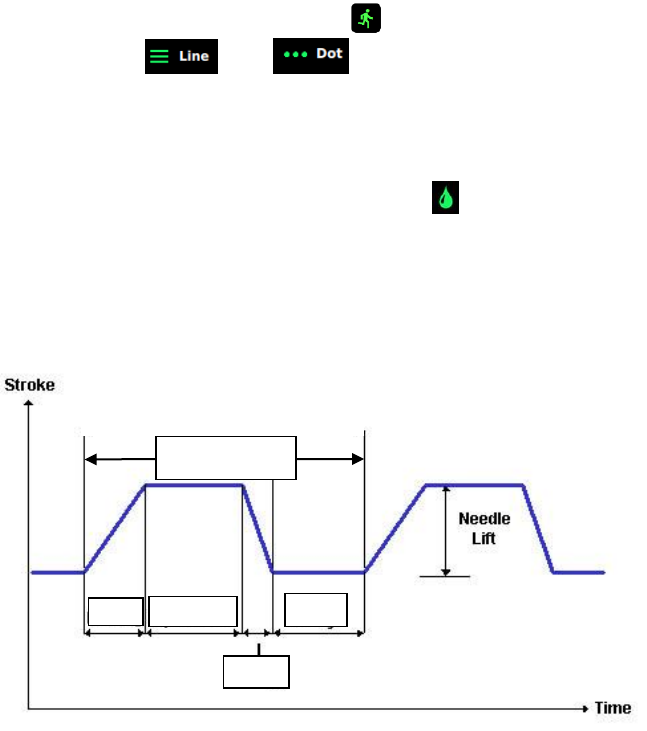
The TS9800 Jet Valve System works according to the control profile shown
below:
both
Figure 4: Control Curve
Delay
Open time
Rise
Fall
One Full Cycle
(Frequency)
17
The essential parameters are:
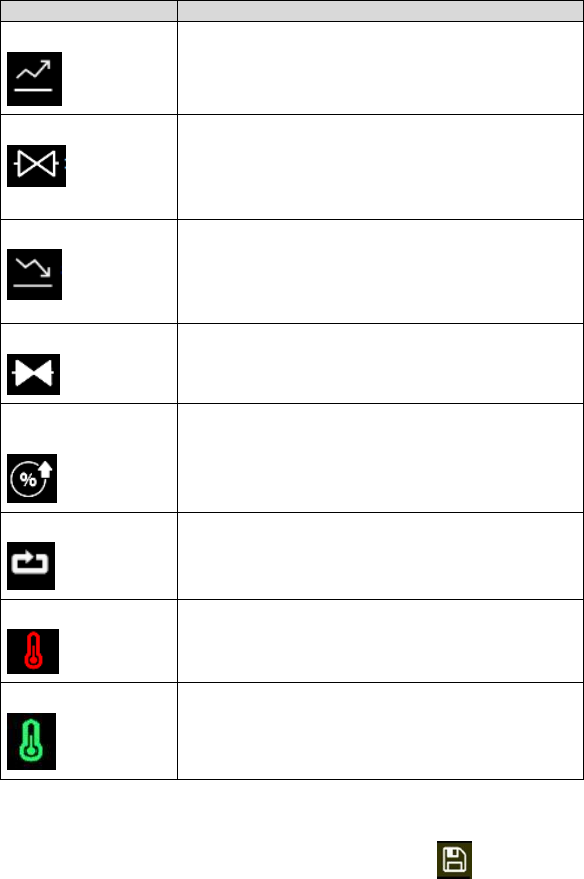
Parameter
Description
Rise Time
This is the time interval in which the valve is open.
The time increment is in 1 µs starting at 80 µs. The
maximum rising time is 1999 µs.
Open Time
This value defines the time in which the valve is
completely open. The value can be varied in steps of
1 µs. The minimum open time is 1 µs and the
maximum open time is 999999 µs.
Fall Time
During this time, the valve is closing and compressing
the media in the nozzle chamber. The time increment
is in 1 µs starting at 80 µs. The maximum falling
time is 1999 µs.
Delay Time
This is the time between two dispense pulses. It is
adjustable in 1 µs.
Percentage Lift (Lift
of Tappet)
This value corresponds to the stroke of the tappet. It is
entered in percent of the maximum stroke (100%).
Pulses
This value corresponds to the number of tappet stroke
per dispensing cycle in dot mode
Heater OFF
This indicate the heater manifold is Off
Heater ON
This indicate the heater manifold is ON (temperature
range is from 0-90 degree C, click on value next to
icon to adjust setting)
After entering the dispensing parameters, touch ‘Save’ icon to save all the
parameters to the current program location. You can then start your dispensing
process. Note: For more detail on how to enter the dispensing parameters,
refer to section 9.5.3.
Table 1 – Essential parameters

18
6. HEATING
6.1 Introduction
The TS9800 Jet Valve with heating system is available for heating high
viscosity fluid.
The heating system also helps to maintain constant temperature. Required
parts:
• TS9800 Jet Valve with heater
• Heater Cable
6.2 Safety Instructions
• Use the Jet Valve with heating system should only be done by
trained staff.
• Carefully review the material safety data from the dispensing
material.
• Wear adequate protective clothing before starting to dispense
aggressive fluid.
• Be cautious that the media you want to dispense is applicable for
use with a heating system.
Warning:
• When using the Jet Valve with heater, please consult with the
material manufacture for proper operating temperature.
• Be aware of the exposed surface and fittings on the manifold. Do
not touch the heater without protective wear. Failure to do so can
result in serious burn and/or injuries.
6.3 Function
Resistance
All hydrous solvents (Media,
organic acid and base)
*Maximum heater setting value
90 °C
Supply Voltage
24 VDC
Power consumption
15 W
*Displayed temperature may not reflect the actual dispensed temperature.