Nordson_EFD_OptiSure_Operating_Manual - 第34页
OptiSure Automated Optical Inspection 34 www.nordsonefd.com info@nordsonefd.com +1-401-431-7000 Sales and service of Nordson EFD dispensing systems are available worldwide. # Click Step Reference Image 8 > > • Inse…
OptiSure Automated Optical Inspection
33www.nordsonefd.com info@nordsonefd.com +1-401-431-7000 Sales and service of Nordson EFD dispensing systems are available worldwide.
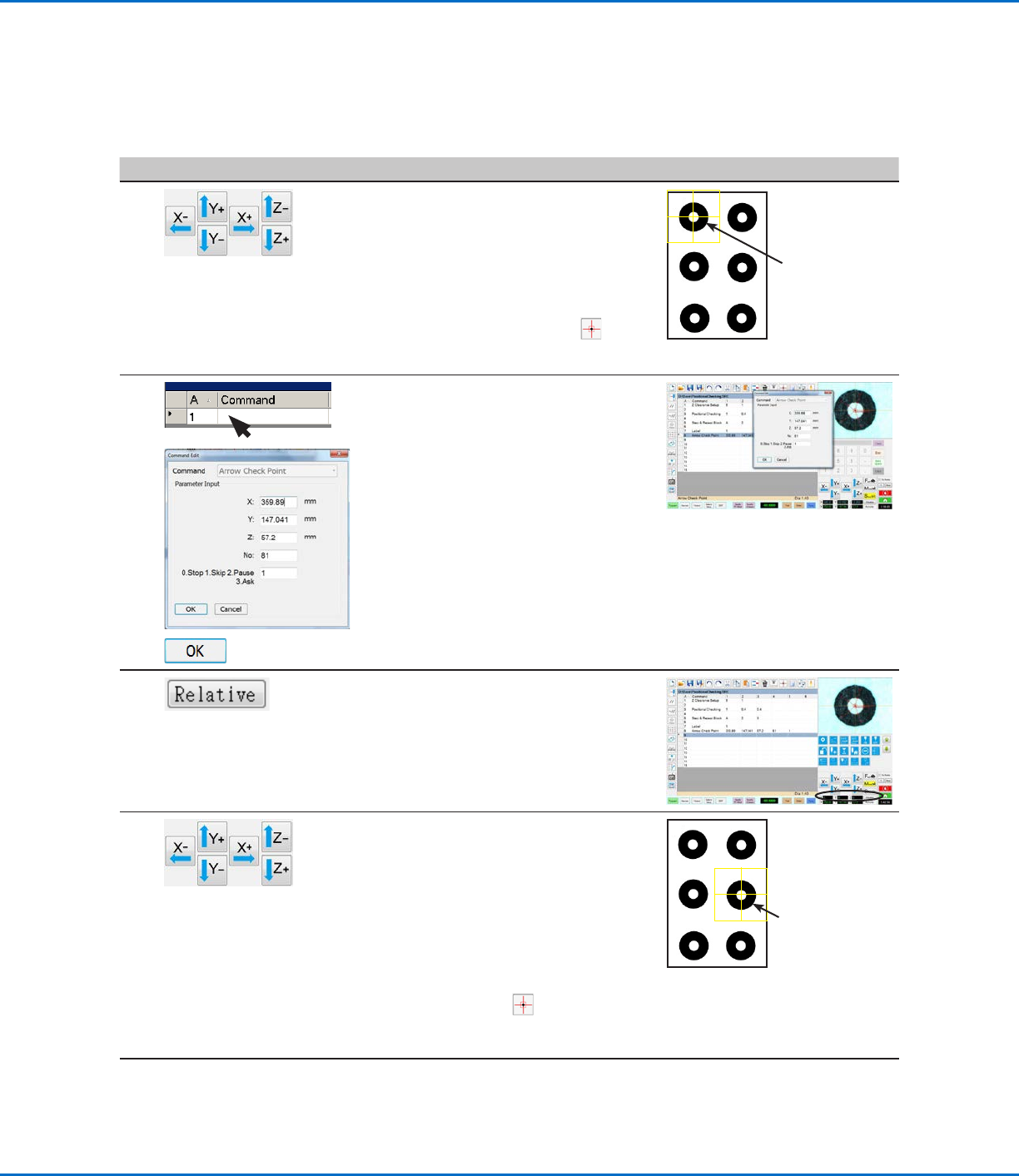
# Click Step Reference Image
4
• Jog the camera to center it directly
over the top left dot.
NOTE: Because this dot is the one
used during setup, the camera
should already be at this location.
• Focus the camera.
Tip: Click the Match icon ( ) to
cause the camera to center over the
mark.
Center the
camera over
this dot.
5
>
>
• Insert an Arrow Check Point
command and enter the following:
- NO.: 81
NOTE: This is the number of the
Mark Image that was saved in the
Mark Library during the previous
procedure. Use the correct Mark
Image No. for your program.
- 0.STOP 1.SKIP 2.PAUSE 3.ASK:
1 (for Skip, so the system will
continue through the program
without stopping in order to
demonstrate this feature)
• Click OK.
6 • Click RELATIVE to set the
coordinates to 0, 0, 0.
7 • If you already know the X and Y
offsets of each dot (how far away
each dot is from another dot), then
skip this step.
• To determine the X and Y offsets of
each dot, jog the camera to center
it directly over the dot located in the
2nd row, 2nd column.
Tip: When at the second dot, click
the Match icon ( ) to center the
camera over the mark.
• Make a note of the offsets.
Center the
camera over
this dot.
Continued on next page
Using the Arrow Types (continued)
Positional Checking Example (continued)
To Use Positional Checking in a Program (continued)
OptiSure Automated Optical Inspection
34 www.nordsonefd.com info@nordsonefd.com +1-401-431-7000 Sales and service of Nordson EFD dispensing systems are available worldwide.
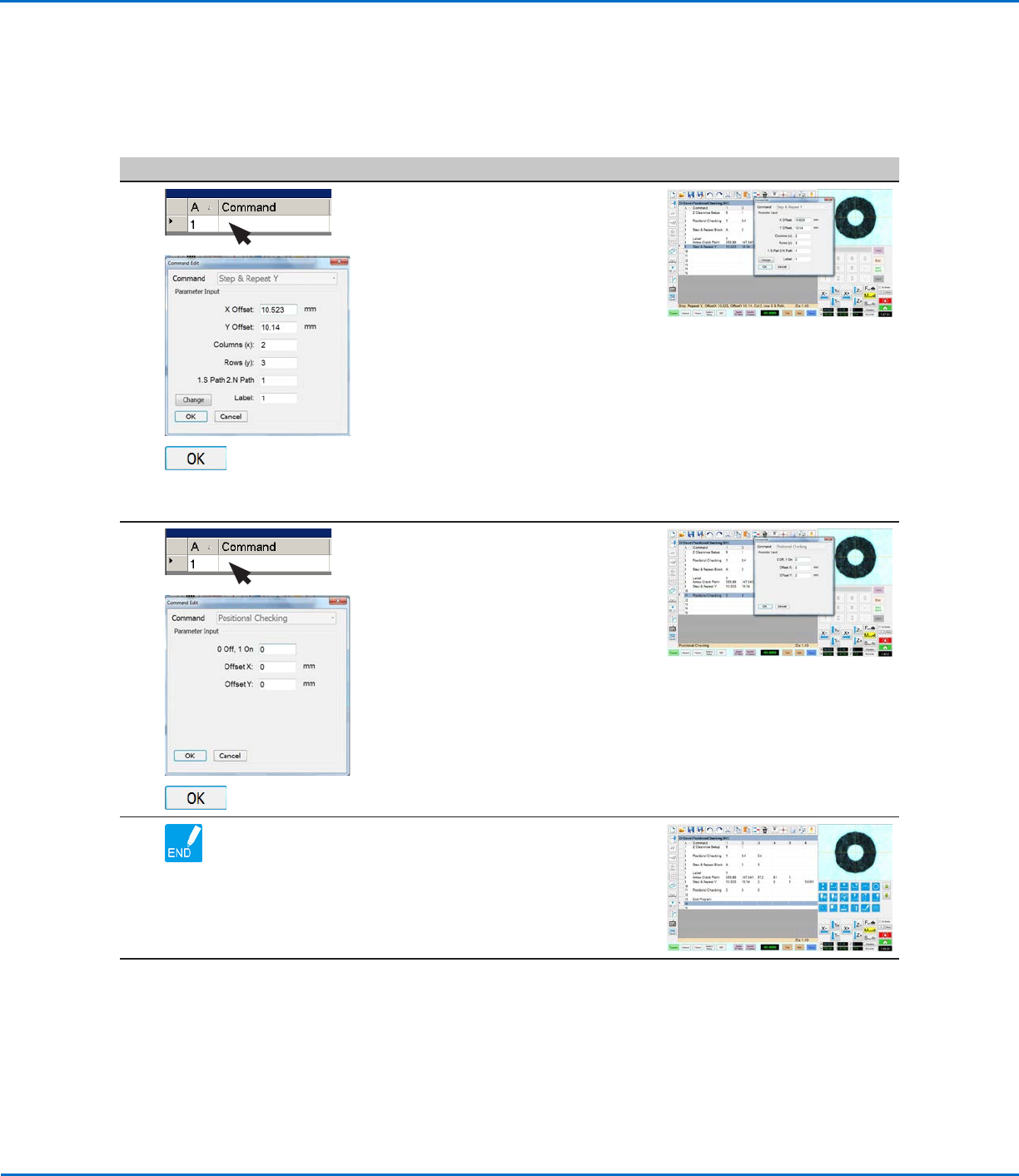
# Click Step Reference Image
8
>
>
• Insert a Step & Repeat Y command
and enter the following:
- X OFFSET: Determined in step 7
on page33.
- Y OFFSET: Determined in step 7
on page33
- COLUMNS (x): 2
- ROWS (y): 3
- 1.S PATH 2.N PATH: 1
- LABEL: 1 (from step 3 on
page32)
NOTE: The Change button toggles
this parameter between Label and
Address.
• Click OK.
9
>
>
• Insert a Positional Checking
command and enter 0 to turn the
command OFF.
NOTE: Offset X and Offset Y can be
blank.
• Click OK.
10 • Insert an END PROGRAM command
to complete the program.
NOTE: The complete example
program is provided on page 36.
Continued on next page
Positional Checking Example (continued)
To Use Positional Checking in a Program (continued)
Using the Arrow Types (continued)
OptiSure Automated Optical Inspection
35www.nordsonefd.com info@nordsonefd.com +1-401-431-7000 Sales and service of Nordson EFD dispensing systems are available worldwide.
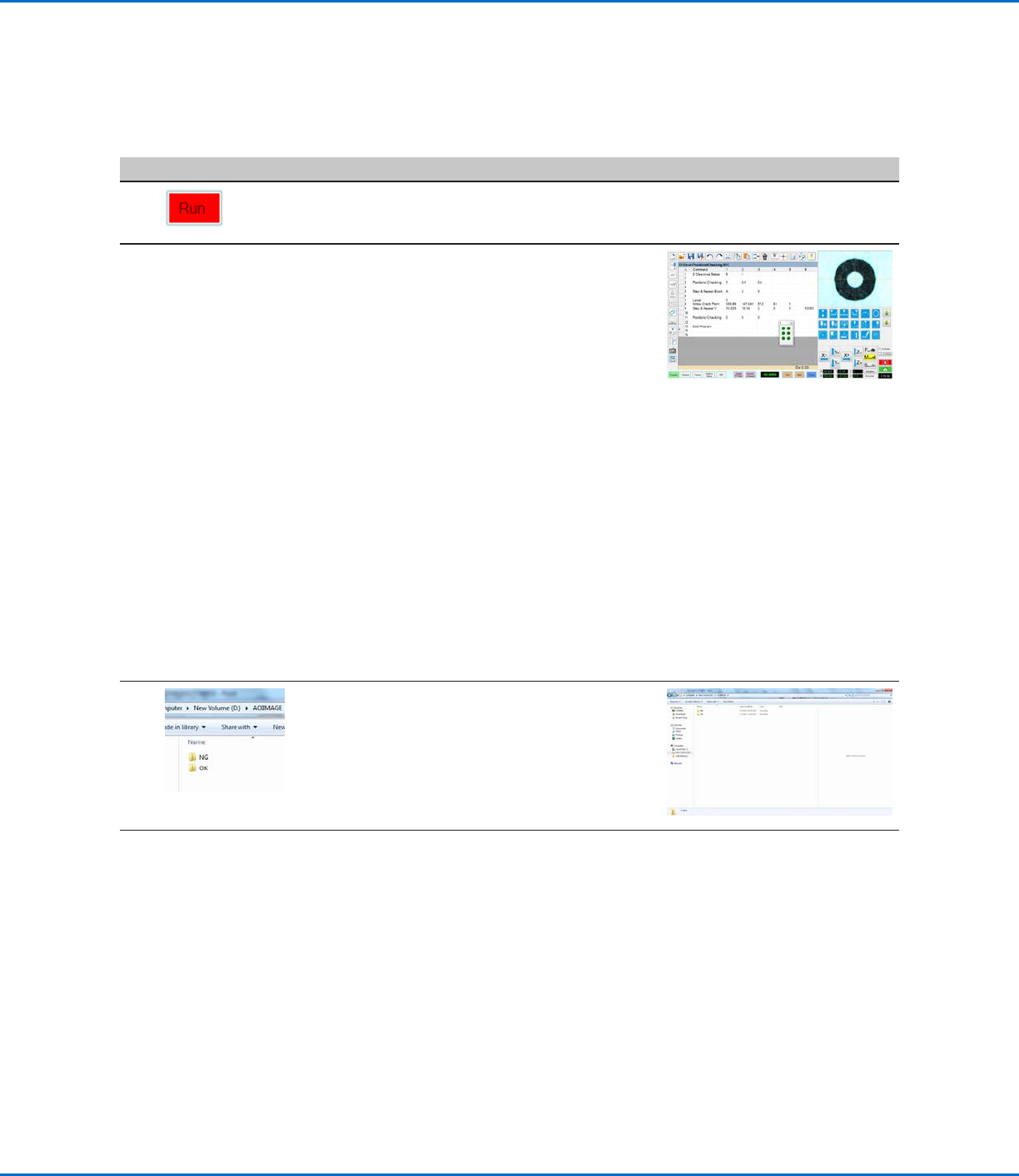
# Click Step Reference Image
11
• Click RUN to view the program
and to observe the results of the
Positional Checking.
As the program runs, the following occurs:
• A window opens to show green or red dots (for this example, in a
grid of two columns and threerows), indicating whether a deposit
(the white dot) passes (green) or fails (red):
- Pass: The deposit is within both Offset X and Offset Y values.
- Fail: The deposit is outside one or both of the Offset X / OffsetY
values.
NOTES:
- The window is named A (from step 2 on page32).
- In this example, all dots are green because all white dots are
within the specified X and Y offsets.
• If a dot fails, the system takes the action specified by the Stop,
Skip, Pause, Ask parameter (Skip, in this example). Refer to “Arrow
Check Point” on page71 for details.
• Screen captures of both passed and failed dots are saved as
images and named automatically.
NOTE: If the screen captures are not automatically saved, ensure
that the Save Images checkbox in System Setup is selected. Refer
to “Setting Up the System to Save Images” on page9 for
details.
12 • To view the images of the marks,
use the file explorer application to
navigate to D:\AOIIMAGE:
- Dots that passed (green) are
saved in the OK folder.
- Dots that did not pass (red) are
saved in the NG folder.
Continued on next page
Using the Arrow Types (continued)
Positional Checking Example (continued)
To Use Positional Checking in a Program (continued)