00194422-09_MM_X-Series_en.pdf - 第14页
Introduction Maintenance Notes 1.3.1 Minor and Major Maintenance 14 Maintenance Manual SIPLACE X Series 1.3 1 . 3 M a in t e n a n c e N o t e s Maintenance Notes See also 1.1.7 Saf ety Instructio ns f or Maintenance…
Introduction
1.1.9 Laser Classification Preparatory Work...
Maintenance Manual SIPLACE X Series 13
► Release of stored energy:
Stored energy in the compressed air supply or electrical energy in electrolytic capacitors must be
released by appropriate means.
⇨ After switching off the machine, wait until the voltages and the compressed air have discharged,
so that work can be performed without any risk.
► Testing the lock out:
The lock can be easily tested by pressing the START button.
► The following steps must be taken to restore the machine to operation.
► Check the working area. Authorized employees should remove all of their tools and reinstall all safety
features.
► Notify all affected employees.
► Before removing even one lock or tag, inform all workers in the affected area that the machine is
going to be restarted.
► Remove locks/tags
► Every authorized employee must remove his own lock and shut it away.
► Turn the machine on. Make sure that authorized staff check the equipment in operation to ensure
that repairs were performed correctly
Testing
Service personnel may test circuits by energizing them briefly without suspending the Lock Out / Tag
Out Procedure. This may only be done when no other work is being performed by any other person on
the equipment being tested.
It is extremely important that all remote START switches be tagged with the "Do Not Operate" tag to pre
-
vent inadvertent operation of the equipment during these periods.
Responsibilities
▪ It shall be the responsibility of the maintenance and service personnel to make sure this procedure
is adhered to.
▪ It shall be the responsibility of the maintenance and service personnel's immediate supervisor to in
-
struct his personnel on this procedure.
▪ It shall be the responsibility of the Safety Officer with assistance from the Safety Committee, Health
Service Department, and the various managers and vice-presidents to administer the Lock Out / Tag
Out Procedure.
Introduction
Maintenance Notes 1.3.1 Minor and Major Maintenance
14 Maintenance Manual SIPLACE X Series
1.3
1.3 Maintenance Notes
Maintenance Notes
See also
1.1.7 Safety Instructions for Maintenance Tasks [ ➙ 9]
1.3.1
1.3.1 Minor and Major Maintenance
Minor and Major Maintenance
Maintenance to production equipment is subject to underlying conditions stipulated by the production
schedule and other organizational circumstances. The availability of the staff trained and authorized to
perform SIPLACE maintenance also plays a role in the ability to realize maintenance work.
To facilitate easier realization of SIPLACE maintenance in the daily work routine, this SIPLACE mainte
-
nance manual takes into account the degree of complexity for each maintenance task. The tasks are
therefore differentiated between Minor Maintenance and Major Maintenance.
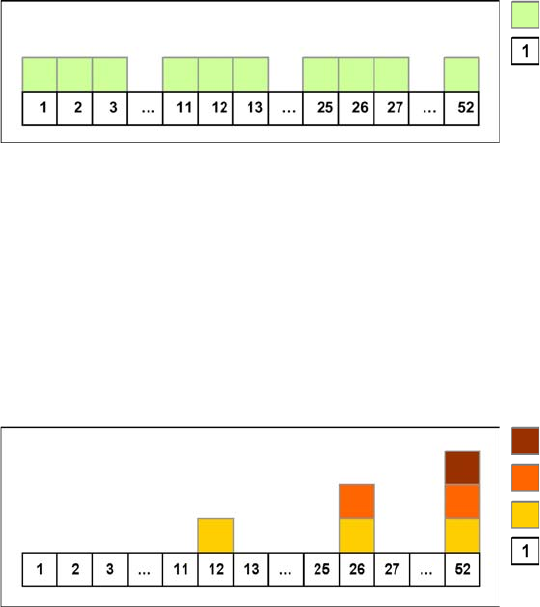
Minor Maintenance
Minor Maintenance includes weekly maintenance tasks. The tasks of the weekly maintenance intervals
can be carried out using the Maintenance Manual; thus no special training is needed. These tasks are
typically executed by the operating personnel.
Minor Maintenance summarizes all maintenance tasks that are to be carried out on a weekly basis. The
average time needed is approximately 1 hour per line, depending on the line configuration as well as the
number of persons who carry out the maintenance and their experience.
Minor Maintenance = weekly maintenance break, simple tasks
Major Maintenance
Major Maintenance summarizes recommended maintenance tasks with a higher degree of complexity
that are usually carried out every 6 or 12 months. These tasks require a special training.
Normally, these tasks are carried out by adequately trained operating, maintenance or service person
-
nel. Major Maintenance tasks are planned and carried out on a 6 and 12 month basis (3 month basis for
C&P20). Planning the Major Maintenance is normally connected to the planned major maintenance of
the oven within the production line.
Major Maintenance = 3, 6, 12 monthly maintenance breaks, complex tasks
Weekly maintenance tasks
Week
12 monthly maintenance work
6 monthly maintenance work
3 monthly maintenance work
Week
Introduction
1.3.2 Calculation of Maintenance Intervals Maintenance Notes
Maintenance Manual SIPLACE X Series 15
1.3.2
1.3.2 Calculation of Maintenance Intervals
Calculation of Maintenance Intervals
The SIPLACE maintenance intervals are time-based and set according to the following conditions:
▪ Shift model: eight hours per shift, three shifts per day, five days a week and 50 weeks a year.
▪ Real placement performance in accordance with machine specifications
▪ Environmental and production conditions: see document "Conditions at Installation Site"
See also
4.1 Maintenance Intervals for Minor Maintenance [ ➙ 25]
5.1 Maintenance Intervals for Major Maintenance [ ➙ 31]
1.3.2.1
1.3.2.1 Adjusting the Maintenance Intervals to Actual Production Conditions
Adjusting the Maintenance Intervals to Actual Production Conditions
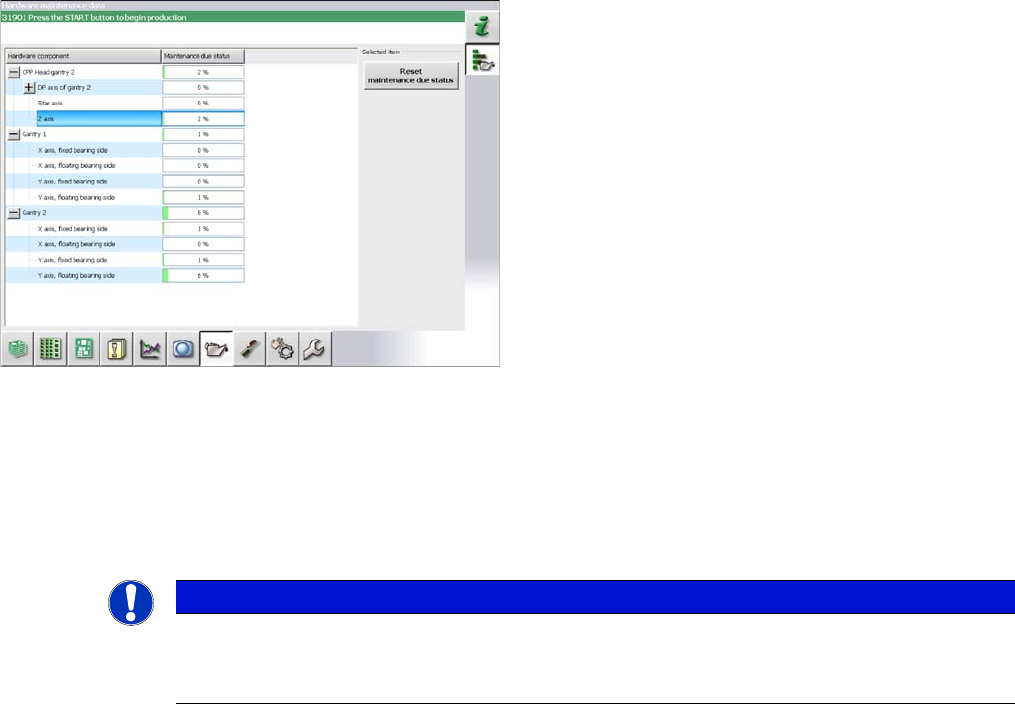
The maintenance status is calculated from the placement cycles, temperature and operating hours. The
status is shown as a progress bar (0 – 100 %).
Placement cycles for maintenance intervals:
▪ CPP: 40 mill. placed components
▪ C&P20: 30 mill. placed components
▪ C&P20A/M/P: 37.5 mill. placed components
Some customers want to adjust maintenance intervals to
their actual environment and production conditions. A
maintenance monitor can also be accessed in the station
software for some assemblies (from SW703.02).
The maintenance monitor is available for the following as
-
semblies:
▪CPP
▪ C&P20/A/M/P
▪ X and Y axis (SX1/SX2/DX1/DX2 only)
NOTICE
Maintenance counter
► After maintenance has been completed, the maintenance counter needs to be reset for the
assembly concerned.