00195440-05-SG_D-Series_FSE-EN.pdf - 第113页
7 Axis Dynamics 7.1 Axis Dynamic Basics Student Guide SIPLACE D-Series (FSE) 113 The over swing explai ned above s hows that the waiting time for t he overswin g check sta rts at 13 dig its before the target are a and th…
7 Axis Dynamics
7.1 Axis Dynamic Basics
112 Student Guide SIPLACE D-Series (FSE)
Digitally controlled axes with A364 for SIPLACE machines
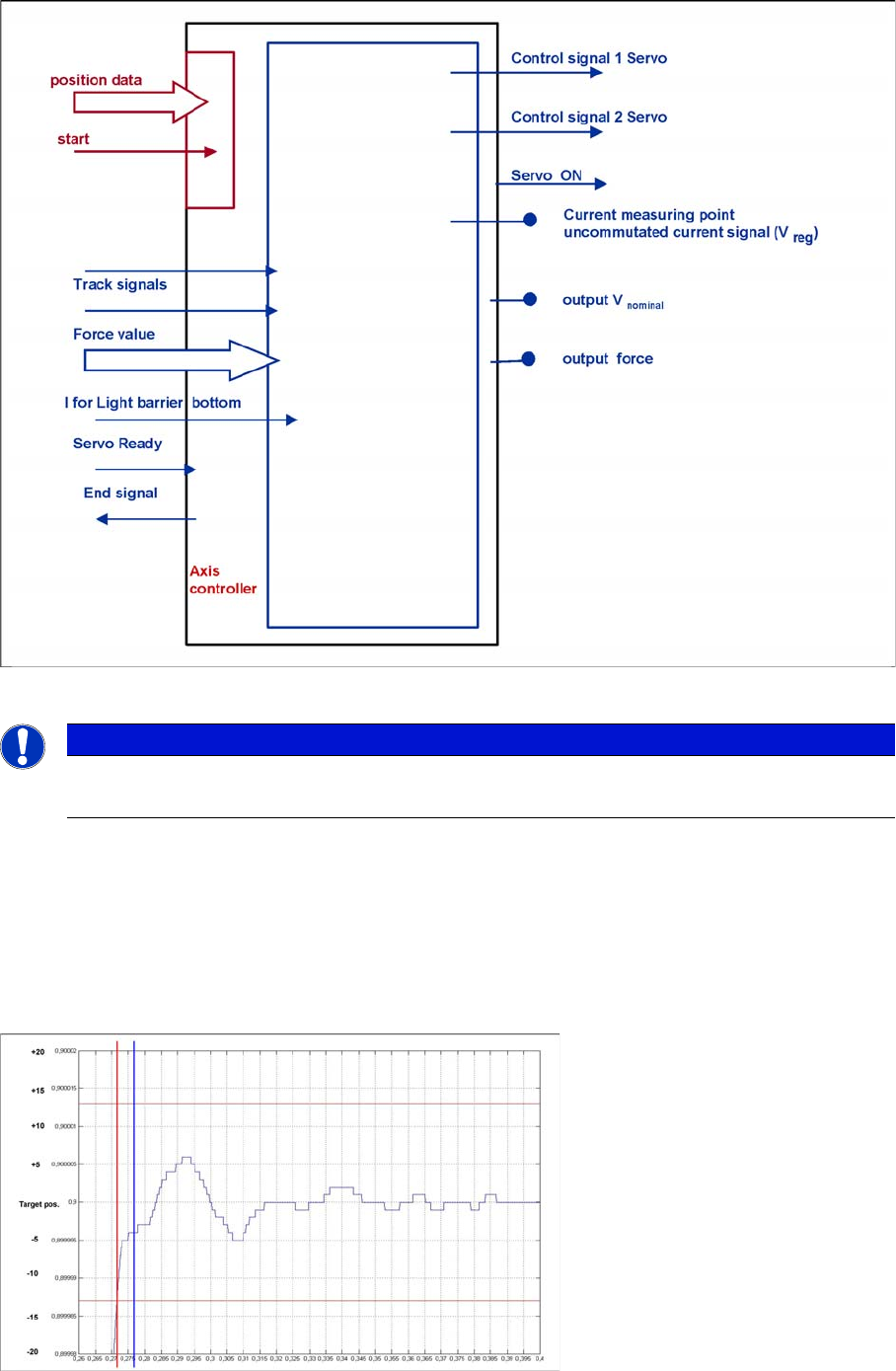
During initial positioning into the target position, the actual equals target position signal triggers an over-
shoot count in the SIPLACE Axis Tester, for calculation of the position deviation signal.
If the overshoot is greater than the permitted position deviation (13 digits) for this axis, the end position
signal will be delayed until the deviation has been regulated to remain within the permitted range.
If the axis nears the permitted target position, axis parameters which do not tend to produce overswings
are used. This effective and fast method of regulation seldom produces overswings and has the added
benefit of shorter waiting times for overswing checks (5 ms).
NOTICE
Art und Quelle der Gefahr
The position deviation signal shows the positioning quality of an axis movement in position.
7 Axis Dynamics
7.1 Axis Dynamic Basics
Student Guide SIPLACE D-Series (FSE) 113
The overswing explained above shows that the waiting time for the overswing check starts at 13 digits
before the target area and that the end position signal is set at 5 ms after this.
The movements of approx. 6 µm which then occur can then be ignored. These do not affect the machine
or the placement process.
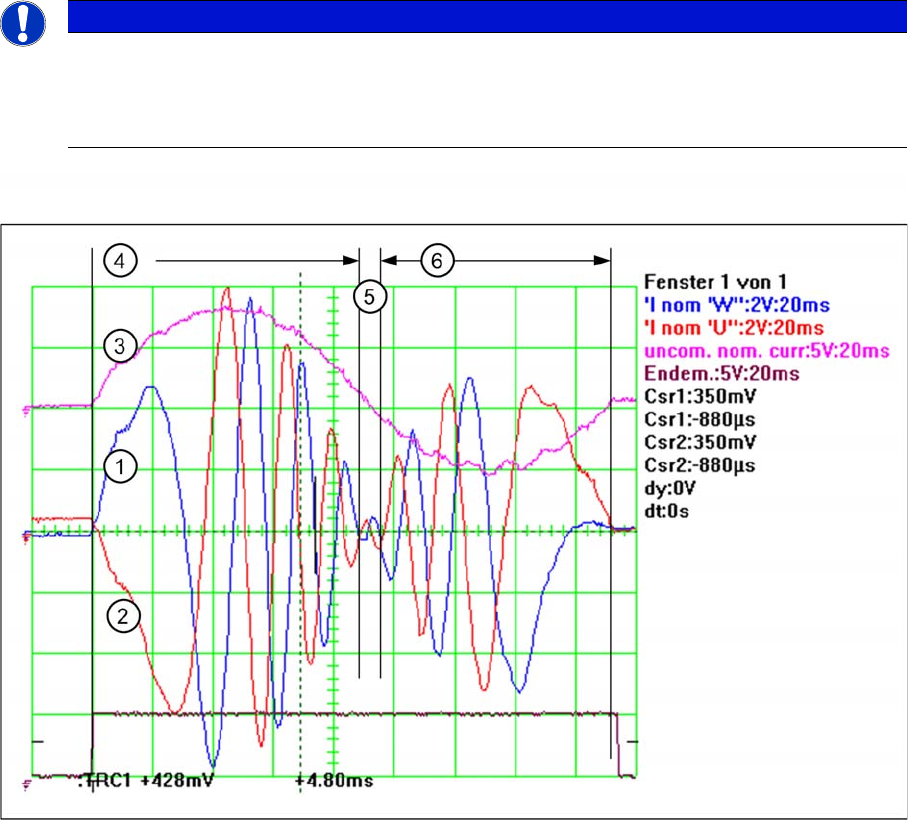
For assessment of the axis dynamics by a service technician, the system generates an uncommutated
current nominal signal from all motor current nominal signals. This informs you about the mechanical fric-
tion in the axis system. It can be measured on the adapter board of the axis controller or at the Vreg
output of the SIPLACE axis tester (SAT).
The uncommutated target current signal is an envelope signal for the 2 visible motor current nominal
signals from the axis controller. The missing 3rd motor current signal is calculated at the servo amplifier
board.
The known V nominal (V-target) speed signal and the force signal have been replaced by the motor cur-
rent nominal signals for DC or AC drives.
The uncommutated motor current nominal signal (3) and the motor current signals (1) (2) of an AC Motor
The acceleration section can be recognized in the motor current nominal signal of the AC motor (4), due
to the high amplitudes needed to supply the axis mechanics with sufficient force. The frequency of this
signal section is low, due to the low speed. The amplitude becomes lower and lower because the nec-
essary motor force is reduced with increasing speed.
The frequency becomes higher as the speed increases, up to a maximum frequency for maximum axis
speed (5).
NOTICE
Art und Quelle der Gefahr
These motor current signals can be measured at the V nominal and the Force output of the axis
tester. The same signals are measured at the two topmost test points of the servo amplifier
board, as Inom. U’ and Inom. W signals.
7 Axis Dynamics
7.1 Axis Dynamic Basics
114 Student Guide SIPLACE D-Series (FSE)
In the deceleration section, the amplitude increases again, to reduce the speed of the axis mechanics.
The frequency is reduced to a lower value, thereby also reducing the speed of the axis (6). Finally, the
axis is moved into the correct target position, with overshoot control.
So there is nothing to adjust all this axes have a dynamic behavior. Each axis has friction to be over-
come. The higher the friction is, the higher the amplitudes will be at acceleration and constant speed.
The higher motor force at acceleration and constant speed can be detected at the uncommutated motor
current nominal signal. Higher friction reduces the required motor force during the deceleration section,
so that the amplitude is smaller for the uncommutated motor current nominal signal.
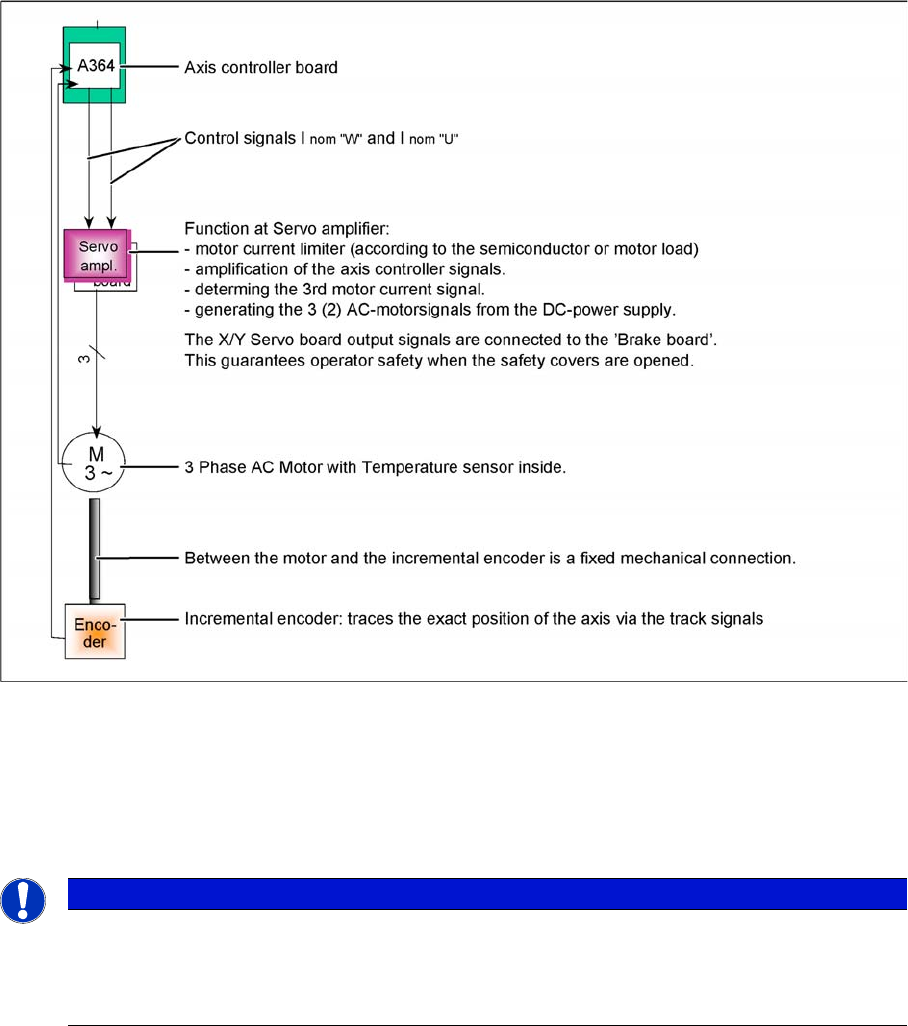
Axis block diagram example X or Y-axis of HF/Siplace X machine
Although the various axis types differ in details, all control tasks are handled by the axis controller. Two
control signals for 2 or 3 phase axis drive are transmitted to the servo. For DC drives, we use the same
hardware principle, with only one control signal to the servo amplifier. The only feedback is provided by
the track signals from the incremental encoder to the axis controller - a tacho (Z/DP axis) is not connect-
ed to the axis system.
See also
7.1 Axis Dynamic Basics [ ➙ 111]
NOTICE
Art und Quelle der Gefahr
In the case of mechanical or electrical faults, the quality of the A364 axis controller is such that
the error state from longer positioning times or signal changes will only be visible if the deviation
is very significant.