00195440-05-SG_D-Series_FSE-EN.pdf - 第153页
9 C&P Placement Heads 9.1.7 Overview of Blast Air Supply 9.1 Overview Student Guide SIPLACE D-Series (FSE) 153 9.1.7 9 . 1 . 7 O v e r v ie w o f B la s t A ir S u p p ly Overview of Blast Air Supply General overview…

9 C&P Placement Heads
9.1 Overview 9.1.6 Throughput Test for Vacuum Holding Circuit
152 Student Guide SIPLACE D-Series (FSE)
▪ Position the Z axis downwards, touch the nozzle tip and press upwards. The LB 'Z down' will shine
and both LEDs will shine until the Z axis is pulled up again.
Check the stepping motor for swiveling in the turning station:
▪ Touch the turning station cam disk on the right side of the head with your finger and rotate it. The 'LB
DP' LED will shine and extinguish with the scan rhythm of the cam disk.
Check the stepping motors of the valve positioning drives:
▪ Feel along the bottom of the placement head from the right side and touch the cam disk upwards in
the pickup/place position.
▪ When rotated, the LB "ZH" shines and extinguishes with the scan rhythm of the cam disk.
▪ Feel along the bottom of the placement head from the left side and touch the cam disk upwards in
the reject position.
▪ When rotated, the LB "BA" shines and extinguishes with the scan rhythm of the cam disk.
9.1.6
9.1.6 Throughput Test for Vacuum Holding Circuit
Throughput Test for Vacuum Holding Circuit
Through the installation of the placement head, the silicon tube for supplying the holding circuit with vac-
uum can become jammed, especially in HF/X/D3 machines.
The lower throughput reduces the holding force for the components during the placement process. This
means that components can be displaced on the nozzle, both before and after the component camera.
If this happens before the camera, the component may be moved out of the pickup tolerance. After the
camera, displacement can lead to random, uncorrectable placement offsets.
This fault can be recognized with the SITEST 'throughput test".
C&P12/6
Perform the following steps:
► Return all C&P head nozzles.
► Measure the holding circuit vacuum. Typical values are around 900 mbar (values over 900 are
shown as 900).
► Open a segment in the reject circuit and
► step the star one position.
► Measure the holding circuit vacuum. Values around or higher than 800 mbar are OK.
► Open another segment in the reject circuit and
► step the star one position.
► Measure the holding circuit vacuum. Values higher than 700 mbar are OK.
Values around 600 mbar are reached at around half the diameter of the silicon supply tube.
Vacuum values in the holding circuit which only reach 500 mbar are no longer sufficient to guarantee the
holding circuit function. (Values under 400 mbar are only shown as -1)
Gemessen wurde hier jeweils ohne Pipetten.
Description Vakuumwerte für die Segmente 1 bis 8
Offene Segmente im
Haltekreis
012345678
Vakuum Haltekreis OK -900 -830 -756 -620 -532 -460 -412 1
Schlauch für Haltekreis leicht
eingequetscht
-900 -800 -674 -532 -428 1 1 1
Schlauch für Haltekreis
eingequetscht
-900 -621 -420 1
Große Probleme Haltekreis -900 -410 1 1
9 C&P Placement Heads
9.1.7 Overview of Blast Air Supply 9.1 Overview
Student Guide SIPLACE D-Series (FSE) 153
9.1.7
9.1.7 Overview of Blast Air Supply
Overview of Blast Air Supply
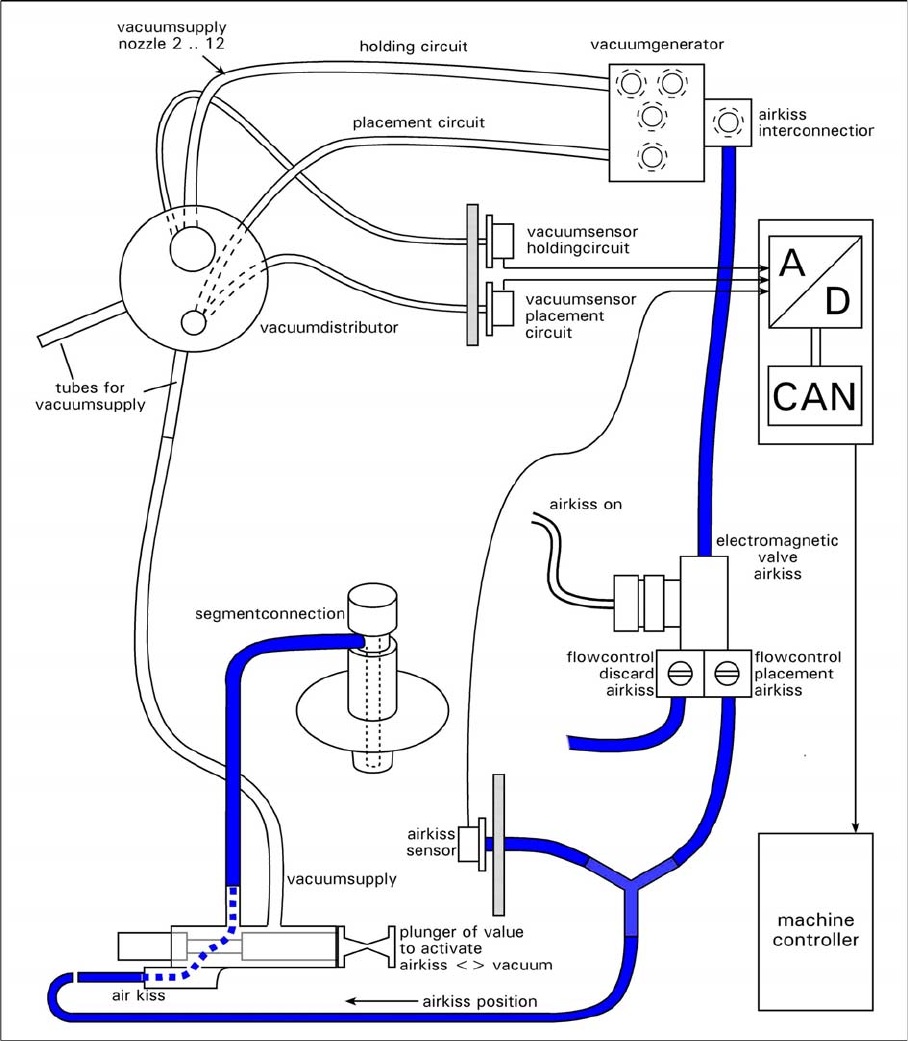
General overview of the blast air function
9 C&P Placement Heads
9.1 Overview 9.1.8 Overview of Vacuum Supply
154 Student Guide SIPLACE D-Series (FSE)
9.1.8
9.1.8 Overview of Vacuum Supply
Overview of Vacuum Supply
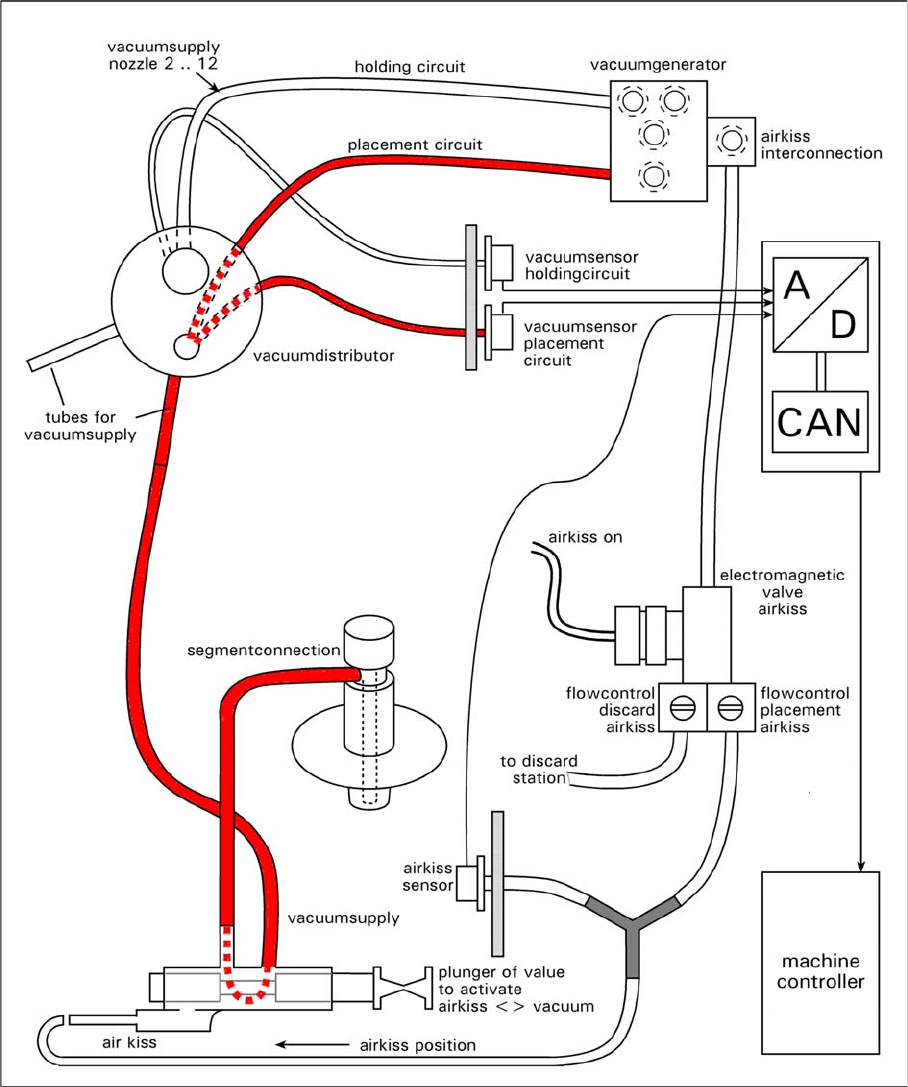
General overview of the vacuum function
9.1.9
9.1.9 Air Blast and Vacuum Supply - Description
Air Blast and Vacuum Supply - Description
The two diagrams show that there are 3 states for air supply to the segments.
▪ Elektromagnet-Ventil "Blasluft" EIN & Ventilstößel innen: air blast is present at the segment for
placement (reject).
▪ Elektromagnet-Ventil "Blasluft" AUS & Ventilstößel innen: the segment is airtight i.e. it is cut off from
the air blast and vacuum supplies.
Dies ist die Stellung für die Vakuummessung. D. h. es wird die Dichtwirkung des Stößels gemessen.
Die Schlauch und Rohrstücke zur Pipette hin werden nie überprüft (siehe folgendes Kapitel).