00195440-05-SG_D-Series_FSE-EN.pdf - 第164页
9 C&P Placement Heads 9.3 Travel Profile - Pickup 9.3.1 Z Axis Down 164 Student Guide SIPLACE D-Series (FSE) ▪ The positioning proce dure for "upwards" is identical to that f or standard pickup. Benefits of…
9 C&P Placement Heads
9.3.1 Z Axis Down 9.3 Travel Profile - Pickup
Student Guide SIPLACE D-Series (FSE) 163
9.3.1.2
9.3.1.2 Special Mode "Contactless Pickup" Z-Axis Down
Special Mode "Contactless Pickup" Z-Axis Down
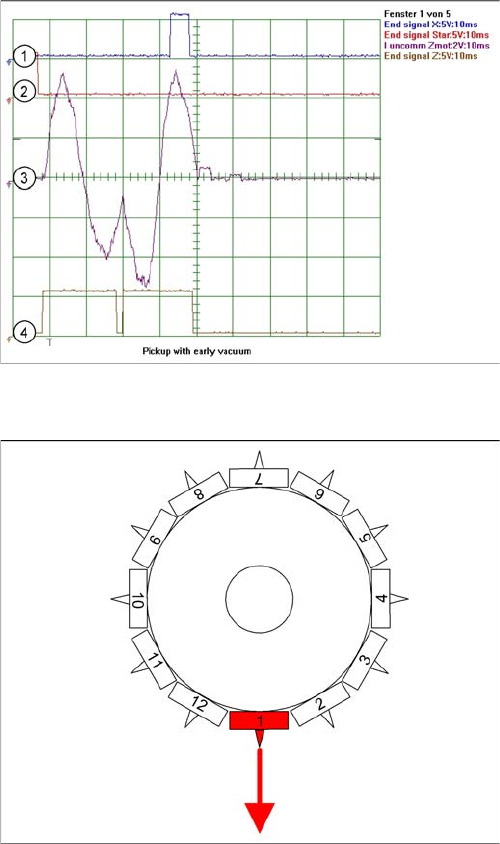
Pickup procedure for "contactless pickup":
▪ Start gantry axes to pickup position of feeder and communication with changeover table:
– Start signal to gantry axes
– Signal for next feeder / this opens the feeder flap
▪ End position signal for X/Y and star axes:
– End position signal for star axis
– Enables vacuum query: "segment airtight?" before pickup
– X/Y end position signals available.
▪ Z-axis starts with operating mode "positioning type - absolute" to saved nominal height:
– Positioning of Z-axis down
▪ Light barrier (LB) up switches:
– Release for function LB down (although not needed))
▪ Axis controller switches:
– When the taught pickup height is reached, end position signal for Z-axis positioning is issued.
▪ The machine controller switches:
– Valve positioning drive for switching over to vacuum ON.
Legend
1. End position signal for X-axis (position to feeder pick-
up position)
2. End position signal for star axis
3. Uncommutated motor current for Z-axis
4. End position signal for Z-axis
Section 1: move down
Section 2: move up
In contrast to the previous diagram, a delay of typical-
ly 2 ms occurs for early vacuum.
Special mode Z-axis down with "early vacuum ON in top
position"
In the case of LRU/LRL 503 and SIPLACE Pro, contact-
less pickup can only be programmed in the CS for SR/
MC 503 stations and higher.
When the component track, for which contactless pickup
has been programmed, is accessed for the first time, the
following is performed:
▪ The Z-axis is taught the pickup height with increased
force. The Z-axis moves until it mechanically stops.
▪ This pickup height is then reduced by 1.13 mm (602)
to give the nominal height (path of segment deceler-
ation and ...) and is saved. The component used for
the teaching procedure is rejected.
9 C&P Placement Heads
9.3 Travel Profile - Pickup 9.3.1 Z Axis Down
164 Student Guide SIPLACE D-Series (FSE)
▪ The positioning procedure for "upwards" is identical to that for standard pickup.
Benefits of special mode "contactless pickup"
The function option "contactless pickup" offers the following benefits:
▪ Prevents touching of component feeder unit and the possible resulting component shift/jump.
▪ Increases the pickup reliability for small COs, lightweight COs and exotic COs. The nozzle "hovers"
about 0.1 mm above the component surface. When the vacuum is switched on, the nozzles sucks
up the component from the tape pocket!
▪ No time loss during pickup (compared to standard pickup).
▪ The function is NOT limited to 0201 component shapes, certain nozzle types or feeder types.
9.3.1.3
9.3.1.3 Special Mode "Pickup with Minimum (Very Low) Force " for Z-Axis Down
Special Mode "Pickup with Minimum (Very Low) Force " for Z-Axis Down
Travel profile 21 and 22
These travel profiles are currently only for the Twin head (P&P module) and are only available with a
special nozzle.
Definable pickup forces: 0.9 - 2.0 N
9.3.1.4
9.3.1.4 Standard Mode for Smaller Components (<6x6mm²) Picked Up with Early Vacuum, Z-Axis Down
Standard Mode for Smaller Components (< 6x6 mm²) Picked Up with Early Vacuum, Z-Axis
Down
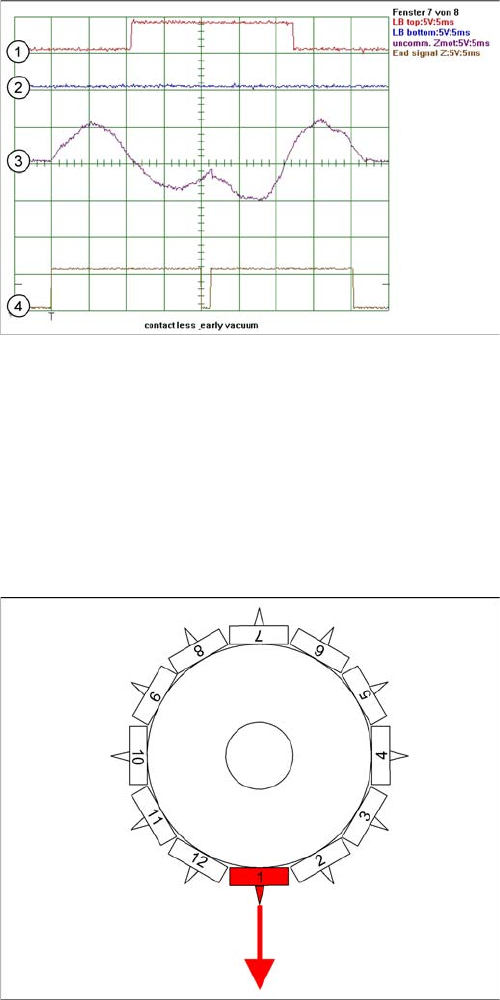
In this programming mode, early vacuum is also pro-
grammed, which is illustrated by the time between "end
signal downward" and "start upward".
Legend
1. Light barrier signal Z-axis LB top
2. Light barrier signal Z-axis LB bottom
3. Uncommutated motor current for Z-axis
4. End position signal for Z-axis
1. Section : Z-axis down (20 ms)
2. Section : Z-axis up (18 ms)
Special mode Z-axis down with "early vacuum" " vacuum
ON in top position"
Start gantry axes to pickup position of next feeder and
communication with changeover table:
▪ Start signal to gantry axes
▪ Signal for next feeder / this opens the feeder flap
End position signal for X/Y and star axes:
▪ End position signal for star axis
▪ Enables vacuum query: "segment airtight?" before
pickup
▪ X/Y end position signals available.
Z-axis starts:
▪ Positioning of Z-axis down
Light barrier (LB) up switches:
▪ Special procedure: valve positioning drive ON for
switching over to vacuum
▪ and releases LB down function
LB down switches:
▪ End position signal for positioning Z-axis down
9 C&P Placement Heads
9.3.1 Z Axis Down 9.3 Travel Profile - Pickup
Student Guide SIPLACE D-Series (FSE) 165
Benefit of standard mode for small components "early vacuum"
The function change "early vacuum" offers the following benefits:
▪ Increases the pickup reliability for small nozzle types 901/904. The vacuum begins to build up during
the downwards movement. This ensures, that when the upwards movement begins, an exotic com-
ponent and /or a heavy component will remain safely on the nozzle.
▪ No time loss during pickup (compared to standard pickup).
CAUTION
Cause of Hazard
The risk of head contamination is higher (without additional vacuum formation) when using noz-
zle types with large openings, generally for components larger than 6 mm!
NOTICE
Cause of Hazard
From SIPLACE PRO 3.0 onwards, early vacuum has been replaced by the component shape
library, for components smaller than 6x6 mm.
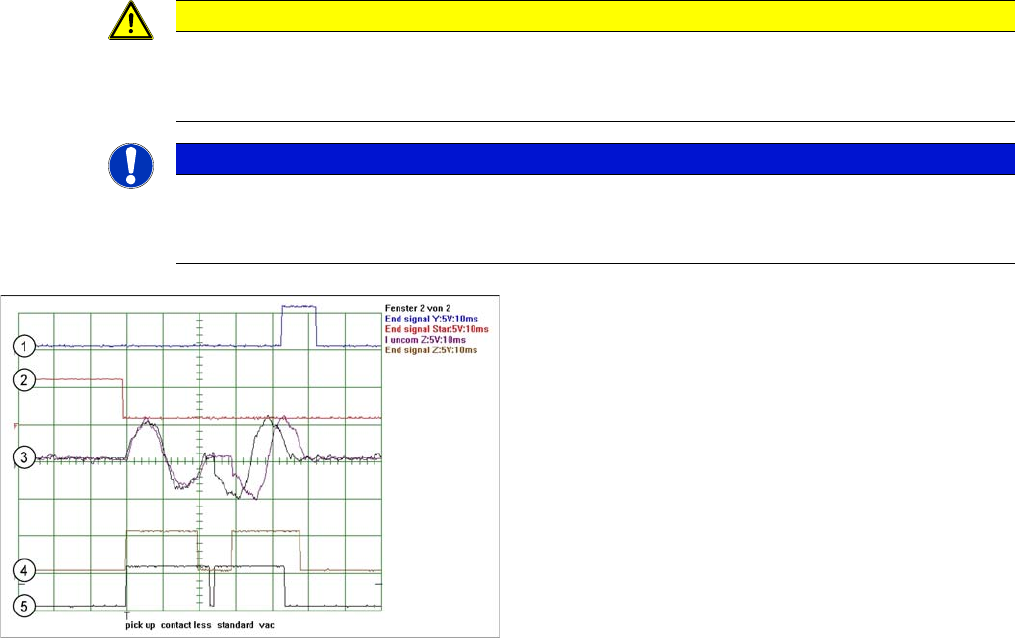
The time between "end position signal down" and "start
upwards" is shown below in the difference between the
"standard" and "early vacuum" modes.
▪ Standard vacuum 9.4 ms.
▪ Early vacuum 1.2 ms
Downwards positioning takes 3 ms longer for contactless
pickup.
Legend
1. End position signal for Y-axis
2. End position signal for star axis
3. Uncommutated motor currents for Z-axis (2 modes)
4. End position signal for pickup procedure with vacuum
switched on at bottom (standard)
5. End position signal for pickup procedure with early
vacuum