00195440-05-SG_D-Series_FSE-EN.pdf - 第20页
2 Operational Safety 2.4 Safety Equipment 2.4.2 Safety and signaling circuit 20 Student Guide SIPLACE D-Series (FSE) ▪ D3: F1 automatic circuit br eaker for t he service s ocket D1/D2/D4 or D1i/D2i/D4i: FBU fuse for the …
2 Operational Safety
2.4.1 Switches and Buttons on the Placement Machine 2.4 Safety Equipment
Student Guide SIPLACE D-Series (FSE) 19
2.4.1.2
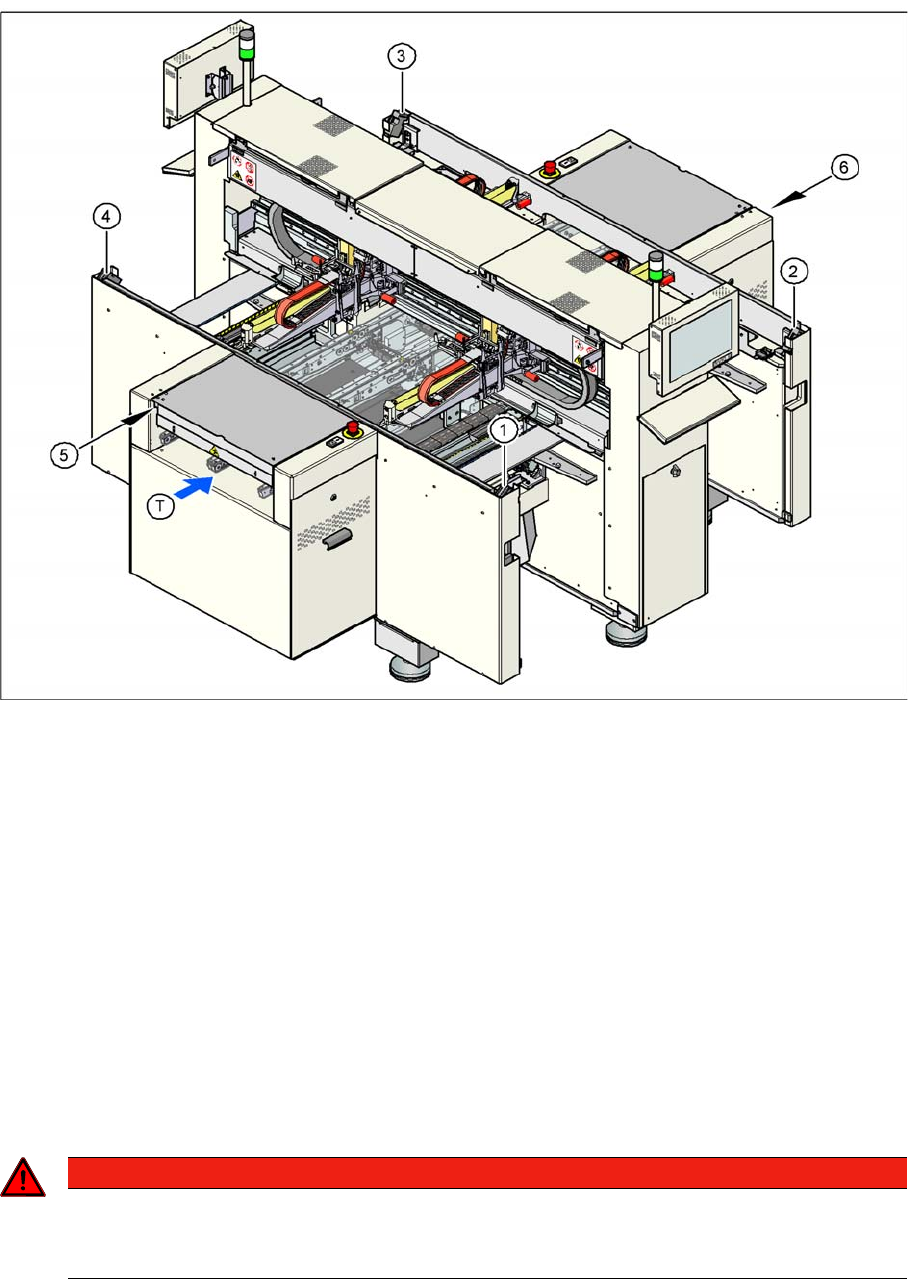
2.4.1.2 Position of Protective Switches on the Placement Machine
Position of Protective Switches on the Placement Machine
Position of protective switches on the placement machine (example of D4/D4i shown)
Legend
1. Protective cover switch, location 1
2. Protective cover switch, location 2
3. Protective cover switch, location 3
4. Protective cover switch, location 4
5. Protective switch for the cover flap on the PCB conveyor input side
6. Protective switch for the cover flap on the PCB conveyor output side
T = PCB direction of transport
2.4.1.3
2.4.1.3 Functions
Functions
Main power switch in the OFF position
The main power switch disconnects the three phases L1, L2, and L3 from the power supply.
▪ Cable connection terminals L1, L2, and L3 of the Q1 main power switch
▪ Z1 line filter
▪ Service socket BU1
DANGER
Cause of Hazard
The following components still carry potentially lethal voltages even if the main power switch is
switched off:

2 Operational Safety
2.4 Safety Equipment 2.4.2 Safety and signaling circuit
20 Student Guide SIPLACE D-Series (FSE)
▪ D3: F1 automatic circuit breaker for the service socket
D1/D2/D4 or D1i/D2i/D4i: FBU fuse for the service socket
▪ The color of all individual wires, which still carry potentially lethal voltages even if the main power
switch is switched off, is brown.
– Death, serious injury or considerable damage may result if these automatic placement systems
are handled incorrectly.
– Always follow the applicable accident prevention and DIN regulations (particularly DIN EN 60
204, part 1) and the applicable regulations in your own country.
– The safety door to the power supply must ONLY be opened by appropriately qualified and
trained personnel.
EMERGENCY STOP pushbutton, latching, with override protection to EN 418
The emergency stop button is red and latches in the ON position when pressed. When pressed, the
emergency stop button opens the switching contact of the emergency stop circuit - the protective con-
tactor combination (PCC K1) triggers. The link voltage (200 VDC) for the gantry axes and the link voltage
(150 VDC) for the star axes is switched off. The servo amplifiers for the DP and Z axes are still supplied
with 40 VDC. The signaling contact of the EMERGENCY STOP button will open and the message
EMERGENCY STOP operated will be shown on the screen. The following assemblies will be disabled:
▪ PCB conveyor
▪ PCB clamping
▪ Width adjustment
▪ PCB stopper
▪ Empty tape cutter.
See also
2.4.2.1 Safety Circuit Function [ ➙ 20]
2.4.2
2.4.2 Safety and signaling circuit
Safety and signaling circuit
2.4.2.1
2.4.2.1 Safety Circuit Function
Safety Circuit Function
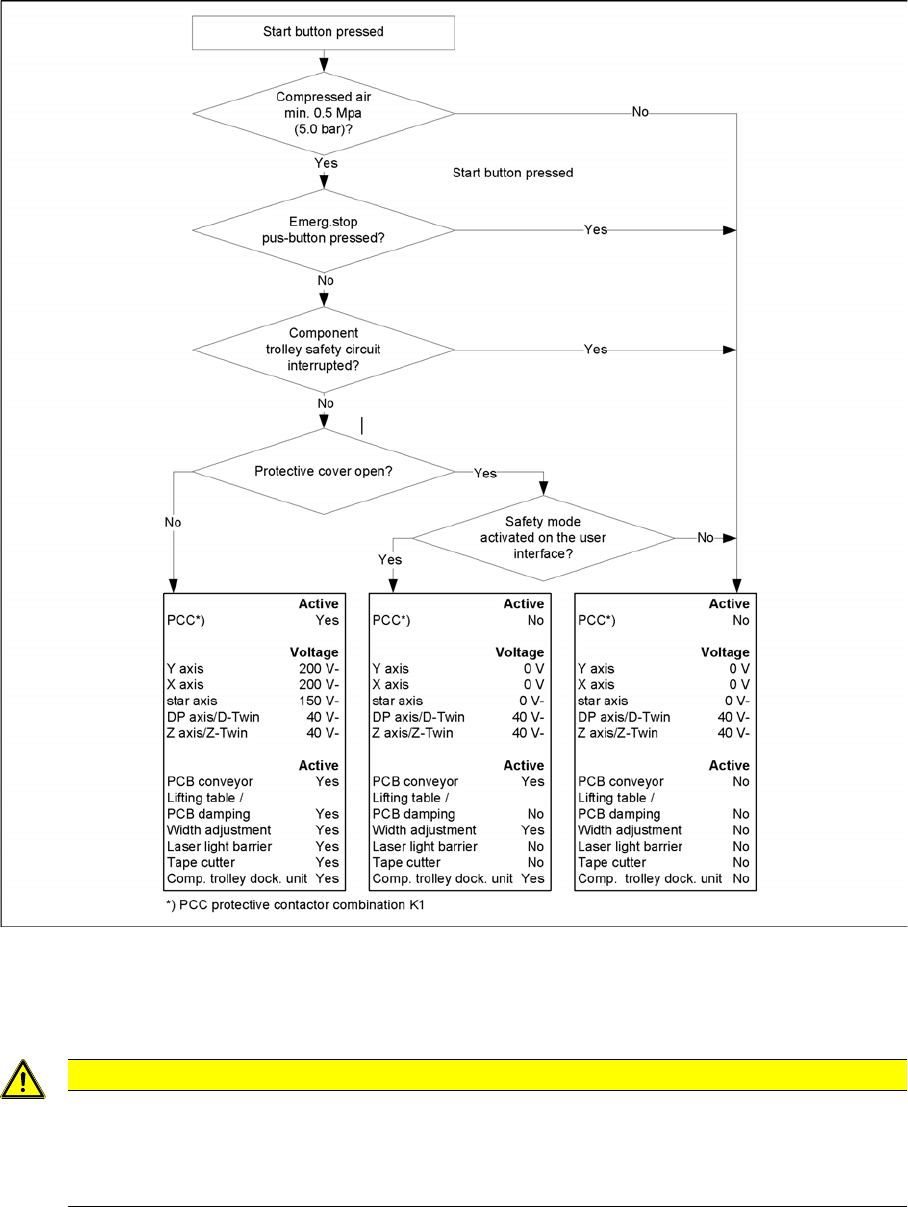
The following conditions must be fulfilled in order to start and operate the placement machine:
▪ All four component trolleys must be docked in and connected.
▪ All protective covers must be closed.
▪ The two cover flaps over the PCB conveyor must be closed.
▪ Both emergency stop buttons must be released.
▪ The cover flaps (option) over the feeder modules must be closed.
▪ The minimum operating pressure must have been reached.
▪ The "software enable" signal must be active. This ensures that the safety circuit is closed.
▪ The power supply must be sending 24 V to the Start buttons and the protective contactor combina-
tion.
▪ If one of the start buttons is pressed now, the protective contactor combination PCC K1 will switch
and enable the following components:
– 200 VDC link voltage for the servo amplifiers for the gantry axes
– 150 VDC link voltage for the star axes
– The axis unit receives a "Servo enable" signal for the servo amplifiers
NOTICE
Cause of Hazard
Placement will be interrupted and can then be continued or canceled once the machine is func-
tional again.
2 Operational Safety
2.4.2 Safety and signaling circuit 2.5 ESD Guidelines
Student Guide SIPLACE D-Series (FSE) 21
– 40 VDC operating voltage is switched to the component trolleys.
– 24 VDC operating voltage is switched to the empty tape cutters.
– The PCB conveyor control receives the enable signal for the PCB clamping, the PCB stopper
and the lifting table control.
The machine is then ready for use.
2.4.2.2
2.4.2.2 Safety Loops
Safety Loops
Safety loops
2.5
2.5 ESD Guidelines
ESD Guidelines
CAUTION
See operating manual
The ESD guidelines apply for all work to and with the electronic assemblies of your own and
the training machine. For more details about the ESD guidelines, refer to the operating manual
for the relevant SIPLACE machine.