00195440-05-SG_D-Series_FSE-EN.pdf - 第48页
3 Overview 3.4 Assemblies 3.4.9 Conveyor system 48 Student Guide SIPLACE D-Series (FSE) Machines with multip le processing areas (D4/D4i/D3) have a boar d mo nitoring function in the statio n software i.e. th e board con…
3 Overview
3.4.9 Conveyor system 3.4 Assemblies
Student Guide SIPLACE D-Series (FSE) 47
3.4.9.1
3.4.9.1 General
General
The standard machine is equipped with a single PCB conveyor. A dual PCB conveyor system is option-
ally available. Depending on individual requirements, either the left or right conveyor side can be select-
ed as the fixed conveyor side.
In the Processing Area (PA1 or PA2), the PCB board will be clamped from the bottom side against the
fixed holder on the conveyor system. Therefore, the space between the upper side of the board and the
placement head remains the same for each board and no longer depends on the thickness of the board.
This means that the placement performance also no longer depends on the board thickness. The PCB
fiducial centering can also be optimized. The consistent space between the board upper edge and the
PCB camera means that the PCB camera is always optimally focussed on the upper side of the board.
The PCB fiducial shape is optimally imaged on the CCD chip of the PCB camera.
The PCB transport in the SIPLACE machine is configured so that the C&P12 head can place compo-
nents up to a maximum height of 6 mm.
The machine height can be adjusted so that the machine can also be integrated into lines with transport
heights of 830, 900, 930 or 950 mm. Communication between the PCB conveyors of the different ma-
chines is provided with the help of a SMEMA or SIEMENS (optional) interface (D/Di-series). Standard
interface: SIEMENS).
The transportation of the boards is monitored and controlled by light barriers, consisting of a transmitter
and a receiver module. Once the board has reached the placement area and the board has been recog-
nized by the light barrier, the speed of the conveyor belt is reduced. The board is stopped with the help
of a laser beam and is then clamped into place from below.
Terminals
The PCB is lifted for placement of components and pressed up against the PCB clamping rail. When the
lifting table rises the PCB and the complete conveyor drive unit is lifted up to the clamping position. This
method enables the placement surface to remain in the same position, irrespective of the board thick-
ness.
Boards with a length up to 368 mm (D1/D1i/D2/D2i: 400 mm) are clamped into place in the relevant
placement area. Clamping does not take place on the input and output conveyor. However, boards with
lengths above 368 mm are placed up to a length of 610 mm on the conveyor belt and are only supported
by the lifting table in the placement area.
Width adjustment
The width is adjusted by means of a motor as programmed. For dual conveyor systems, differing widths
can be set for the two conveyor belts. The width adjustment uses a stepping motor, meaning that the
new PCB width can be set independently of other machine components (e.g. the Y-gantry). The proxim-
ity switch on the conveyor side is no longer needed.
The PCB width is adjusted via two adjustment units (pneumatic cylinder), which are installed under the
input and output conveyors. The stepping motor moves the two adjustment units synchronously back
and forth, through the use of ball bearing spindles and a toothed belt.
In the Di-series single conveyor, the moveable rail is directly mounted to the stepping motor through the
use of ball bearing spindles and a toothed belt.
Board control In the conveyor
The boards are checked with the help of light barriers (transmitter and receiver). The transmitter is locat-
ed below the conveyor belt and the receiver opposite to it, above the conveyor belt. The light barriers
stop the board in the input conveyor, intermediate and output conveyors.
The light barrier in the placement areas starts the braking process via the DC motor and switches the
laser (stopper) on. The board moves at reduced speed, within a fixed time window (100 ms) , until it
reaches the stopping position (laser). The braking profile is adjusted to the weight of the board (software-
controlled). This guarantees a consistent transport time, irrespective of the board used.
3 Overview
3.4 Assemblies 3.4.9 Conveyor system
48 Student Guide SIPLACE D-Series (FSE)
Machines with multiple processing areas (D4/D4i/D3) have a board monitoring function in the station
software i.e. the board conveyor process must be uninterrupted up to the relevant sensor, in each of the
five sectors. Removal at intermediate positions is not permitted.
Board stopper
In the placement area, the board is stopped by the laser light barrier. This laser light barrier recognizes
the front edge of the board and stops it. This prevents the board from hitting the mechanical end stop.
The positioning accuracy for the board is +/-0.5 mm.
An optional second, mechanical stopper is available for long boards, with lengths up to 610 mm.
Lifting table
Each placement area has one or two independently working lifting tables (single/dual conveyor). The lift-
ing table is driven indirectly via a pneumatic cylinder, with 5/2 direction control valve. Different PCB thick-
nesses are automatically compensated. The vertical guidance for the lifting table plate (up/down) is
defined at four points. The travel range is determined by a measurement system.
The top position is controlled by the measurement system, with the help of an incremental encoder and
a defined time window. The conveyor motor checks whether the board has been successfully clamped
into place.
The bottom position is checked by the measuring system, with the help of a proximity switch on the pneu-
matic cylinder and a defined time window.
The space below the board is 40 mm.
The "old" 74 mm high, red board supports are no longer supported by the HF and SIPLACE X/D/Di ma-
chines. Instead, use the black (94 mm) PCB supports.
The dual conveyor can also be used as a single conveyor, if the conveyor sides from lane 2 are moved
together (flexible dual conveyor).
3.4.9.2
3.4.9.2 Single Conveyor Construction
Single Conveyor Construction
PCB conveyor construction (D4/D4i)
3 Overview
3.4.10 Waffle Pack Changer (WPC) 3.4 Assemblies
Student Guide SIPLACE D-Series (FSE) 49
Legend
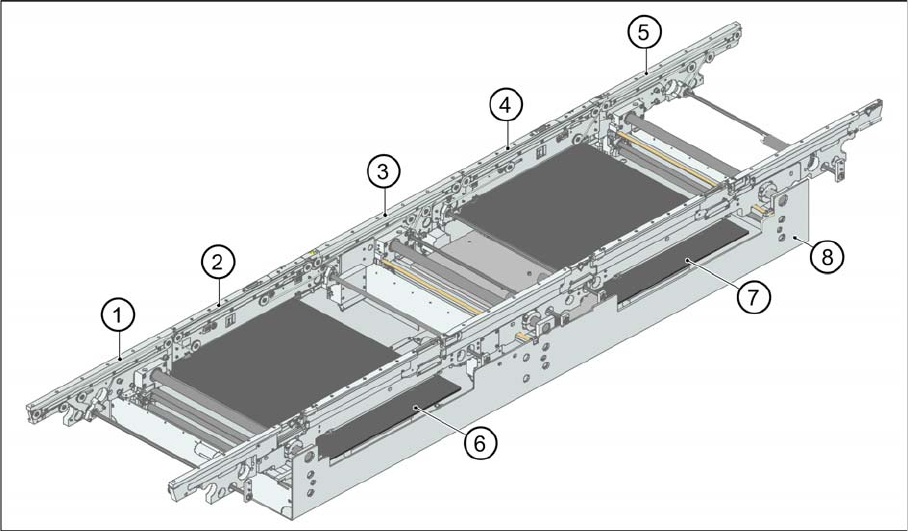
The single conveyor system consists of an input conveyor, two placement areas, the intermediate con-
veyor and the output conveyor. Each conveyor has automatic width adjustment and two lifting tables to
clamp the PCB in place.
3.4.9.3
3.4.9.3 Dual Conveyor Construction
Dual Conveyor Construction
Dual conveyor construction (D4/D4i)
Legend
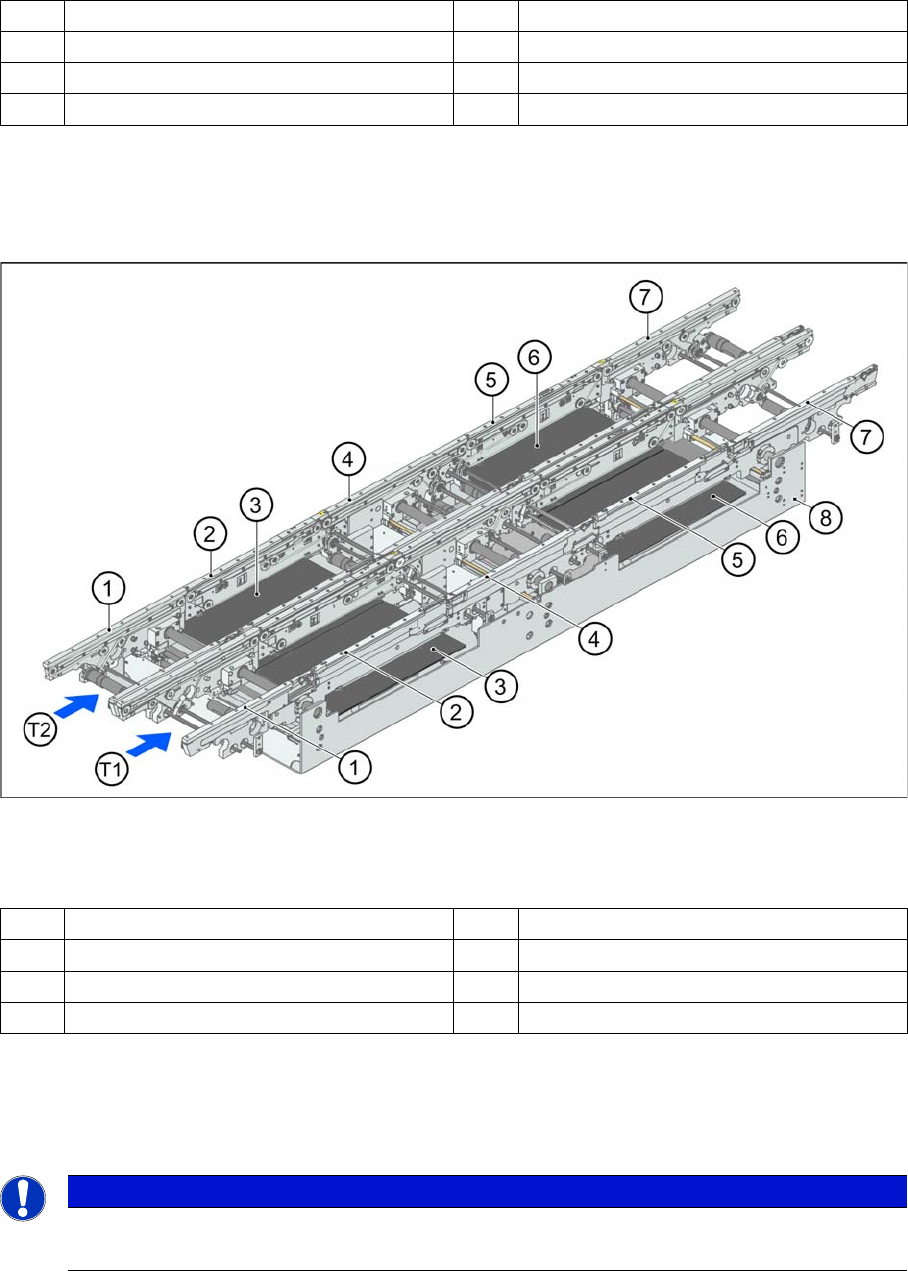
The dual conveyor has two conveyor lanes (1 and 2). In the standard model, the fixed conveyor side is
on the right side of each lane. This fixed conveyor side can be easily changed to the left.
3.4.10
3.4.10 Waffle Pack Changer (WPC)
Waffle Pack Changer (WPC)
Ab SW-Version SR/MC 605.01 kann der WPC4 auch an der D3 eingesetzt werden.
1 Input conveyor 5 Output conveyor
2 Processing conveyor 1 6 Lifting table 1
3 Intermediate conveyor 7 Lifting table 2
4 Processing conveyor 2 8 Conveyor vat
1 Input conveyor 5 Processing conveyor 2
2 Processing conveyor 1 6 Lifting table 2
3 Lifting table 1 7 Output conveyor
4 Intermediate conveyor 8 Conveyor vat
NOTICE
Further information
For further information about the WPC, refer to the relevant student guide or service manual.