80S-15贴片机.pdf - 第374页
9 Revolver Head SIPLACE 80S/F/G Service M anual Edition 04/97 9 - 90 Fig. 9.10.1 Optical component centering (component vision system) Optical component centering unit with illumination Cable Y0575-W1 to conversion board…

SIPLACE 80S/F/G Service Manual 9 Revolver Head
Edition 04/97
9 - 89
9.10 Optical Component Centering (Component Vision
System)
The optical component centering or the component vision system registers the precise position of a compo-
nent on the one hand by measuring the offset of component midpoint relative to the axis of symmetry of the
nozzle, and on the other hand, by measuring the rotational angle offset with respect to the relative rotational
position of the nozzle. It is also possible to analyze the state of the leads configuration in the x and y
directions.
9.10.1 System Description
The optical component centering system consists of
–
the optical System for position recognition of the components with
●
SONY XC75 camera with amplifier and CCD chip, deflector mirror, field of view 18 mm x 18 mm
●
component lens with LED illumination at different levels
●
illumination controller board Y0059
–
the vision evaluation unit with
●
MVS 100 motherboard with vision processor, interfaces and LED display
●
MVS 500 camera interface (piggyback board) for up to 4 CCD cameras
9.10.2 Technical Data
Camera type: SONY XC75
Number of pixels: Camera 768 (H) x 493 (V)
Image 640 (H) x 484 (V)
Pixel shape: rectangular
Field of view: 18 x 18 mm
2
Precision of positioning measurement: ± 0.02 mm
Precision of angular measurement: < 0.2 ° (depends on component)
Illumination method: Incident light method (red light)
Image processing: HALE grey-scale technique (High Accuracy Lead Extraction)
Evaluation time with lead test: approx. 230 msec (PLCC18)
approx. 140 msec with small components
Screen: RGB monitor (VGA mode) 640 x 480 pixels
Component sizes: 1 x 0.5 mm
2
... 14 x 14 mm
2
Range of recognized components: TSOP, LCC, PLCC, QFP, SO series, etc.
basically all components with
J and gullwing leads
Minimum lead spacing: 0.5 mm
Measurement precision per lead: 0.04 mm (or better)
Number of package forms:
≤
2047
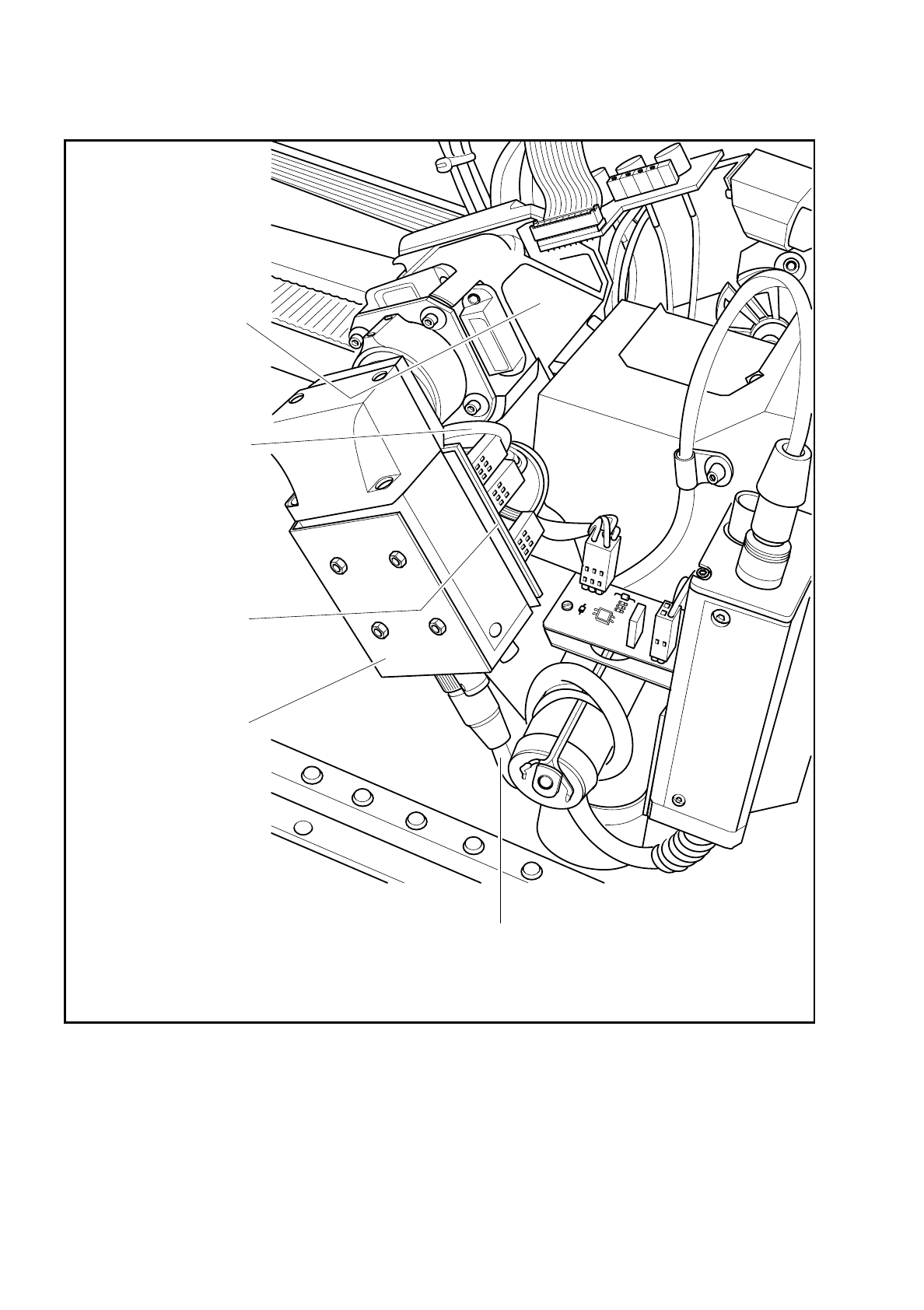
9 Revolver Head SIPLACE 80S/F/G Service Manual
Edition 04/97
9 - 90
Fig. 9.10.1 Optical component centering (component vision system)
Optical component
centering unit with
illumination
Cable Y0575-W1
to conversion board
'small axis' Y0005
Y0059 board
Component illumination
control (older version
Y0028)
Camera amplifier
Sony XC75
Camera cable Y0574-W1 for power supply and signal lines
to conversion board 'small axis' Y0005

SIPLACE 80S/F/G Service Manual 9 Revolver Head
Edition 04/97
9 - 91
9.10.2.1 Functional Description
A segment of the placement head picks up a component at revolver head station 1. The revolver head cycles
on, further components are picked up. Revolver head station 8 accommodates the optical unit of the compo-
nent vision system. Upon arrival of the component, it is evenly illuminated with red light by staggered rows of
LEDs. The lens can reproduce with sharp focussing components up to 5 mm tall in the camera's CCD chip.
The digital image of the components created by the components camera is transmitted to the vision evalua-
tion unit. With the aid of digital image processing (the HALE technique) the evaluation unit compares the com-
ponent image with a synthetic model previously created in the GF editor (GF = package form). The
parameters so obtained provide information on positional deviations, angle of rotation, leads condition and
components re-identification. The HALE technique has proved to be very resistant to interference, such as
reflection and dazzle, different reflectivity of leads, dispersed light, and so on. It is quicker and more precise
than the matching technique. After successful measurement the segment rotates the component in revolver
head station 9 into the correct placement orientation. In revolver head station 1 the component is than
inserted onto the PCB with the correct orientation.