3MAINTENANCE__O.pdf - 第121页
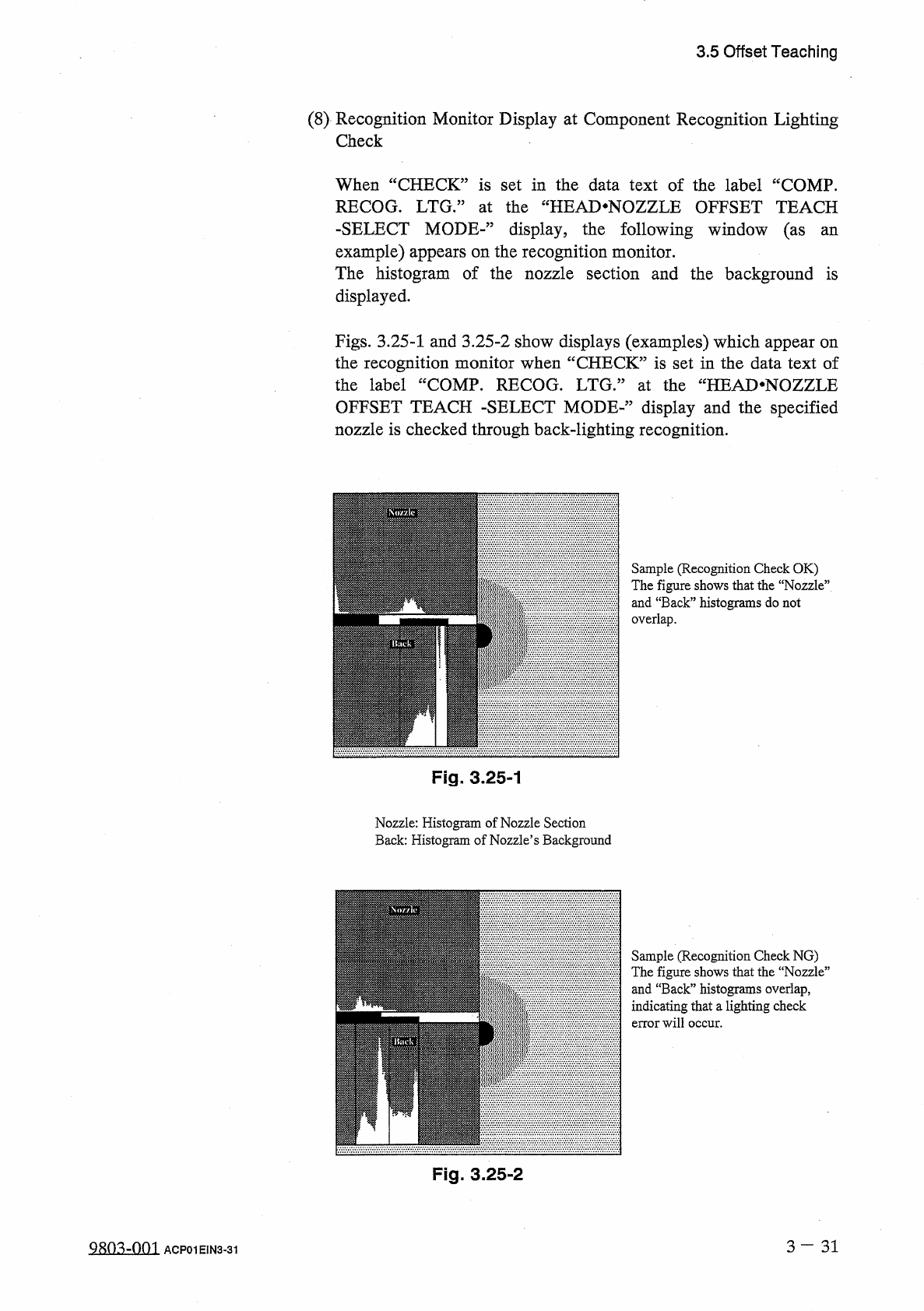
3.5 Offset Teaching ( 8 ) Recognition Monitor Display at Component Recognition Lighting Check When “ CHECK ” is set in the data text of the label “ COMP . RECOG . LTG • ” at the “ HEAD . NOZZLE OFFSET TEACH - SELECT MODE…
3.5
Offset
Teaching
•
The
following
explains
about
causes
and
remedies
(
troubleshooting
)
in
order
of
frequency
.
①
Stained
Nozzle
Distinction
:
Lighting
check
results
in
“
NG
”
on
a
specific
nozzle
.
An
NG
factor
may
be
found
visually
in
the
nozzle
image
on
the
recognition
monitor
.
Remedy
:
Wipe
the
nozzle
end
and
the
tapered
area
with
a
soft
cloth
.
②
Stained
Glass
Surface
of
Ring
Lighting
Distinction
:
Lighting
check
results
in
“
NG
”
on
almost
all
heads
and
nozzles
.
Remedy
:
Remove
any
foreign
residues
from
the
glass
surface
and
wipe
the
surface
with
a
soft
dry
cloth
.
③
Stained
Diffusion
Plate
Distinction
:
Lighting
check
results
in
“
NG
”
on
specific
heads
and
nozzles
.
Remedy
:
Wipe
the
diffusion
plate
(
red
acrylic
plate
on
the
lower
surface
of
placement
head
)
with
a
soft
cloth
.
④
Deterioration
of
Lighting
Distinction
:
When
the
level
of
deterioration
is
small
,
light
checking
results
in
“
NG
”
on
a
specific
nozzle
.
When
there
is
considerable
deterioration
,
“
NG
”
is
caused
on
almost
all
heads
and
nozzles
.
Remedy
:
Consult
our
service
personnel
for
re
-
adjustment
of
the
light
source
unit
.
Replace
the
lamp
of
the
light
source
unit
.
Adjust
the
image
input
parameters
.
■
Time
for
Lamp
Replacement
The
lighting
deterioration
rate
of
the
halogen
lamp
which
appears
after
longterm
use
is
10
%
when
power
is
supplied
for
5
,
000
-
6
,
000
hours
(
=
Approx
.
7
8
months
)
.
While
the
lighting
deterioration
rate
is
10
%
-
20
%
(
Approx
.
1
-
year
use
under
normal
condition
)
,
the
lamp
must
be
replaced
with
a
new
one
.
■
Reproducibility
of
Component
Recognition
Lighting
Teaching
Result
The
halogen
lamp
used
for
component
recognition
lighting
normally
shows
the
deterioration
of
lighting
after
longterm
use
.
In
addition
,
some
changes
in
the
light
intensity
are
caused
due
to
ambient
temperature
and
the
time
of
power
supply
.
Therefore
,
a
result
of
lighting
check
sometimes
shows
“
OK
”
or
“
NG
”
depending
upon
the
time
frame
and
/
or
the
room
temperature
when
component
recognition
lighting
teaching
operation
was
performed
and
the
lighting
condition
is
very
similar
to
the
detection
criteria
.
When
maintenance
work
is
done
but
component
recognition
lighting
teaching
operation
still
results
in
“
NG
”
,
there
might
be
a
sizeable
difference
between
the
pre
-
adjustment
at
shipment
and
the
actual
environmental
condition
.
In
this
case
,
consult
our
service
personnel
for
detailed
information
.
9
sn
^
-
nm
ACP
01
EIN
3
-
30
3.5
Offset
Teaching
(
8
)
Recognition
Monitor
Display
at
Component
Recognition
Lighting
Check
When
“
CHECK
”
is
set
in
the
data
text
of
the
label
“
COMP
.
RECOG
.
LTG
•
”
at
the
“
HEAD
.
NOZZLE
OFFSET
TEACH
-
SELECT
MODE
-
”
display
,
the
following
window
(
as
an
example
)
appears
on
the
recognition
monitor
.
The
histogram
of
the
nozzle
section
and
the
background
is
displayed
.
Figs
.
3.25
-
1
and
3.25
-
2
show
displays
(
examples
)
which
appear
on
the
recognition
monitor
when
“
CHECK
”
is
set
in
the
data
text
of
the
label
“
COMP
.
RECOG
.
LTG
/
5
at
the
“
HEAD
*
NOZZLE
OFFSET
TEACH
-
SELECT
MODE
-
’
,
display
and
the
specified
nozzle
is
checked
through
back
-
lighting
recognition
.
Sample
(
Recognition
Check
OK
)
The
figure
shows
that
the
“
Nozzle
”
and
“
Back
”
histograms
do
not
overlap
.
Fig
.
3.25
-
1
Nozzle
:
Histogram
of
Nozzle
Section
Back
:
Histogram
of
Nozzle
’
s
Background
Sample
(
Recognition
Check
NG
)
The
figure
shows
that
the
“
Nozzie
”
and
“
Back
”
histograms
overlap
,
indicating
that
a
lighting
check
error
will
occur
.
Fig
.
3.25
-
2
3
—
3 1
QRO
^
-
Om
ACP
01
EIN
3
-
31
3.5
Offset
Teaching
3.5
.
2
Head
Origin
Offset
Teaching
When
the
[
HEAD
ORIGIN
OFFSET
]
key
is
pressed
at
the
“
OFFSET
TEACH
”
display
,
the
following
display
appears
on
the
screen
.
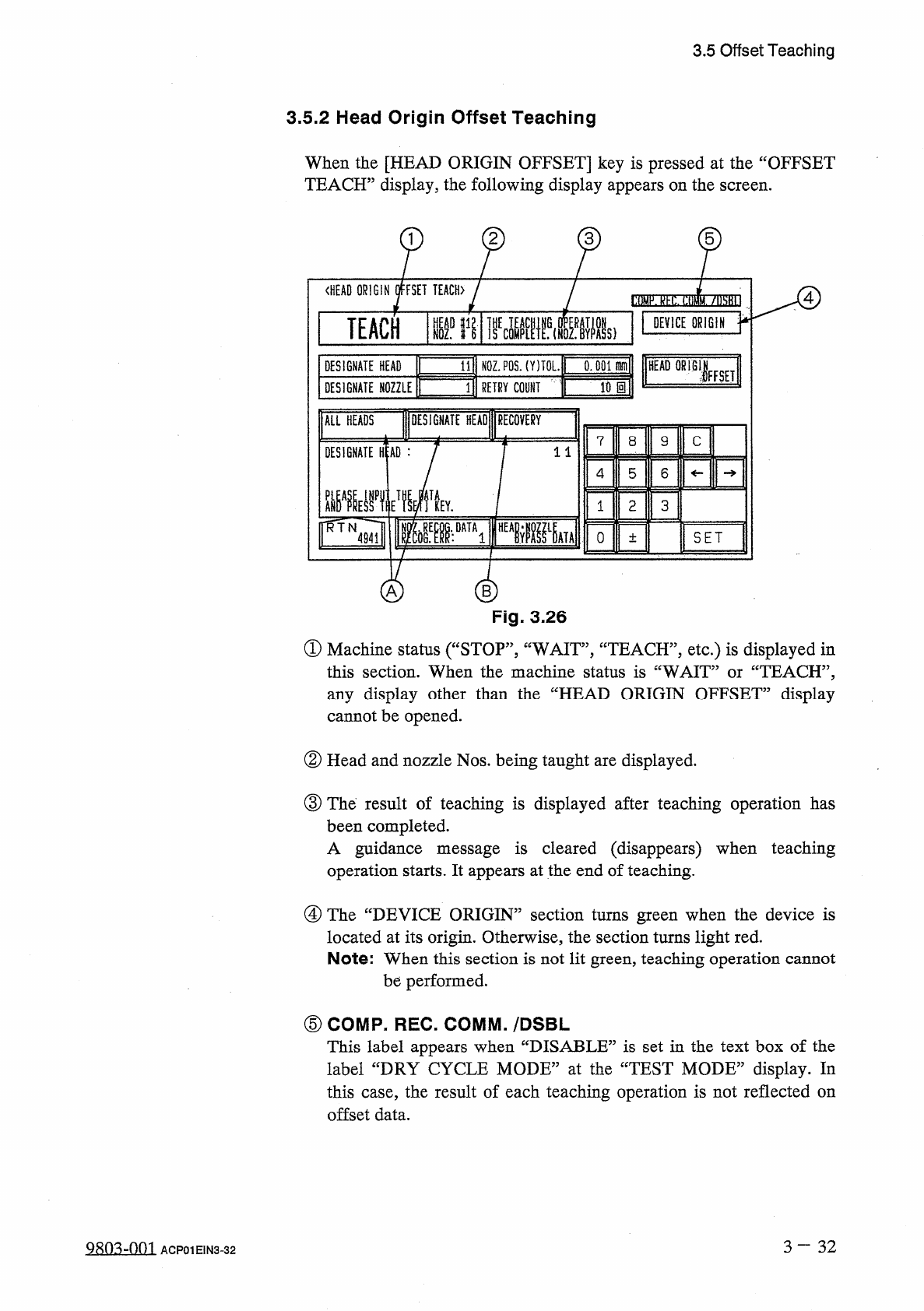
2
3
5
〈
HEAD
ORIGIN
OFFSET
TEACH
)
OTTW
!
!
!
7
IM
0
TEACH
tifl
liE
«
lfs
(
HIs
)
DEVICE
ORIGIN
0
:
001
爾
HEAD
OR
!
B
1
N
0
Z
.
P
0
S
.
(
Y
)
TOL
.
DESIGNATE
HEAD
IFFSET
Wm
3
RETRY
COlif
DESIGNATE
NOZZLE
DESIGNATE
HEAD
RECOVERY
ALL
HEADS
7
8
9
C
DESIGNATE
H
:
AD
:
11
5
6
4
觀
Vf
Y
1
2
3
^
TN
^
Tl
0
SET
4941
±
"
A
Fig
.
3.26
①
Machine
status
(
“
STOP
”
,
“
WAIT
,
,
,
“
TEACH
”
,
etc
.
)
is
displayed
in
this
section
.
When
the
machine
status
is
“
WAIT
”
or
“
TEACH
”
,
any
display
other
than
the
“
HEAD
ORIGIN
OFFSET
”
display
cannot
be
opened
.
②
Head
and
nozzle
Nos
.
being
taught
are
displayed
.
③
The
result
of
teaching
is
displayed
after
teaching
operation
has
been
completed
.
A
guidance
message
is
cleared
(
disappears
)
when
teaching
operation
starts
.
It
appears
at
the
end
of
teaching
.
④
The
“
DEVICE
ORIGIN
”
section
turns
green
when
the
device
is
located
at
its
origin
.
Otherwise
,
the
section
turns
light
red
.
Note
:
When
this
section
is
not
lit
green
,
teaching
operation
cannot
be
performed
.
⑤
COMP
-
REC
.
COMM
.
/
DSBL
This
label
appears
when
“
DISABLE
”
is
set
in
the
text
box
of
the
label
“
DRY
CYCLE
MODE
”
at
the
“
TEST
MODE
”
display
.
In
this
case
,
the
result
of
each
teaching
operation
is
not
reflected
on
offset
data
.
3
~
3 2
ACP
01
EIN
3
-
32