00198371-01_UM_SWS-EN.pdf - 第56页
2 Operational safety User manual SIPLACE Wafer System (SWS) 2.7 Disabling the compressed air supply and discharging the pressure Edition 04/2018 56 2.7 Disabling the compressed air supply and discharging the pressure The…
User manual SIPLACE Wafer System (SWS) 2 Operational safety
Edition 04/2018 2.6 Safety features
55
2.6.4 Energy state of the SWS after switching off at the main power switch
2
2
2.6.5 Compressed air conditions in the SWS after switching off at the main power
switch
When switching off the main switch or if the power supply fails, the electrically-controlled main
valve of the compressed air unit will close. The pressure will drop to 0 MPa (0 bar) within 5 sec-
onds.
CAUTION
Please note that each SIPLACE Wafer System has its own main switch.
DANGER
Lethal voltages in the power supply unit!
The power supply unit has certain components (such as the mains power filter) which still
conduct lethal voltages even when it is switched off.
Only ASM Assembly Systems GmbH&Co.KG service engineers or the machine
owner's service engineers, who have been trained by ASM, may perform work on the
power supply and the safety cutoff (CBS).
CAUTION
Data loss!
To avoid data loss, only switch the SIPLACE Wafer System off after fulfilling the following
criteria (unless it is an emergency):
– The SIPLACE Wafer System has completed data transfer.
– The SIPLACE Wafer System has completed processing.
– The SIPLACE Wafer System has completed the shutdown phase.
2 Operational safety User manual SIPLACE Wafer System (SWS)
2.7 Disabling the compressed air supply and discharging the pressure Edition 04/2018
56
2.7 Disabling the compressed air supply and discharging
the pressure
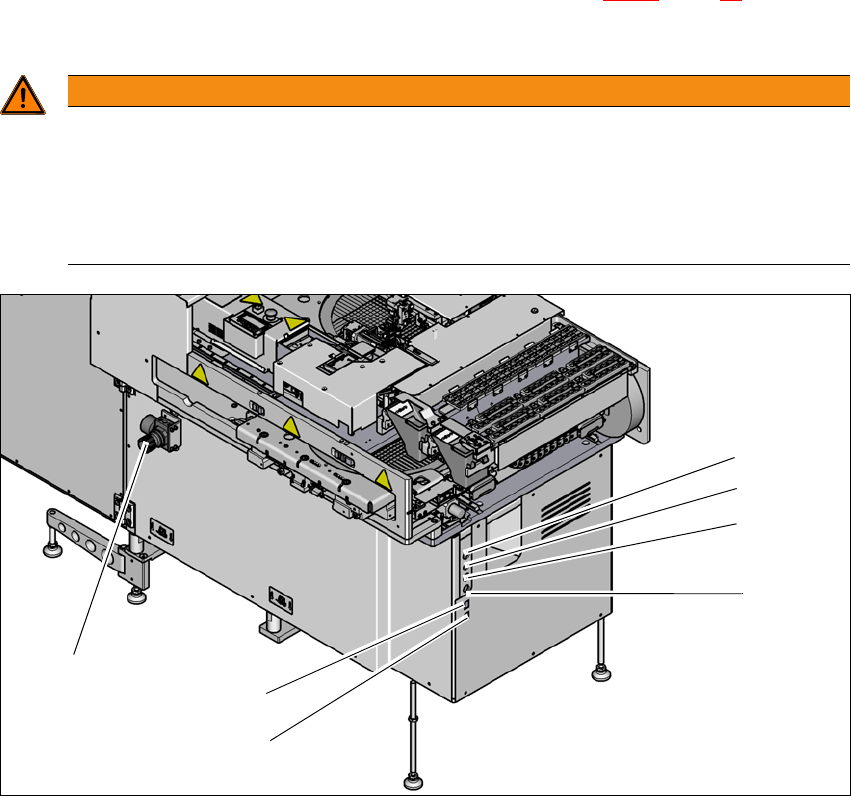
The compressed air unit is located on the back of the SWS (see fig. 2.7 - 1, page 56 ). The com-
pressed air working pressure of the SWS is set to 0.50 ± 0.025 MPa (5.0 ± 0.25 bar).
2
2
Fig. 2.7 - 1 Electrical and pneumatic connection point on the SWS (example SWS 2/4)
2
WARNING
Risk of injuries!
Risk of injuries from pressurized compressed air lines. The compressed air supply to the
SWS is made available by the SIPLACE CA4 V2.
Switch the compressed air off at the SIPLACE CA4 V2.
NEVER detach compressed air lines while they are still pressurized.
(1) Setting the air blast for flip head segments
or die attach segments
(2) Voltage supply
(3) Interface safety cutoff with SIPLACE CA4
V2
(4) CAN bus (for SW 605.x only)
(5) Opening for compressed air hose from the
SIPLACE CA4 V2
(6) LAN1 - communication with external map
server
(7) LAN2 - communication with SIPLACE CA4
V2 and possible with other SWS
(1)
(2)
(3)
(4)
(6)
(7)
(5)

User manual SIPLACE Wafer System (SWS) 2 Operational safety
Edition 04/2018 2.8 Locking the SIPLACE Wafer System and attaching warning labels
57
2.8 Locking the SIPLACE Wafer System and attaching
warning labels
2.8.1 Purpose and scope
Before performing any preventive maintenance work or service work on the SIPLACE Wafer Sys-
tem, a procedure of locking and tagging must be followed. The procedure, when followed correctly
eliminates the possibility of an employee being injured.
2
2.8.2 Description
Whenever it becomes necessary to isolate, control and release energy for the SIPLACE Wafer
System, the following procedure must be followed
Notify affected employees.
Switch off the SIPLACE Wafer System and any auxiliary devices. Carry out all normal stop-
ping procedures:
– Shut down the SIPLACE Wafer System.
– Switch off the SIPLACE Wafer System at the main switch.
Disconnect the SIPLACE Wafer System from all its energy sources:
– Switch off the compressed air at the SIPLACE CA4 V2, thereby interrupting the supply
of compressed air to the SIPLACE Wafer System.
– Interrupt the power supply to the SIPLACE Wafer System.
Lock out the machine.
– Attach a lock whenever possible (e.g. to the main switch).
PLEASE NOTE
Minimum requirements
These procedures represent the minimum lock/tag out requirements for the preventive
maintenance or service work. Any additional safeguards needed to complete work safely
can be specified by facilities supervision, the safety officer, the safety committee and the
health department.