YSI_Prog_E - 第151页
3-28 3 Step screen 3. Editing Assistance By press the [Edit Assist] button at the "T uning" tab, an "Edit Assist" screen used to create steps efficiently appears. This section describes operations tha…
3-27
3
Step screen
2.4.2 Measurement results
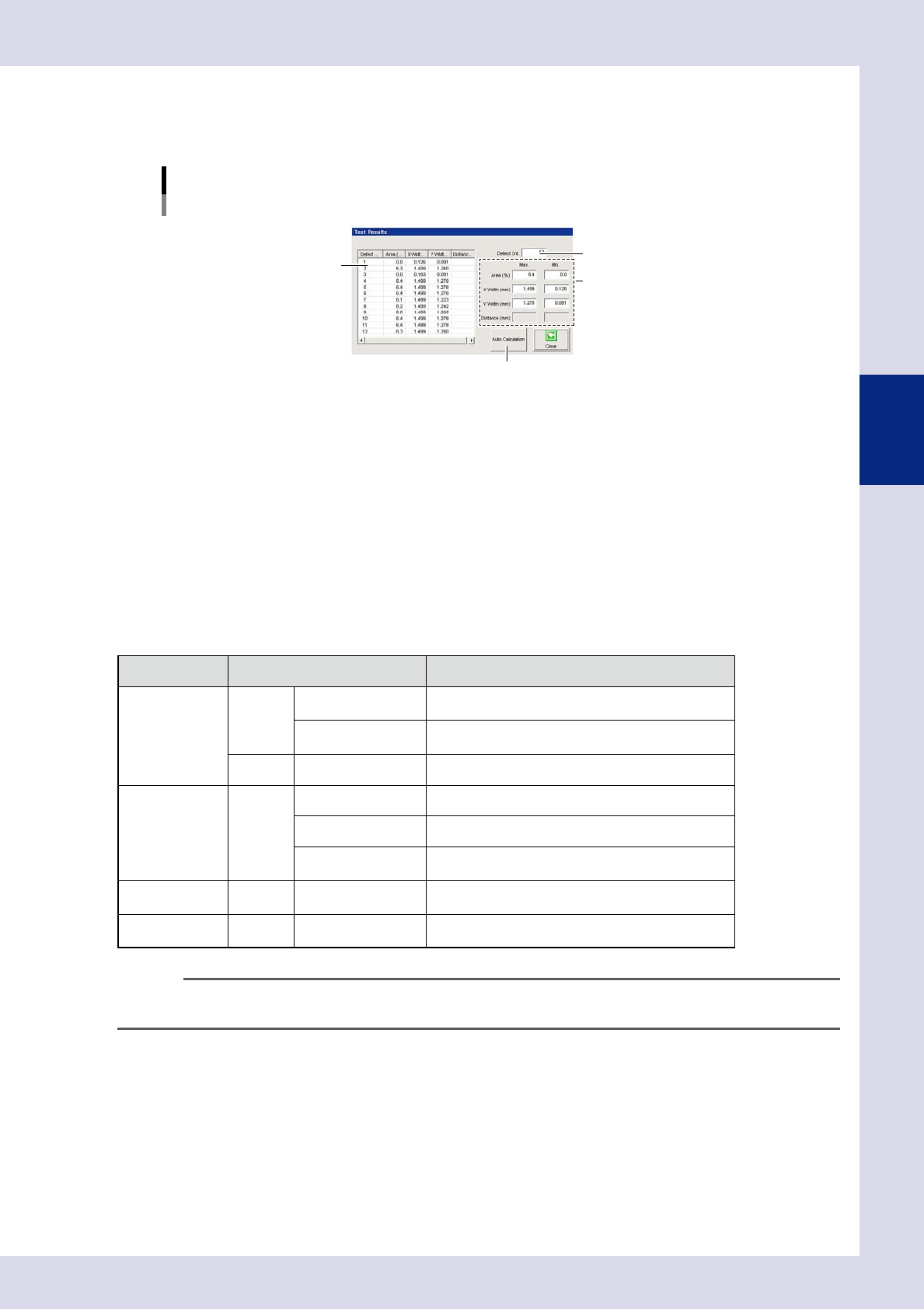
By pressing the [Detail] button following a step test, a "Test Results" screen appears containing data for
detected areas within steps.
"Test Results" screen
Inspection mode: "Lead Check"
3
2
1
4
24332-P6-00
1. Detection area details
Shows the details of all detection areas within the step. Recognized characters and corresponding scores are displayed
following a character recognition test.
2. Detect count
Shows the number of detected steps and number of inspection steps.
3. Max. / Min.
Displays the "Area", "X Width", and "Y Width" maximum and minimum values.
4. [Auto Calculation] button
By pressing this button, detection condition setting values change to appropriate values automatically based on the
detection area. The locations which change and appropriate value calculation method differ for each inspection status.
The items that are automatically set by pressing the [Auto Calculation] button are as follows.
Status Parameters Setting value
Lead Check Judge
Maximum Acceptable
Size X, Y
1.5 times the maximum size XY of each detected lead
Lead Width Check
0.7 times the minimum size of each detected lead when
this parameter is enabled.
Detect Std Area Step area
Electrode Check Detect Std Area Sum of two electrode areas
Minimum Area Fixed to 20%
Minimum Detectable
Size X, Y
0.7 times the step frame size
Character
Recognition
Detect Character Size Maximum detectable size XY by character recognition
Parts Check Detect
Minimum Detectable
Size X, Y
0.7 times the step frame size
n
NOTE
Values entered by pressing the [Auto Calculation] button cannot be applied to all parts. If a step test is performed
and the test result is not incorrect, change the parameter settings as required.
3-28
3
Step screen
3. Editing Assistance
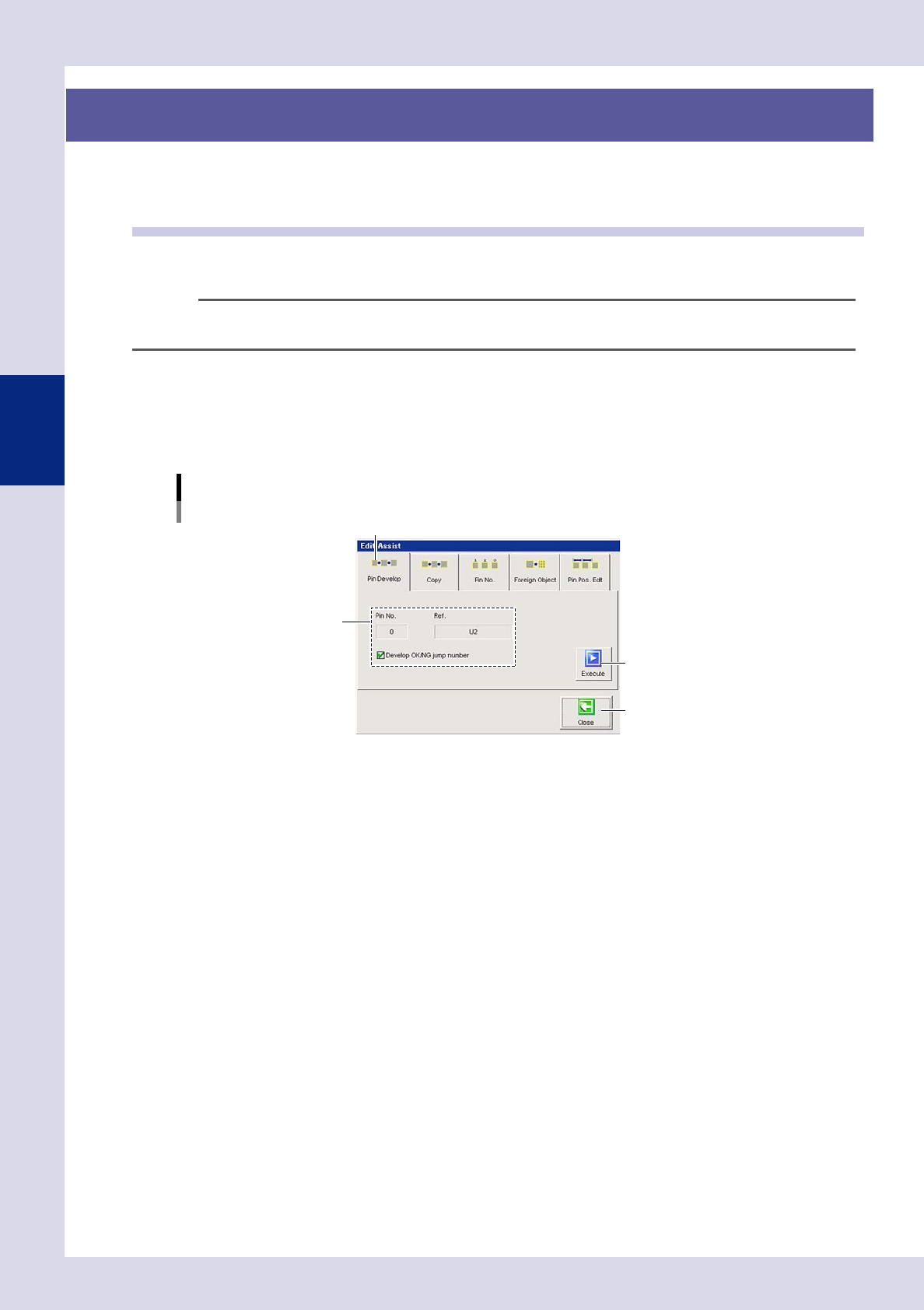
By press the [Edit Assist] button at the "Tuning" tab, an "Edit Assist" screen used to create steps efficiently
appears. This section describes operations that can be performed at the "Edit Assist" screen.
3.1 Pin Information Deployment
Pin information deployment is used when changing parameters for steps in which leads with set pin Nos. are
inspected by deploying parameters for inspection of other leads on the same parts to the same settings.
TIP
In order to deploy pin information, the "Ref. No." and "Pin No." must be set correctly for all relevant steps in the basic
parameters.
1
Select a step.
Select the deployment source lead step at the "Step" screen.
2
Press the [Edit Assist] button and open the "Pin Develop" tab.
A screen used to set the deployment of pin information appears.
Editing assistance
Pin information deployment
Step 3
[Execute] button
[Close] button
"Pin Develop" tab
24333-P6-00
3
Check the Pin No. and Ref No.
The Pin No. and Ref No. for the step selected at Step 1 are displayed. Verify that they are correct. To
deploy the OK/NG jump number, select the "Develop OK/NG jump number" check box.
4
Press the [Execute] button.
The inspection parameter settings for all leads on the same parts will be the same for the lead
parameters selected at Step 1.
5
Press the [Close] button to end deployment.
3-29
3
Step screen
3.2 Copying steps
This function is used when creating multiple selected steps in the X and Y directions with arbitrary pitch.
1
Select a step.
Select the steps to be copied at the "Step" screen.
Multiple steps can also be copied by dragging with the mouse.
2
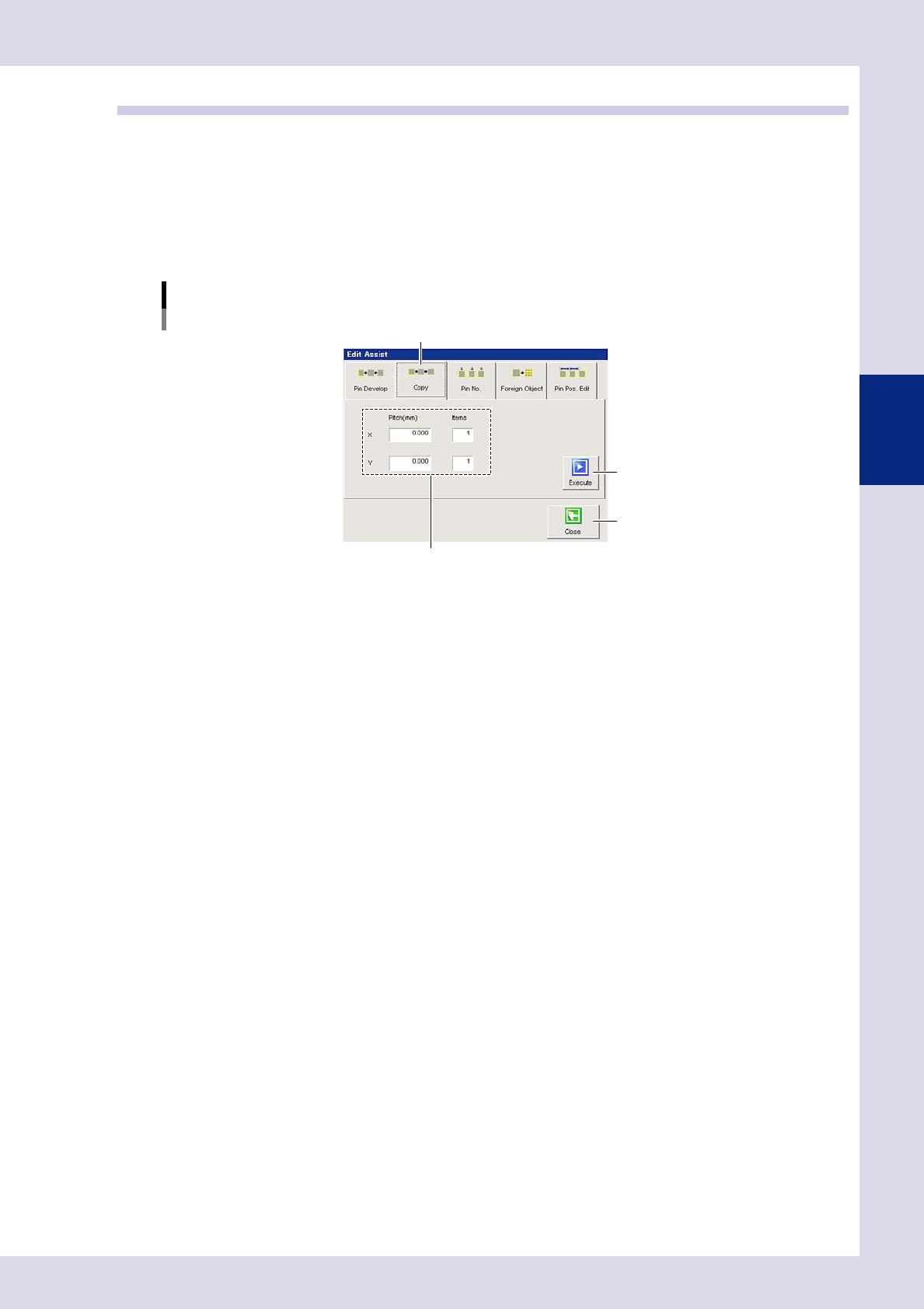
Press the [Edit Assist] button and open the "copy" tab.
A screen used to set step copy conditions appears.
Editing assistance
Copying
Step 4
[Execute] button
[Close] button
"copy" tab
24334-P6-00
3
Enter the pitch and number of items.
If copying the X direction (horizontal), enter the pitch and number of items after copying in the X field.
By entering a positive value for pitch, steps are copied in the right direction, and by entering a negative
value, steps are copied in the left direction. If copying the Y direction (vertical), enter the pitch and
number of items after copying in the X field. By entering a positive value for pitch, steps are copied in
the upward direction, and by entering a negative value, steps are copied in the downward direction.
4
Press the [Execute] button.
Copied steps are displayed in a step image.
5
Press the [Close] button to end deployment.