00195346-0302_SM_WPC4_EN.pdf - 第56页
Replacing Spare Parts Limit Switches, Sensors and Light Barriers Repl acing the Collisio n Light Bar riers [03047281- xx] 56 Ser vice Manual SIPLACE WPC4 The status of the collisio n lightbarrier is display ed at the int…
Replacing Spare Parts
Replacing the Collision Light Barriers [03047281-xx] Limit Switches, Sensors and Light Barriers
Service Manual SIPLACE WPC4
55
3.6.8.1 Adjusting the Collision Light Barriers
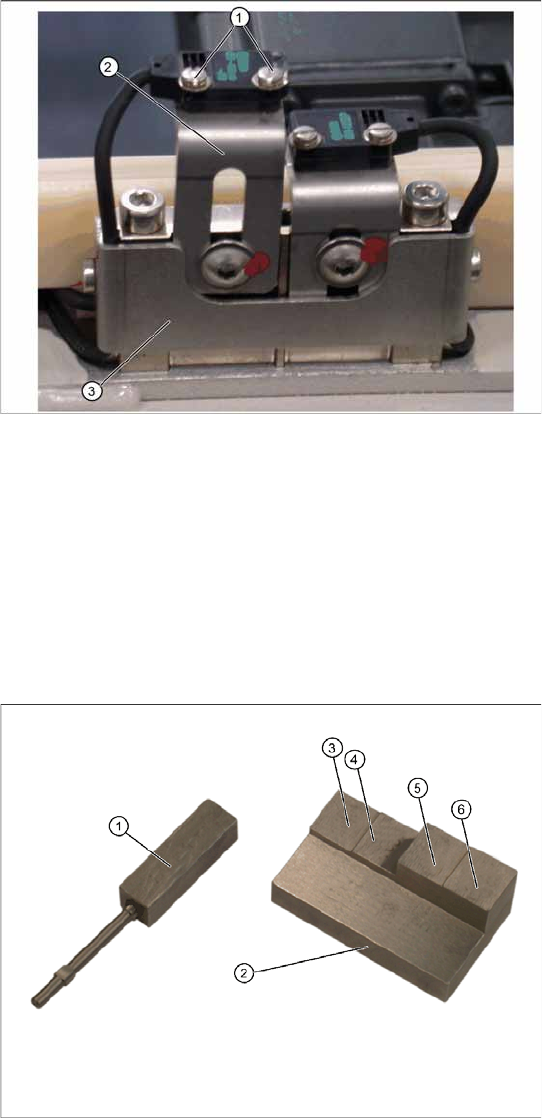
X Loosen the two fastening screws (1) for the
relevant sensor (transmitter or receiver) on the
mounting bracket (2).
X Loosen the two screws holding the cable
fixtures (3).
X You need to remove the plastic guidance on
the right-hand side, so that you can unthread
the plug or light barrier.
X Loosen the cable clamps and remove the
cable ties.
X Unthread the connection cable as far as the
control unit back plane and unplug it from the
terminal strip.
X Fit the sensor on the mounting bracket (2).
X Align the sensor parallel to the mounting
bracket (3).
X Restore the electrical connection and fix the
connection cable into place.
Settings
Set the collision light barriers. See Section (3.6.8.1
Adjusting the Collision Light Barriers
J
55) .
Tools and equipment
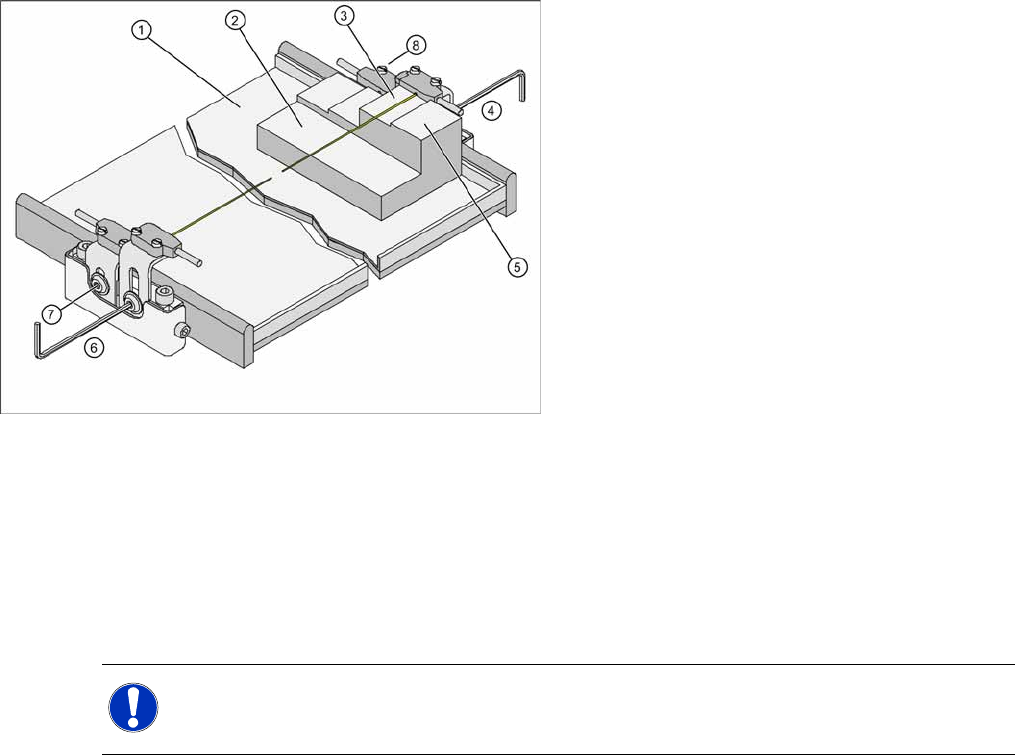
1. Setting gauge small [03052363-02]
2. Setting gauge large for collision lightbarriers
[03051814-01]
3. Step for passage height of "normal"
components in case that every level of the
WPC is used.
4. Step for trigger height of collision light barrier
for "normal" components
5. Step for passage height for "high" components
if the subsequent level above is not used.
6. Step for trigger height of collision lightbarrier
for "high" components
Replacing Spare Parts
Limit Switches, Sensors and Light Barriers Replacing the Collision Light Barriers [03047281-xx]
56 Service Manual SIPLACE WPC4
The status of the collision lightbarrier is displayed at the integrated LED
Red LED ON = not triggered (normal mode)
Red LED OFF = triggered (light beam is interrupted - collision situation)
Green LED ON = ready for operation/stability display (optimum light barrier setting)
Green LED OFF = ready for operation/stability display (no optimum light barrier setting)
X For the setting of the collision lightbarriers the large setting gauge (2) is needed.
Step 1: Height setting
X Put the setting gauge with the step for passage height on the WPTC in front of the corresponding
sender/receiver.
The green and the red LEDs must be ON.
X Move the gauge or the WPTC to the trigger height step.
X Check whether at the trigger height step the light beam is now interrupted:
The red LED must be OFF.
X If the setting is not correct the height of the sender or receiver at position (4) and (6) resp. (7) and
(8) must be corrected.
X Put the setting gauge with the step for trigger height on the WPTC in front of the corresponding
sender/receiver. The collision lightbarrier must definitely trigger here, too.
X Repeat the described procedure until the collision lightbarrier is adjusted to the correct height and
switches at the trigger points over the whole width of the WPTC.
Step 2: Functional check in SITEST
X Additionally check in SITEST if the correct outputs are switched.
In the SITEST main menue in
Function => SITEST Inputs-/Outputs
the display
collision
lightbarrier for normal components
or
collision lightbarrier for high components
will be
activated.
Measurement setup and procedure
1. Waffle pack tray carrier (WPTC)
2. Setting gauge
3. Passage height (for high components)
4. Setting of collision lightbarrier (receiver) for
high components
5. Step for trigger height of collision lightbarrier
for "high" components
6. Setting of collision lightbarrier (sender) for high
components
7. Setting of collision lightbarrier (receiver) for
normal components
8. Setting of collision lightbarrier (sender) for
normal components
NOTE:
X The settings must be set on both sides of the WPTC.
X Check the function in SITEST (Step 2)
Replacing Spare Parts
Replacing the Reference Sensor, Lifting Axis [03047278-xx] Limit Switches, Sensors and Light Barriers
Service Manual SIPLACE WPC4
57
3.6.9 Replacing the Reference Sensor, Lifting Axis [03047278-xx]
Settings
X Check the function and correct position of the reference sensor.
X To do this, open the SITEST main view and select the function=>
SITEST Settings
.
X In the input area
Axis
select
Lifting axis
.
X In the input area
Travel range
select
Reference bero
.
The lifting axis is moved, approaches the reference sensor and determines the reference point.
In the SITEST main view, function=>
SITEST inputs/outputs 1,
the display
Reference sensor,
lifting axis
will be activated.
A dialog box will open and the calculated reference point will be shown. The permissible limits
(minimum/maximum position) will also be shown. The reference point must be within these limits.
X Check the permissible limits against the value actually measured.
X If necessary, correct the mechanical position of the reference sensor and repeat the measurement
procedure.
X If the value is within the permissible limits, save the data by clicking on
Accept
.
Spare part
Reference point proximity switch for lifting axis
[03047278-01]
Removal/installation
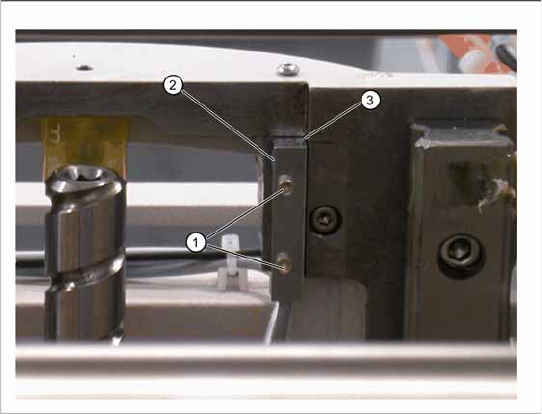
X Loosen the two fastening screws (1) on the
reference sensor.
X Loosen the cable clamps and remove the
cable ties.
X Unthread the connection cable as far as the
control unit back plane and unplug it from the
terminal strip.
X Fit the reference sensor so that the sensor
surface (2) points to the side.
X Align the reference sensor parallel to the right-
hand and top stopper edges (3).
X Restore the electrical connection and fix the
connection cable into place.