AOI_RS_v85_en - 第140页
Chap ter3 SPC User Ma nual AOI Repair Station 136 7.4.1.10 Other Settings Besides the 8 settings mentioned above, there are several other settings. Y ou can press “Parameter” in “Setting” ,then select “Others” page. …
Chapter3 SPC User Manual
AOI Repair Station
135
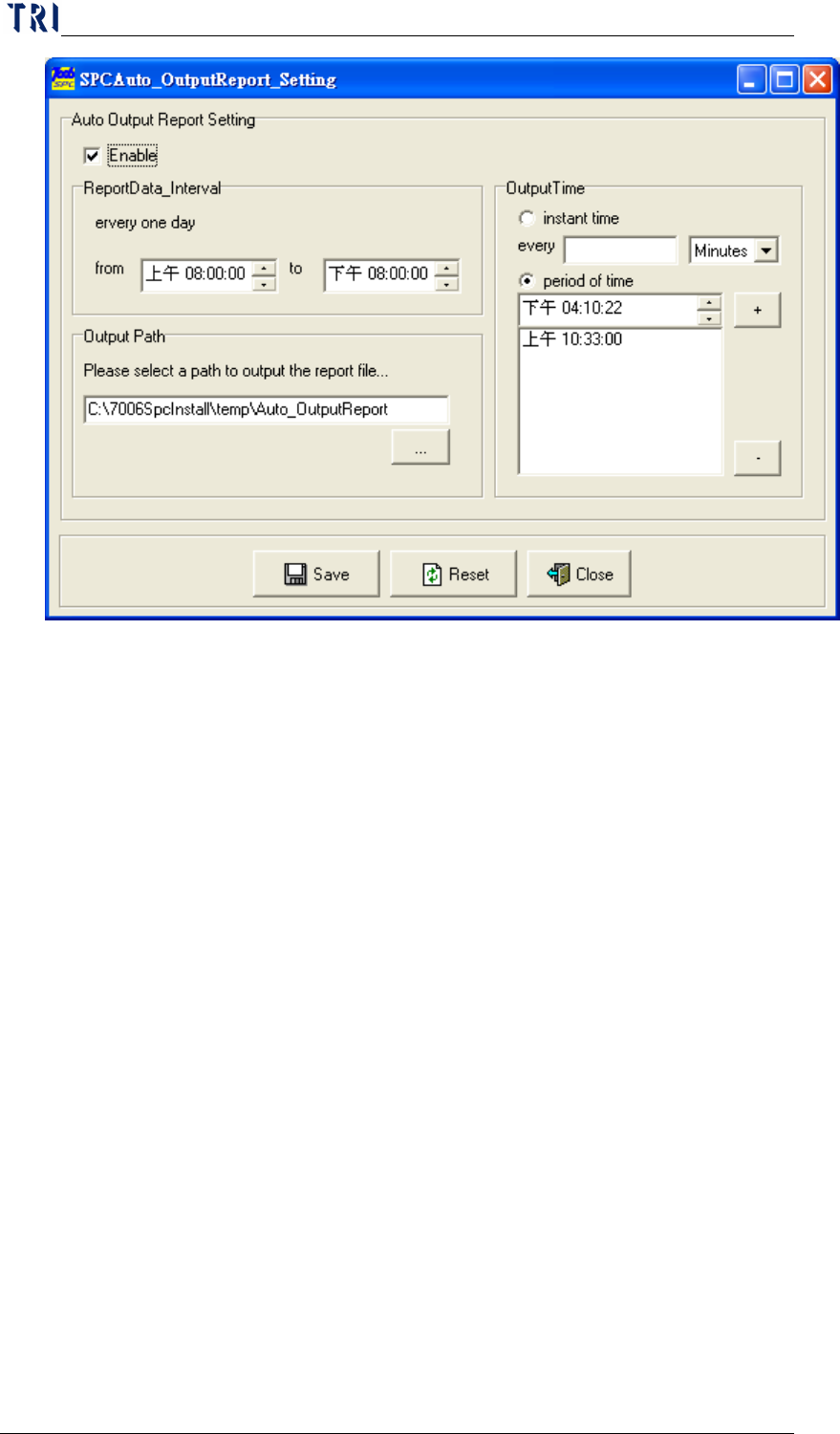
When user checks [Enable], the Style 3 Report will be created
automatically. [ReportData_Interval] Area is to set the time
interval; because the report is a daily report, the report will contain
the data collected in this interval everyday. Take the figure for
example, system will export the data collected form 8 a.m. to 8p.m.
[Output Path] is to set the output path of the report. Take the
figure for example, the report will be saved in
[C:\7006SpcInstall\temp\Auto_OutputReport] automatically. The
report is named by the date, for example, [2005.11.03.xls] is
created at 3
rd
, November, 2005. There are 2 kinds of output time
could be selected in [Output Time] Area.
Instant time method: Sets the time interval for sampling. The unit
for time interval can be in Minutes or Hours. For example, if you
set “5 Minutes”, this indicates that sampling will be performed
once every 5 minutes. If you set “0 Minutes” or “0 Hours”, this
indicates that there is no need to pause, the sampling is performed
non-stop.
Period of time method: Sets the time zone for sampling everyday.
For example, if you set “Morning 09:00:00”, this indicates that
sampling will be performed once at 9:00 a.m. everyday.
Chapter3 SPC User Manual
AOI Repair Station
136
7.4.1.10 Other Settings
Besides the 8 settings mentioned above, there are several other
settings. You can press “Parameter” in “Setting” ,then select
“Others” page.
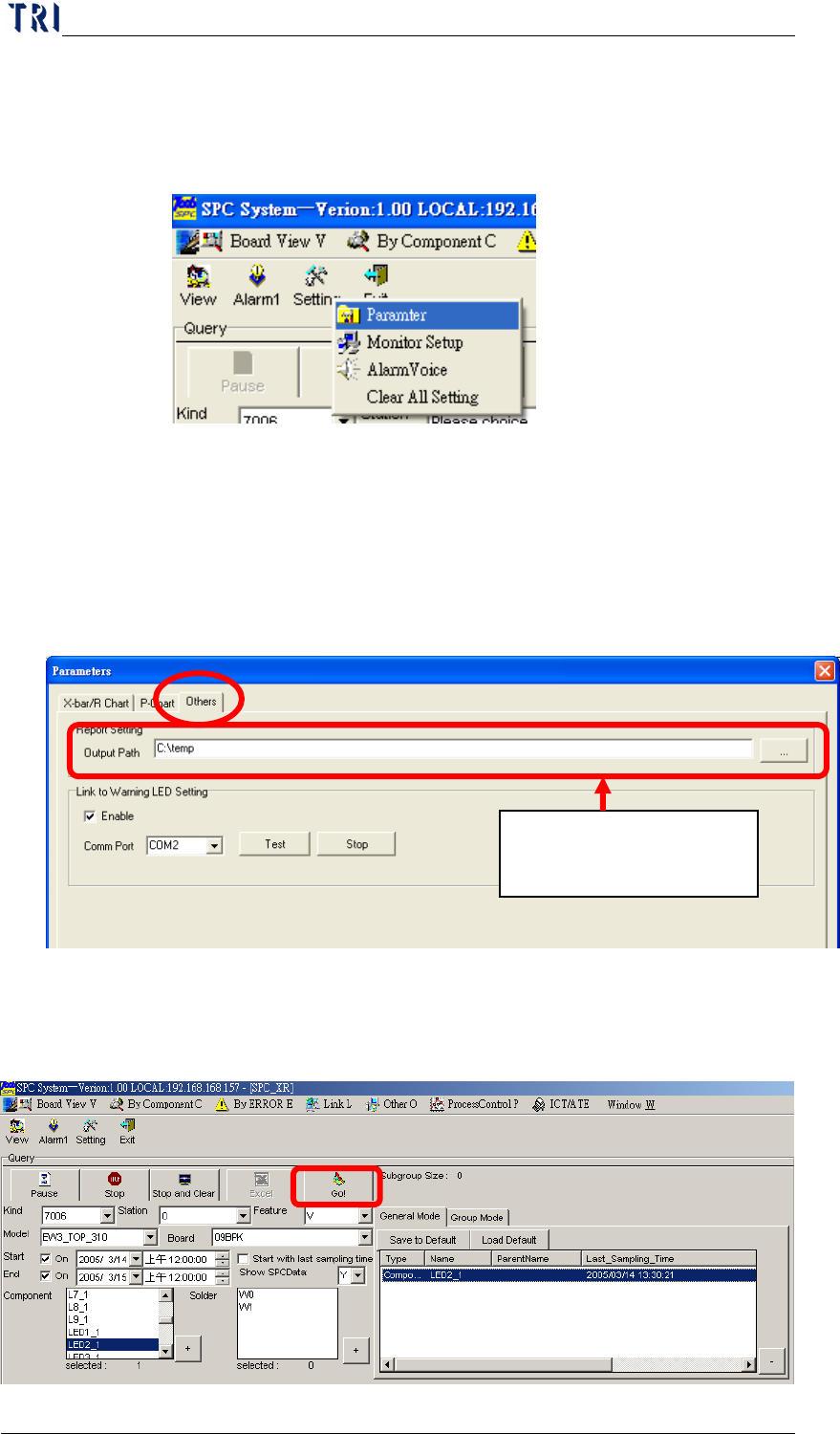
Report Setting: Select the default path for outputting report.
Link to Warning LED Setting: If check “Enable” item, user can set
a signal tower to display warning when there is an alarm coming up.
“Comm Prot” means the communication port (COM1, COM2…)
the signal tower uses; “Test” and “Stop” is to test the signal tower
and to stop testing.
7.4.2
Start monitoring
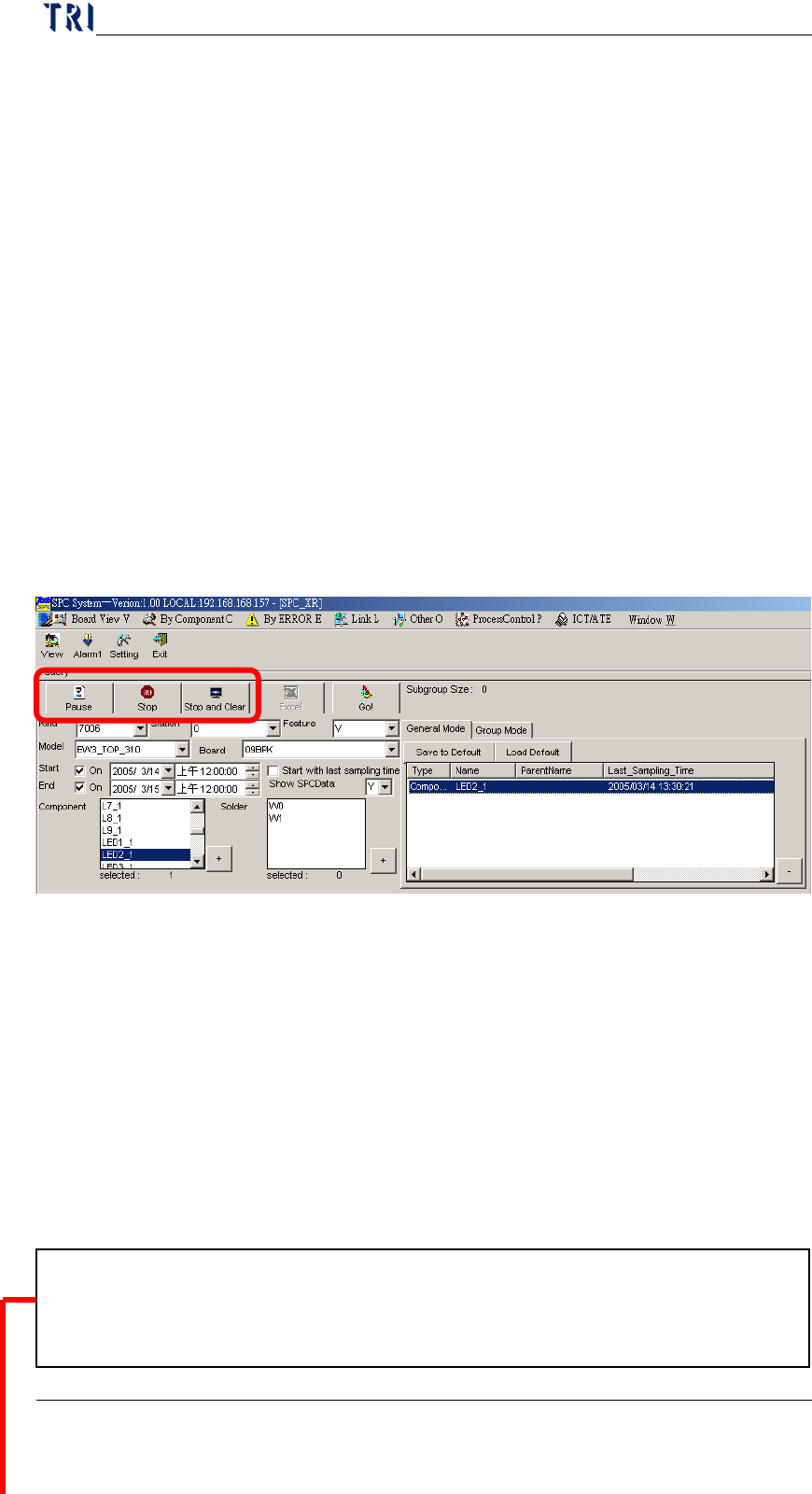
After completing all settings, just click on the “Go!” button and the
system will starts monitoring as shown in the following figure.
Select the default path
for outputting report
Chapter3 SPC User Manual
AOI Repair Station
137
When user enables the Style 3 Report and clicks on [Go!], system
will start the reporting function. System changes the date in [Start]
and [End] field to that day; it also changes the time in [Start] and
[End] field to the reporting time set in [ReportData_Interval]; and
the check boxes front of [Start] and [End] are checked
automatically. When time for reporting, system will report Style
3 Report and change the date in [Start] and [End] field to the next
day. The function goes this way until a user Pause or Stop the
monitoring.
7.4.3
Monitoring
(I) During monitoring, you can perform these three actions:
①
Click on “Pause” to halt monitoring
②
Click on “Stop” to stop monitoring
③
Click on “Stop and Clear” to stop monitoring and clear all data in
the screen.
In addition, after each sampling the system will check if this
component or solder is an applicable monitor item (that is,
non-realtime monitor item) for this alarm. Real-time monitor items
will definitely use this alarm. If applicable, the system will check for
errors by comparing the alarm conditions with the computed control
upper limit, lower limit, and control mean value and sample mean
value. If there is an error, the system will generate beeps to remind
the user that error has occurred and also display the following alarm
window.
The “Reason” box shows what kind of error occurred in a component while “in points” at the end
of reason text line also indicates the error control point location. Using this figure as example,
“C1_1” has an “over X bar chart UCL/LCL” error at point “9”.