00198521-01_UM_LDU_E_EN.pdf - 第25页
3 Function description and structure 3.2 Structure User Manual SIPLACE Linear Dipping Unit E 12/2018 25 3.2.9 Control unit 1. 7 segment display 1/2 (operation mode, er- ror mode, emergency stop) 2. 7 segment display 3/4 …
3 Function description and structure
3.2 Structure
24 User Manual SIPLACE Linear Dipping Unit E 12/2018
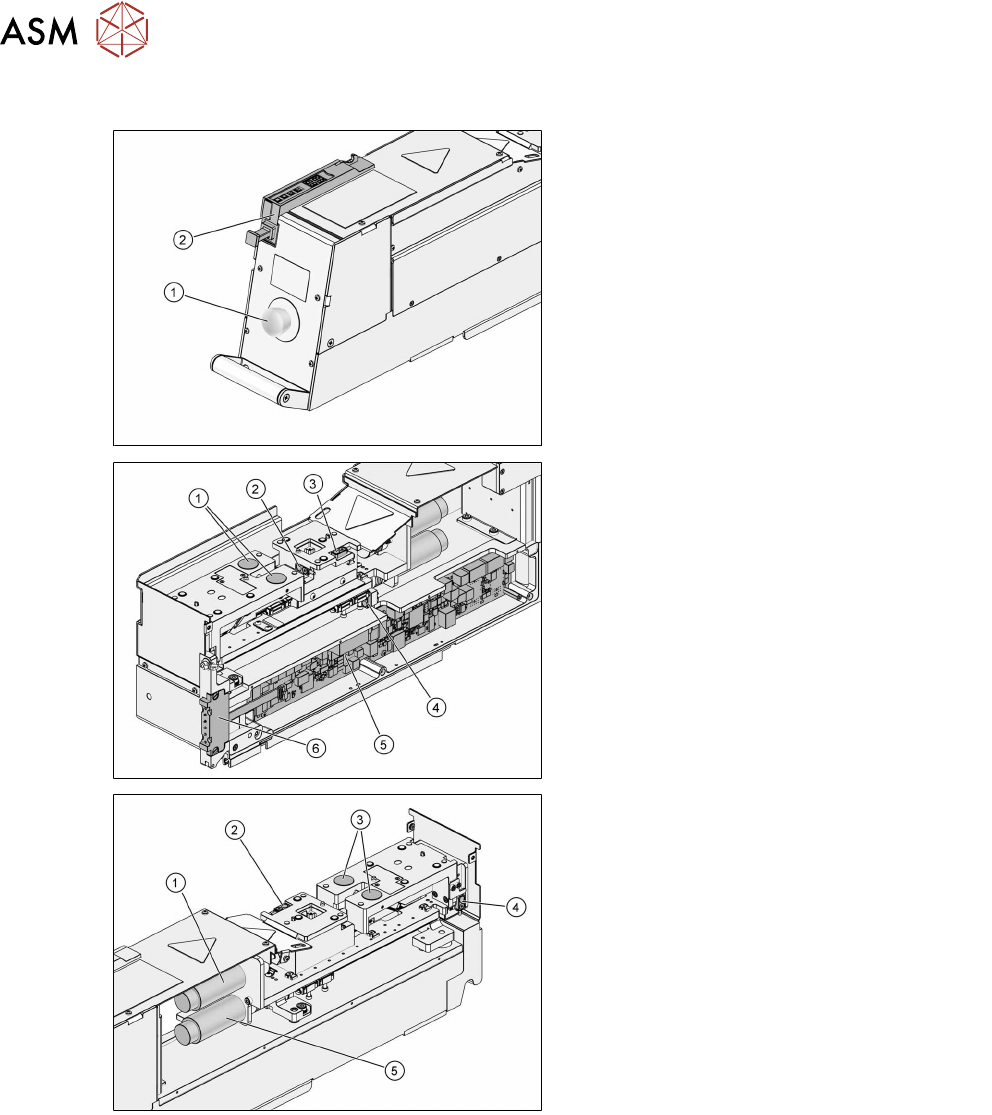
3.2.8 Electronics
1. Emergency stop button
2. Control unit
1. Electromagnets
2. Sensor for drip tray
3. Sensor for park plate
4. Position switch of squeegee axis
5. Control board
6. Spring contact area
1. Motor of lift axis
2. Sensor for park plate
3. Electromagnets
4. Position switch of lift axis
5. Motor of squeegee axis
3 Function description and structure
3.2 Structure
User Manual SIPLACE Linear Dipping Unit E 12/2018 25
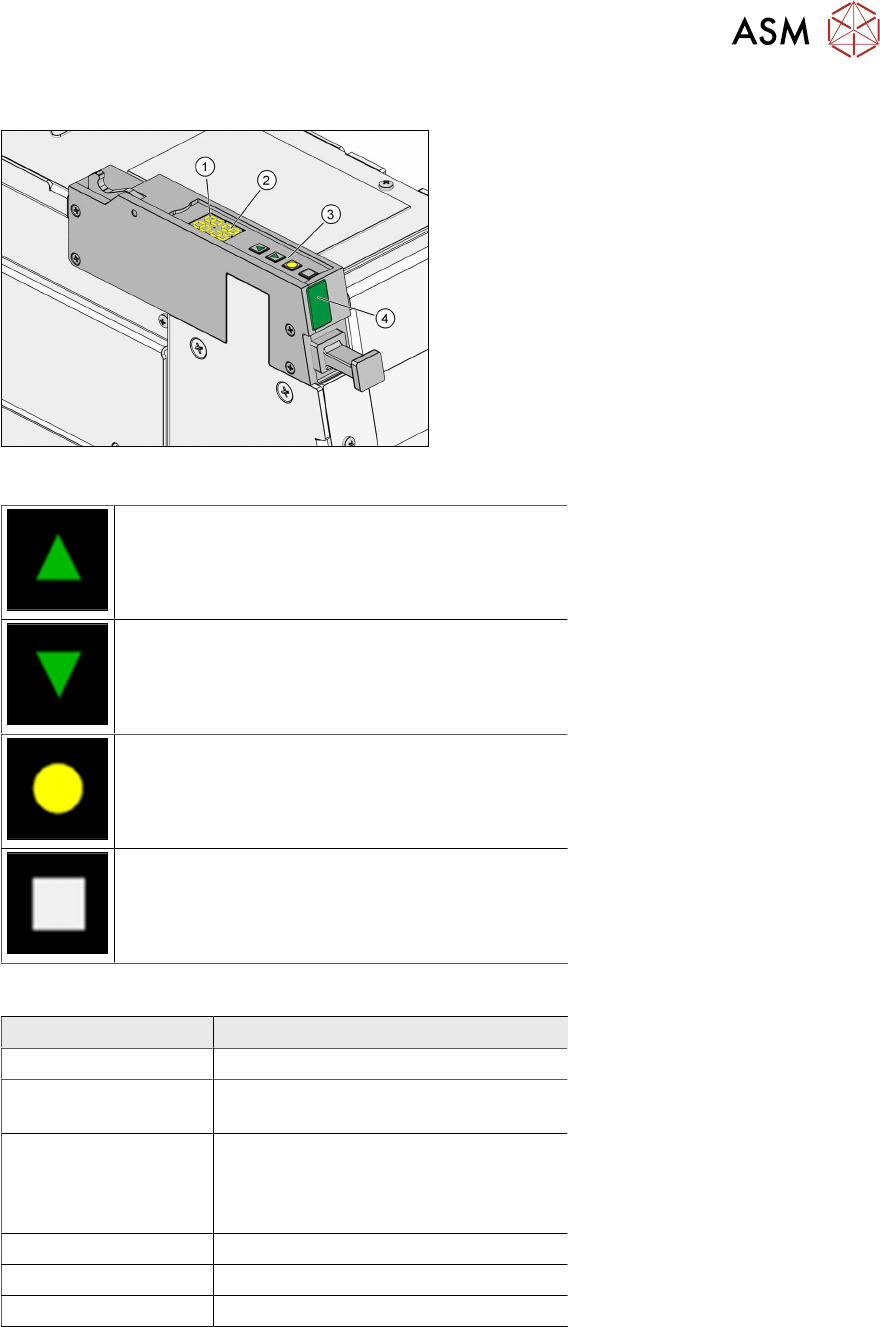
3.2.9 Control unit
1. 7 segment display 1/2 (operation mode, er-
ror mode, emergency stop)
2. 7 segment display 3/4 (error number,
squeegee speed, remaining cycles, emer-
gency stop)
3. Function keys
4. Status LED
Function keys
Up key: Pressing it briefly switches to the next
operating mode (P0 -> P1 -> P2 -> …). Pressing
it long while in mode P2 switches to the activity
level Advanced production (P2 -> P3).
Down key: Switches to the previous operating
mode (P2 -> P1 -> P0…). Clears the current error
in the Er display.
<Select> key: Selects the operating mode dis-
played, starts an operation, switches on the 7
segment displays.
<Adjust> key: Sets a parameter, clears an error,
halts the warm-up cycle.
Status LED
Color of status LED Operating state of the LDU
Green (permanent) Ready for operation
Amber (permanent) Warning. The LDU will change soon to
the state "Not ready".
Red (permanent) LDU not initialized, not warmed up or
in error mode. The 7 segment display
1/2 shows the corresponding error
number.
Off Not ready for operation
Green (fast flashing) Software download
Red (fast flashing) Application software invalid
Operating the LDU with the help of the function keys is described in chapter 4.17 "Operating the
control unit" [}56].
3 Function description and structure
3.3 Basic process
26 User Manual SIPLACE Linear Dipping Unit E 12/2018
3.3 Basic process
The following section describes the dip process and the parameters which influence this process.
3.3.1 Usage of flux
To improve the solderability of corrosive components or components with complex structures,
these components should be coated with additional flux during production. This increases the qual-
ity of the soldered connection. The flux is applied to the relevant contact surfaces of the component
or board during the placement procedure. The two most common procedures are dispensing and
dipping. In addition, there are other procedures such as printing, stamping, spraying, brush applic-
ation etc.
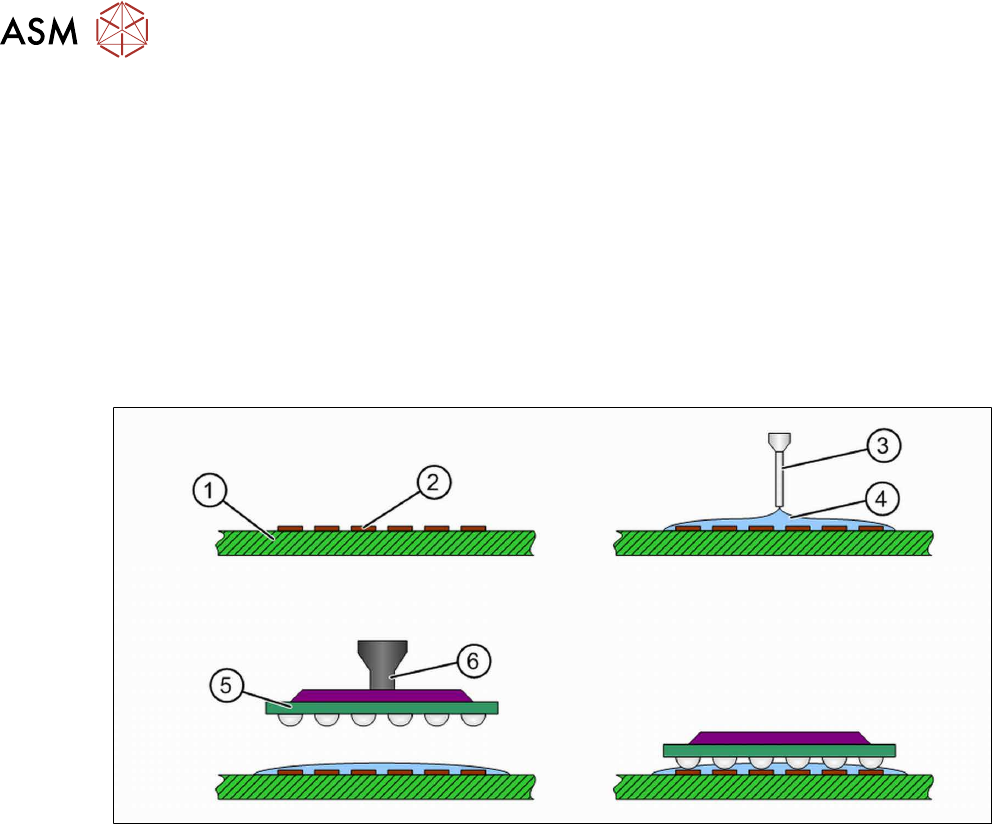
Flux application by dispensing
During dispensing, the flux is applied directly onto the board (1). A needle (3) is positioned exactly
over the soldered connection or the contact surfaces (2) and a defined amount of flux (4) is applied
to the soldered connection. A film forms on the soldered connection, in which the component (5) is
placed with the tweezers (6). Only thin flux types are suitable for dispensing.