IT Feeder Manual-45Series(English V2.0)Ver5.pdf - 第18页
Samsung Intelligent Feeder System Figur e 1-5. Part library addit ion 1.4. Feeder Information Server (FIS) When Mark3 MMI is started and FIS is executed normally , the FIS icon ( ) appears in the System T ray of W indows…
IT Feeder System
1-5
1.3.2. Automatic Feeder Creation in PCB Edit
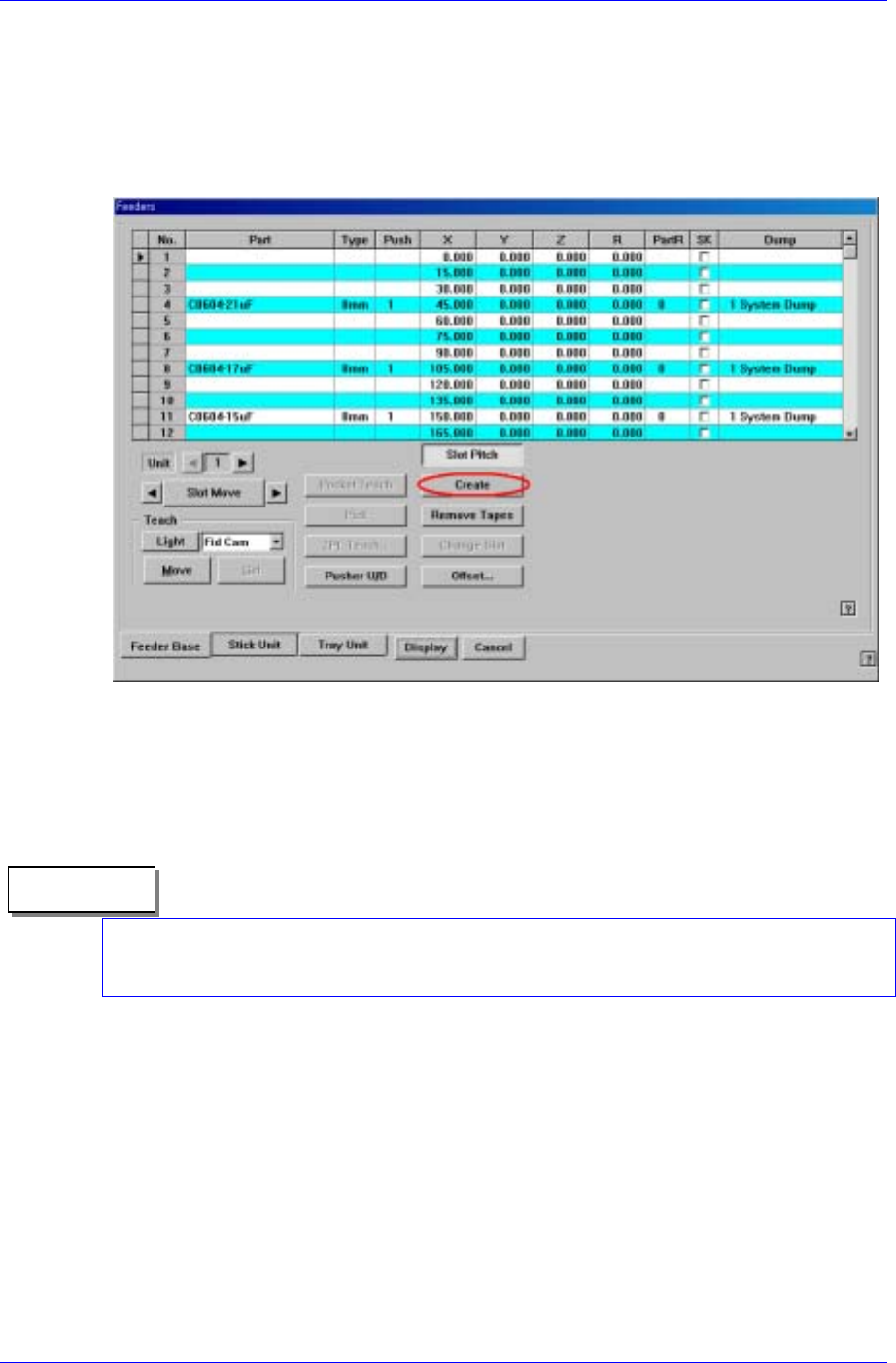
If the IFS is used there is a <Create> button that creates the feeder in the “Feeders” dialog
box of the CP45F(V) MMI. When the ‘Create’ button is pressed, the information on the
feeder being installed on the feeder base is automatically registered in the ‘PCB’ file in
operation. In this case, the feeder information already registered in the ‘PCB” file is
deleted.
Figure 1-4. Feeder creation in PCB Edit
1.3.3. Part Library Synchronization with IFS Database
The parts registered in the equipment are automatically registered in the IFS database.
Therefore, take precautions for the parts that have identical names but have different data.
All equipment that uses IFS (CP40, CP45, …) and off-line systems (Feeder Station, Part
Station) share a common IFS database as well as part names. Therefore, to benefit from
using IFS, it is necessary to control part names systematically.
Reference
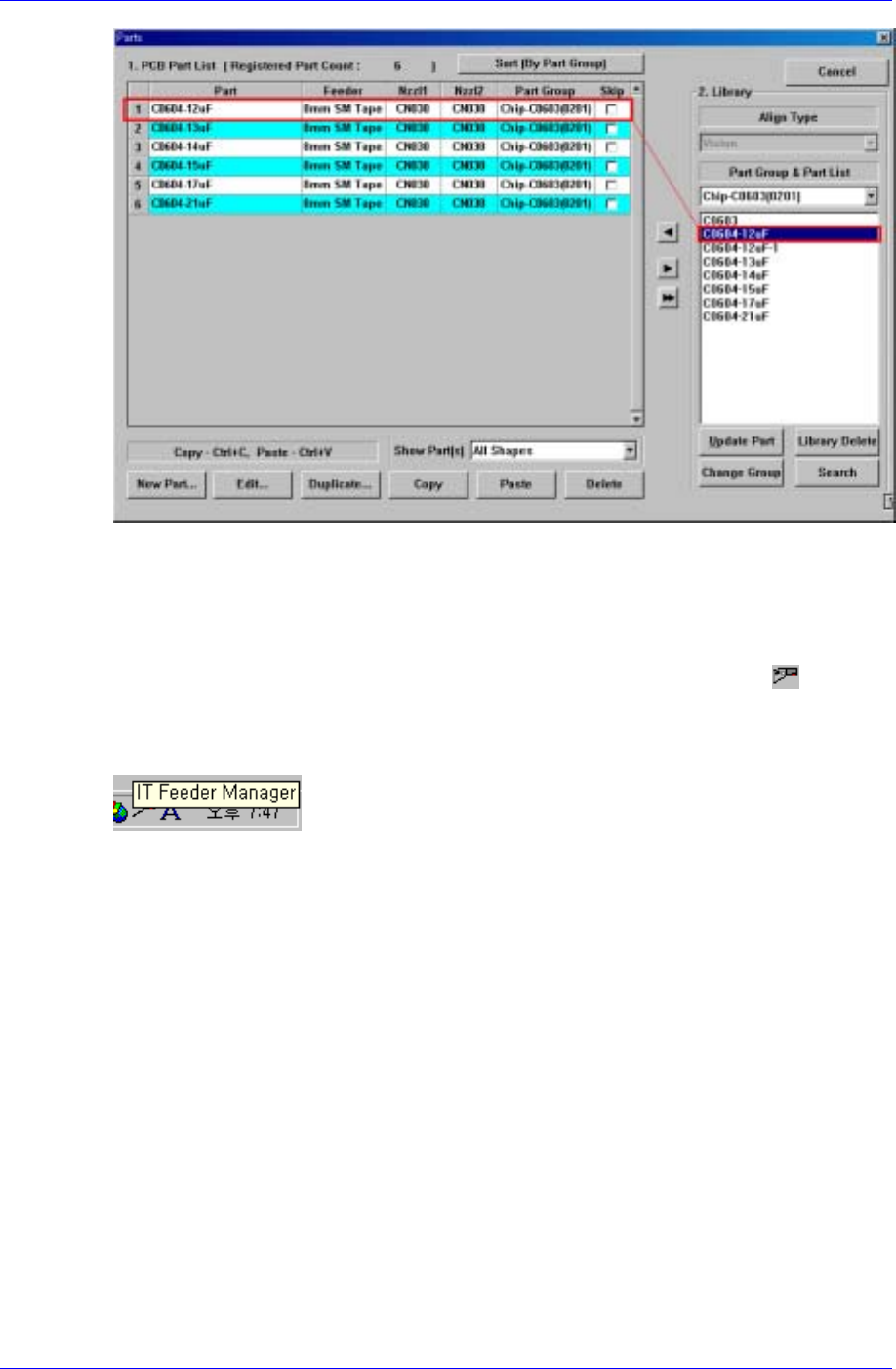
When a component is registered under a new name (New Part) or duplicated
(Duplicate) in the ‘Parts’ dialog box as in [Figure1-5], the newly created part is added in
the Part Library automatically. And the added part is automatically registered if it does
not exist in the IFS database already.
Samsung Intelligent Feeder System
Figure 1-5. Part library addition
1.4. Feeder Information Server (FIS)
When Mark3 MMI is started and FIS is executed normally, the FIS icon ( ) appears
in the System Tray of Windows as shown in [Figure 1-6]. When the mouse pointer is
located on this icon, a tool tip describing “Feeder Scanner Controller” is displayed as
shown in the figure.
Figure 1-6. Windows System Tray and FIS Icon
FIS consists of one main window and several status dialog boxs. All manipulation is
carried out by the MMI Toolbar buttons.
1.4.1. FIS main window
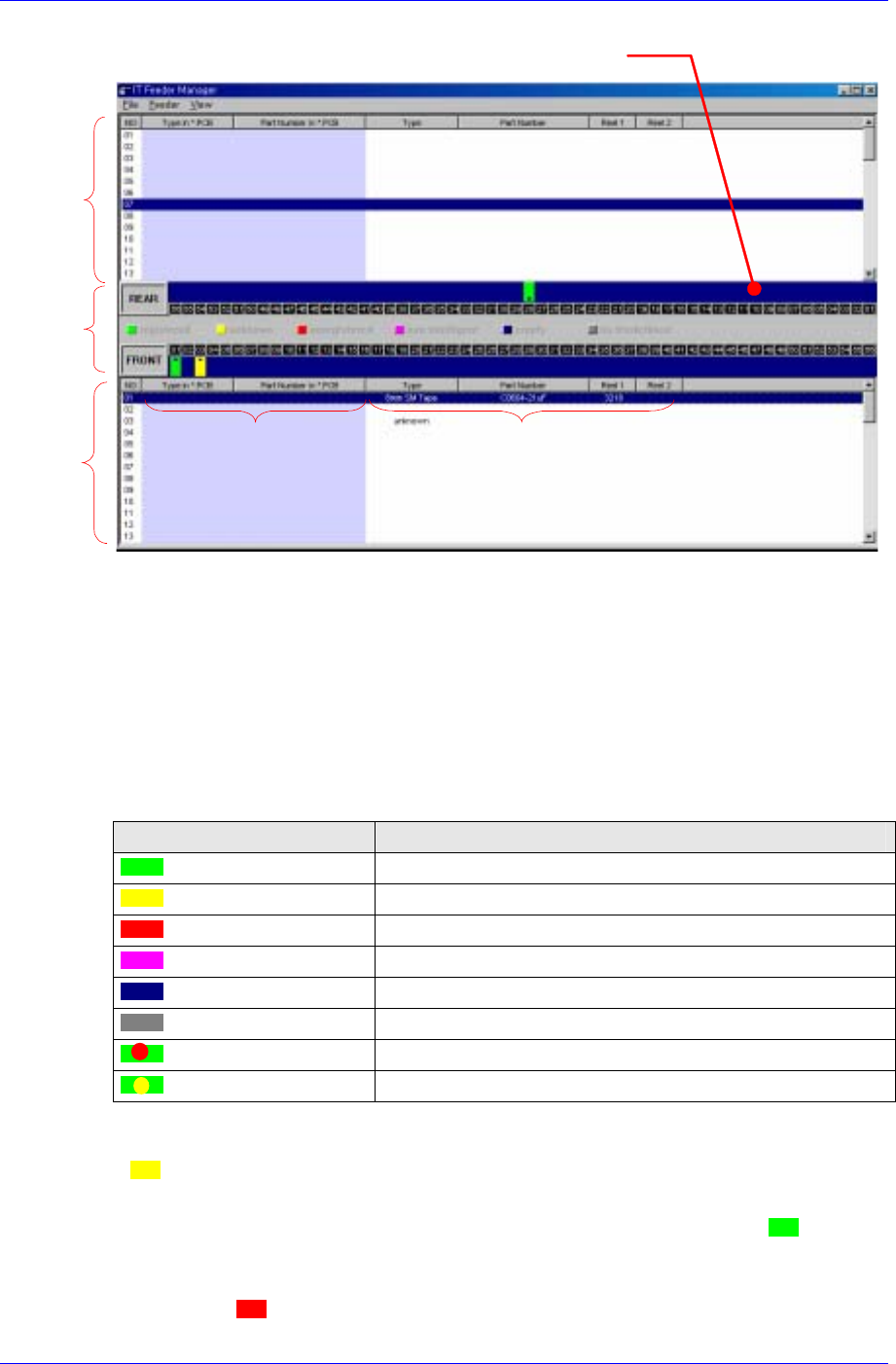
The FIS main window displays the PCB program currently loaded in the equipment, the
feeder array and component to be mounted in the feeder in the program, types of feeders
installed in the actual equipment and their part counts. The screen structure is shown in
[Figure 1-7].
The FIS main window is not displayed unless a certain manipulation is taken by the user.
Execute Display FIS Main Window to view the feeder in the PCB program downloaded
in the equipment, ID of the feeder mounted on the actual equipment, and other
information. There are two ways to view the FIS main window. Firstly, pressing the
right most button on the FIS Toolbar menu of Mark3 MMI Toolbar in [Figure 1-3]
displays the FIS main window.
Secondly, double click on the left button of the mouse on the FIS icon from System Tray
in [Figure 1-6].
1-6
IT Feeder System
1-7
Front
feederbase
Rear
feederbase
status
description
Programmed
feeder & part
Actual
feeder & part
Feeder status
Figure 1-7. FIS main window
1.4.1.1. Feeder Status
Displays real time information on the feeder currently installed on the feeder base. The
statuses of front and rear feeder bases are displayed separately in the upper and lower part
of the screen. The feeder status is indicated by the color and width. The width displayed is
in proportion to the actual feeder width and the meaning of each color is illustrated in
[Table 1-2].
Table 1-2. Feeder Status
Color Description
Green Intelligent feeder
Yellow Unknown feeder
Red Intelligent feeder unregistered in database
Magenta Non-intelligent feeder
Dark blue Empty feeder slot
Dark gray Non-intelligent feeder base or docked-out
Red blinking In case the ‘Mismatch Error’ occurs
Yellow blinking In case the ‘Shortage Warning’ occurs
When a Feeder is installed on the feeder base, the respective slot appears as unknown
(
) . This means the Feeder Scanner has sensed the newly installed Feeder.
When the Feeder scanner reads the feeder ID normally, the database is searched. If there
is a feeder with the respective ID, the feeder status changes to intelligent (
) and the
feeder information is displayed in the feeder list.
If there is no feeder with the ID in the database, the feeder status changes to
unregistered(
) and displayed in the feeder list.