4OM-1075-002.pdf - 第82页
1 . 4 "ERROR" Windows • Window Layout When the machine detects an error , the following "ERROR" window opens. Fig. 4B3 Example of "ERROR" Window • Window Composition *1 Error ID Displayed is…
Error ID Display Section A Display Section B
800401 Start Auto Recovery
Mode
800402 Start Auto Recovery
Mode
800403 Start Auto Recovery Comp. Missing (Recog)
Mode
800404 Start Auto Recovery Comp. Recog Error
Mode
800405 Start Auto Recovery Shortage of Component
Mode
800406 Start Auto Recovery V.Bend Detection Error
Mode
800407 Start Auto Recovery Shortage of Component (Alternated Feeder)
Mode
80040a Start Auto Recovery Auto Recovery Pause
Mode
80040c Start Auto Recovery Vacuum Sensor Error
Mode
80040d Start Auto Recovery Comp. Missing (Sensor) After Chuck
Mode
80040e Start Auto Recovery Comp. Missing (Sensor) Before Mount
Mode
(Contents) The automatic (delayed) recovery function has worked.
(Description) Check the related feeder and take necessary measures such as compo-
nent replenishment.
1.3 Machine lnformation
0308-001 2-3-12 AHB01ETRP
1.4 "ERROR" Windows
• Window Layout
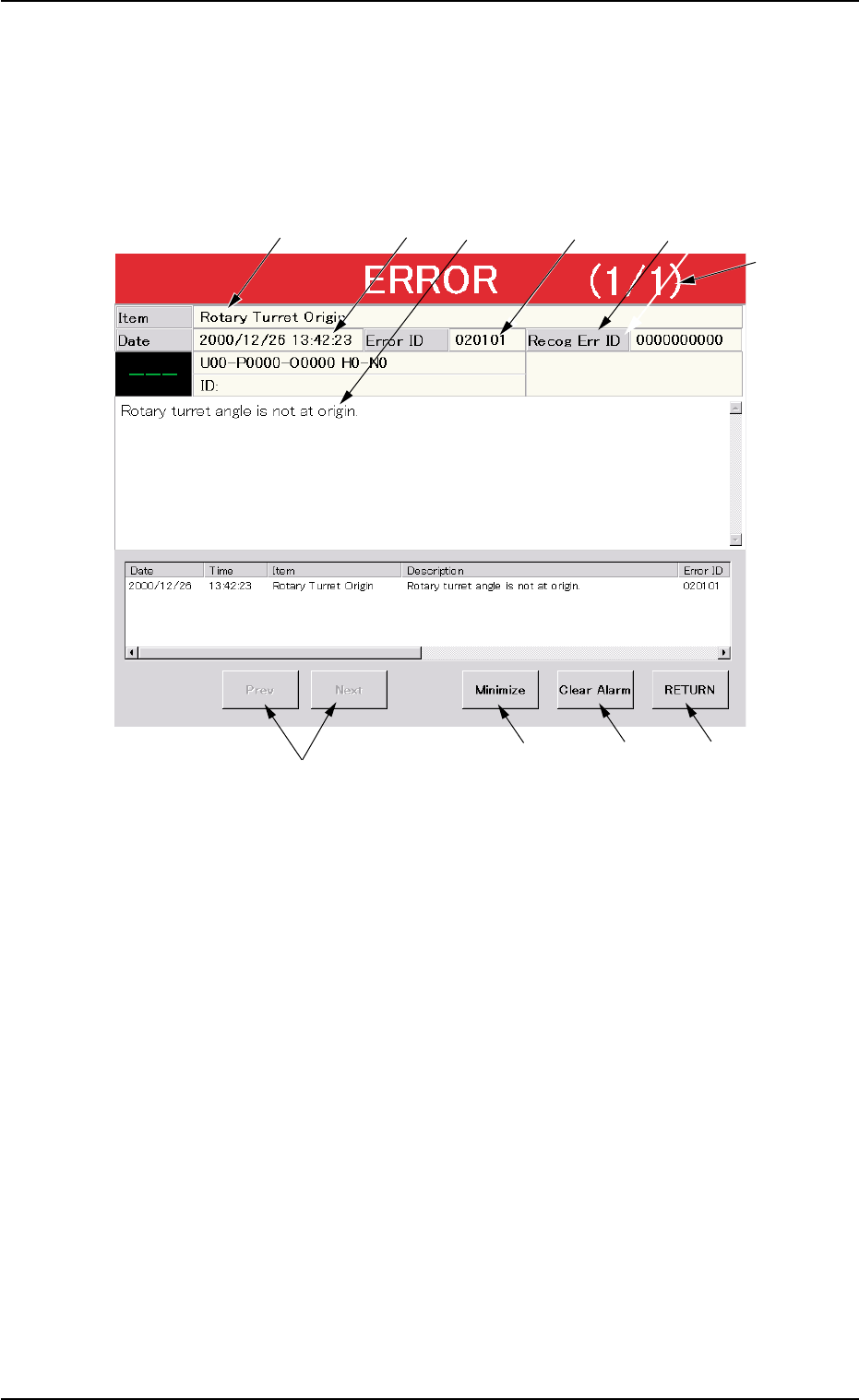
When the machine detects an error, the following "ERROR" window
opens.
Fig. 4B3 Example of "ERROR" Window
• Window Composition
*1 Error ID
Displayed is a string of alphanumeric characters (6 characters) that
identifies an error.
When an error has occurred, use the error ID as an index and refer
to "3. Troubleshooting after "ERROR" Window (Error ID)" for de-
tails.
*2 Recog Err ID
Displayed is a string of alphanumeric characters (10 characters)
that identifies an error.
When an error has occurred, use the error ID as an index and refer
to "4. Troubleshooting after "ERROR" Window (Recognition Error
ID)" for details.
*3 Item
Displayed is a name of the classified element that caused an error.
1.4 "ERROR" Windows
0107-001 2-4 AHB01ETRP
*6
*1
*9
*8
*5
*3
*4
*2
*7
*10

*4 Description
Displayed are the contents of the error.
*5 Date and Time
Displayed are the date and time of error occurrence.
*6 Number of Pages
Displayed are the total number of pages and the number of the
current page.
Example: (3/5)
Total Number of Pages : 5
Number of Current Page : 3
*7 [Prev] and [Next] Buttons
[Prev] Button: When pressed, this button opens the previous page.
[Next] Button: When pressed, this button opens the next page.
*8 [Clear Alarm] Button
When pressed, this button cancels an alarm (sound) only.
*9 [RETURN] Button
When pressed, this button cancels an alarm (sound) and closes
the "ERROR" window. The original window resumes.
*10 [Minimize] Button
When this button is pressed, the "ERROR" window is minimized
and moves to the bottom left of the window.
Double-click the minimized window to return it to the size it was
before it was minimized.
• Reset Procedure from "ERROR" Window
(1) Take a note of "Error ID", "Item (Error Name)", and "Description" in
the "ERROR" window.
Note: When you have forgotten an error message, refer to the list
of errors in the "RECALL" window. (Operation Sequence:
[RECALL] Button (Submenu) Æ "RECALL" Window
(Submenu)).
(2) Press the [RETURN] button to resume the original window.
(3) Use the error ID as an index and refer to "3. Troubleshooting after
"ERROR" Window (Error ID)" and "4. Troubleshooting after "ER-
ROR" Window (Recognition Error ID)" for correct operations to re-
set the machine to its normal condition.
0107-001 2-5
AHB01ETRP
1.4 "ERROR" Windows