YesAX V3.1.2 - Software User Manual - 第140页
10 - 46 General Inspecti on Methodolo gy 9. Run the inspection. 10. I f necessary, repeat step B one more time. The learn local bias process will perfor m one more time based on the current local bias number. Please be n…
General Inspection Methodology 10-45
Local Biasing group includes related functions and parameter adjustments for local biasing
adjustment. Local Biasing is a technique that uses the background characteristic learnt from a
good board to compensate the shadowing effect during inspection. In the learning phase a good
board is placed in the machine. Once the process starts, the software will run the board once and
adjust the threshold value for each ball until the area measured is equal (or as close as it can be)
to the expected area. The adjusted value of the threshold (called Local Bias) is stored on a per
ball basis (i.e. not part of the library update).
Steps to setup Local Biasing:
A. Enter the correct expected diameter
Expected diameter is used to determine expected area. So it is very important to set it
right before the learning process.
1. Disable local biasing, Click Reset Statistics
button to clear statistics for each ball.
2. Run the inspection once.
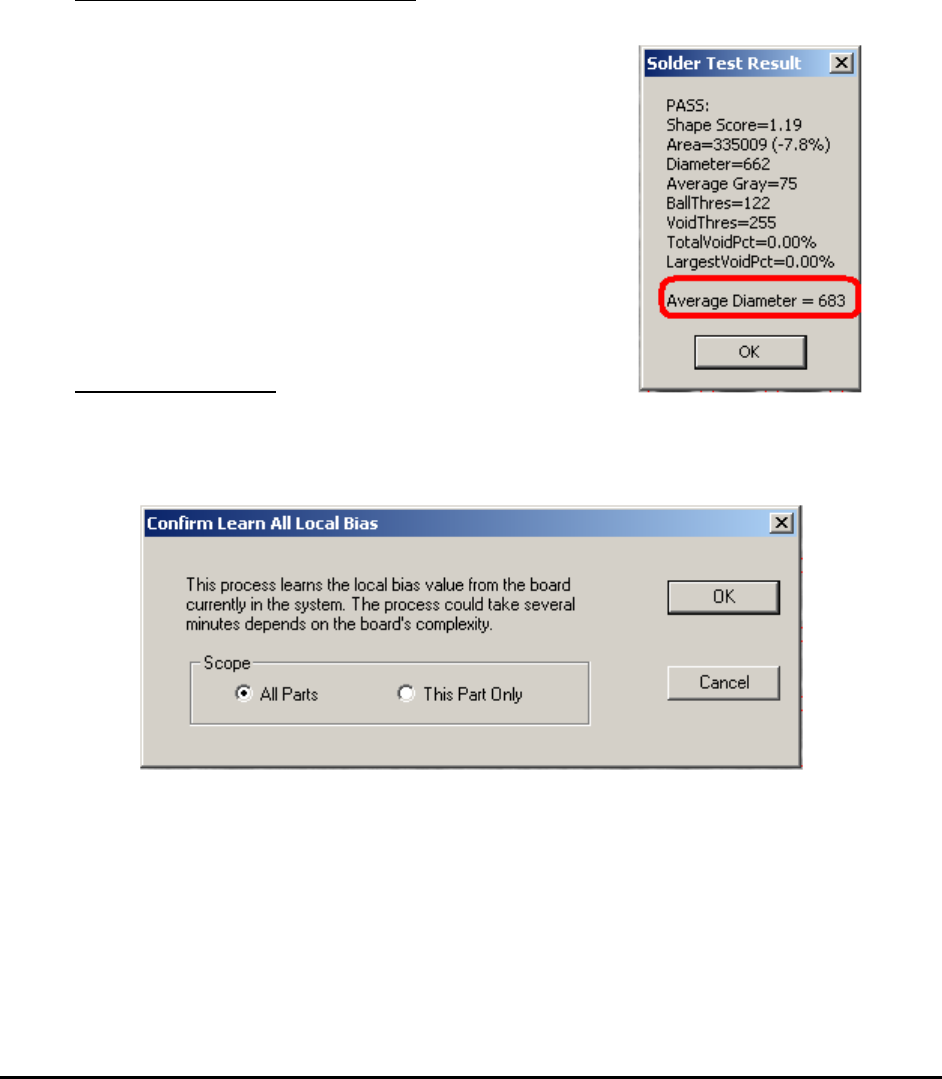
3. Look at the average diameter statistics by doing a
test on one of the inspection box on each part
(package).
4. Set the expected diameter parameter.
5. Do “Update Solder” to set the expected diameter
for all inspection boxes for this package.
B. Learn the Local Bias
6. Enable local biasing, and then press the Learn
All Values button.
7. Select the scope of the learning from the prompt dialog.
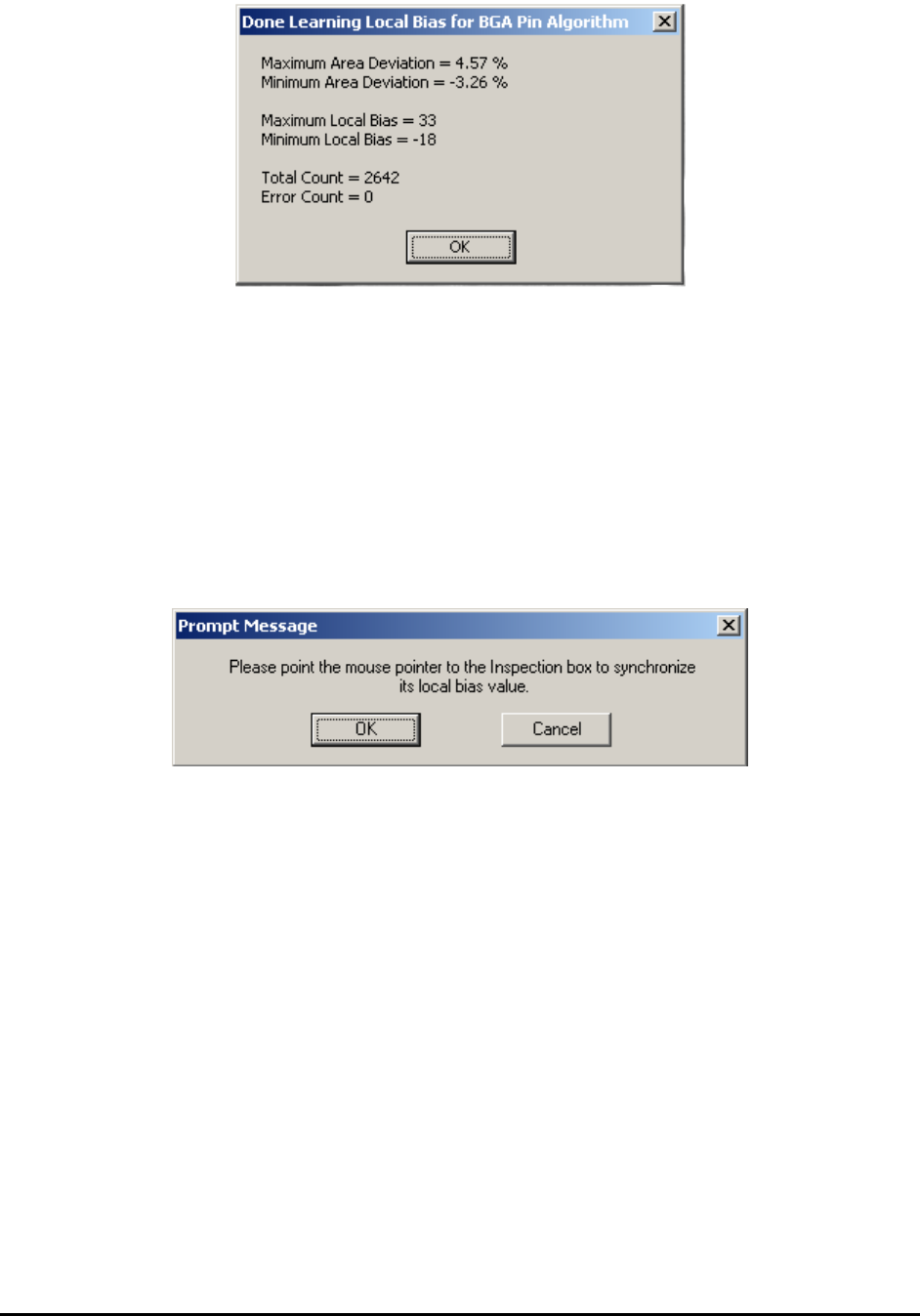
8. Press Start button from the Run dialog. The inspection could take many minutes
depends on the board’s complexity. At the end of the process a summary statistic is
displayed.
10-46 General Inspection Methodology
9. Run the inspection.
10. If necessary, repeat step B one more time. The learn local bias process will perform
one more time based on the current local bias number. Please be noticed that the
lower limit and upper limit for local bias is -50 and 50, respectively.
11. If possible, the user can manually type in the local biasing number for each
individual ball. To apply the same local biasing number to other balls, the user
needs to click the .. button first to dismiss the dialog. The following dialog will
show up. Then the user can follow the instruction and click any BGA ball which he
likes to put the same local biasing number on and click OK to dismiss this message
box and apply the changes.
10.5.4 Steps to Create a New BGA Package
There are times when you may need to create a new BGA package from scratch. Creating new
packages for different BGA devices is not difficult. Below is the general procedure:
1. Create the part body in vision or X-ray view; enter the Reference ID, part number and
package.
2. Turn on the X-ray and switch to X-ray view, experiment with different FOVs and Power
levels to find out the desirable FOV and power level. Make the selection in your mind;
you will need to enter them later.
3. Move to a large field of view and try to have the entire BGA in one view. Count the
number of balls by row and column. Measure the pitch of balls by the measurement
function. As for the pitch of BGA, most BGA devices will have one of the following
numbers: 0.5mm, 0.75mm, 0.8mm, 1.0mm, 1.27mm and 1.5mm.
4. You will need all the information later.
5. For full array BGA train a lead bank that includes all the balls. For perimeter array BGA
train a lead bank that includes all the balls for one direction.
General Inspection Methodology 10-47
6. Enter the correct parameters for the lead bank; this includes the pitch, the total number of
leads, and the row count.
7. From the Lead bank pop-up menu, select Train Solders.
8. From the Solder pop-up menu, select Align, and line up the solder inspection boxes.
9. Hide the solder inspection boxes by pressing the button on the tool bar.
10. From the Lead bank menu, select Break into Sectors, to break the lead inspection box
into sectors that will fit into the FOV selected in step #2. The FOVs are rectangular; you
want to break the Lead bank into small enough sectors that will fit in the smaller
dimension (Y dimension) of the desired FOV. This way the package will work even if it
needs to be rotated 90 degree.
11. Move the Z axis into the selected FOV. Switch the FOV of the Lead bank to the selected
FOV. Setup other lead parameters.
12. Setup BGA Group parameters, then update the parameters into other lead sectors.
13. Un-hide the Solder inspection box by pressing the again. Display the solder pop-up
menu and setup the solder inspection parameters.
14. Setup the BGA ball parameters then update the parameters to other solder inspection
boxes.
15. For perimeter array the user needs to repeat step 3 to 13 for lead banks in the other
directions.
For X3 AXI system inspection programs, it is necessary to create a 3D BGA package based on
the existing 2D package. Below is the procedure:
1. Create normal BGA package in 2D. Try to align solder box and make sure all solder
boxes cover the whole ball. If BGA group is used for lead inspection and that lead bank is
bigger than the current FOV, the large lead bank may needs to be broken into smaller
ones. When breaking the lead bank, the general rule is to assign less 3D sites to cover the
whole package.
2. Select 3D sites and create 3D slices for BGA. During this period it is possible to re-
adjust the power level or even FOV. It is important to set the right FOV at the beginning
of programming. Adjusting the power level for a package is easy while adjusting all
inspection boxes to a different FOV may be complicated. The user can either locate 3D
sites manually or use some automatic way. Inside part body when user right mouse clicks
any open space and launch the part menu, execute Create 3D Sites… command will
launch the following dialog.