00191025-01.pdf - 第206页
7 Vision Systems SIPLACE 80S /F/G User’s Manual 7.2 PCB Vision S ystem Edition 07/97 from Software Version S R.010.xx 7 - 14 Line engine er and the di splay LE D's for – the CPU – the visio n process or – the came r…

SIPLACE 80S/F/G User’s Manual 7 Vision Systems
Edition 07/97 from Software Version SR.010.xx 7.2 PCB Vision System
Line engineer 7 - 13
7.2 PCB Vision System
The PCB vision system senses the precise position of the board by scanning the fiducials and determines the
offset in x and y directions, the rotation angle relative to the direction of PCB transport and the shear of the
PCB. Even reject fiducials (ink dots) are registered by the PCB vision system and evaluated.
7.2.1 Description of the System
The PCB vision system for PCB position recognition consists of
●
the optical system for PCB position recognition.
Each revolver head is equipped with its own PCB position recognition system (see Fig. 7.1.2).
On auto-
matic glue application machines, the PCB camera system is located beneath the gantry
(see Fig. 7.1.8,
page 7 - 10).
PLEASE NOTE:
PCB position recognition is only carried out with gantry 1.
●
the vision evaluation unit.
For each gantry one evaluation unit for the position recognition of PCBs and components is installed in the
control unit (see Figures 7.1.3, 7.1.6 and 7.1.9). The adhesive application head is only equipped with one
system for PCB position recognition.
A CCD camera (Sony XC77 camera) with integrated imaging and lighting lens constitutes the optical PCB
position recognition system. The field of view of the PCB module equals 5.7 mm x 5.7 mm. Within the dimen-
sions of the visual fields a search area can be freely programmed with respect to position and size. The imag-
ing lens is a special measuring lens which provides the most extensive compensation for measurement errors
due to warping of PCB's. The lighting is only switched on when fiducials are being scanned.
The vision evaluation unit (MVS) is a single-board system in accordance with the VME standard. The hard-
ware consists of:
●
the MVS100 motherboard with vision processor and interface connections
The rear side of the board accommodates the
–
plug connections for the VME bus and
–
the very-high-speed communications unit (HS
3
L)
The front side of the board accommodates the connectors for
–
the screen
–
up to 4 camera inputs
–
two serial interfaces (RS232 or RS422)
Placement System PCB camera MVS evaluation unit
80S (2 gantries) 2 2
80F (1 gantry) 1 1
G (1 gantry) 1 1

7 Vision Systems SIPLACE 80S/F/G User’s Manual
7.2 PCB Vision System Edition 07/97 from Software Version SR.010.xx
7 - 14 Line engineer
and the display LED's for
–
the CPU
–
the vision processor
–
the camera input
–
the screen display.
The switches for “RESET” and “ABORT” are located below the display LED's
●
the MVS500 camera interface (piggyback board) for up to four CCD cameras.
7.2.2 Technical Data
Camera type: SONY XC77
Number of pixels: camera 768 (H) x 494 (V)
image 640 (H) x 484 (V)
Field of view: 5.7mm x 5.7 mm
Lighting method: incident-light illumination (is activated during measurement)
Image processing: correlation principle, grey-scale system
Processor cycle time: < 200 msec
Screen: RGB monitor (VGA mode) 640 x 484 pixels of the stations
computer
Fiducials: library for up to 255 fiducial definitions
7.2.3 Description of Function
Before placement position, rotation angle and shear of the board are determined on the basis of the positions
of the fiducials by the PCB vision system. Deviations from the setpoint values are then included in the calcula-
tion of the placement positions of the components as corrections.
At least 2 fiducials must be marked on a board so that the system can recognize deviations in the PCB posi-
tion and in the PCB rotation angle. Where 3 fiducials are marked, you will be additionally provided with infor-
mation on compression and deformations of the board and of the board layout.
7.2.4 Functional Sequence
Before a fiducial can be used for PCB recognition, it must first have been “taught”, i.e. the fiducial structure
parameters must be stored in the PCB vision system for the pattern.
●
The fiducial structure is taught using the PCB vision camera fitted to the placement head and the vision
program.
The vision evaluation unit determines the significant fiducial structure parameters using methods of digital
image processing.
●
Measurement takes place in two steps:
–
2D pattern search procedure (2-dimensional procedure) in the rough grid and provisional determina-
SIPLACE 80S/F/G User’s Manual 7 Vision Systems
Edition 07/97 from Software Version SR.010.xx 7.2 PCB Vision System
Line engineer 7 - 15
tion of the fiducial coordinates
–
1D pattern search procedure (1-dimensional procedure) for precise determination of the position of
the fiducials.
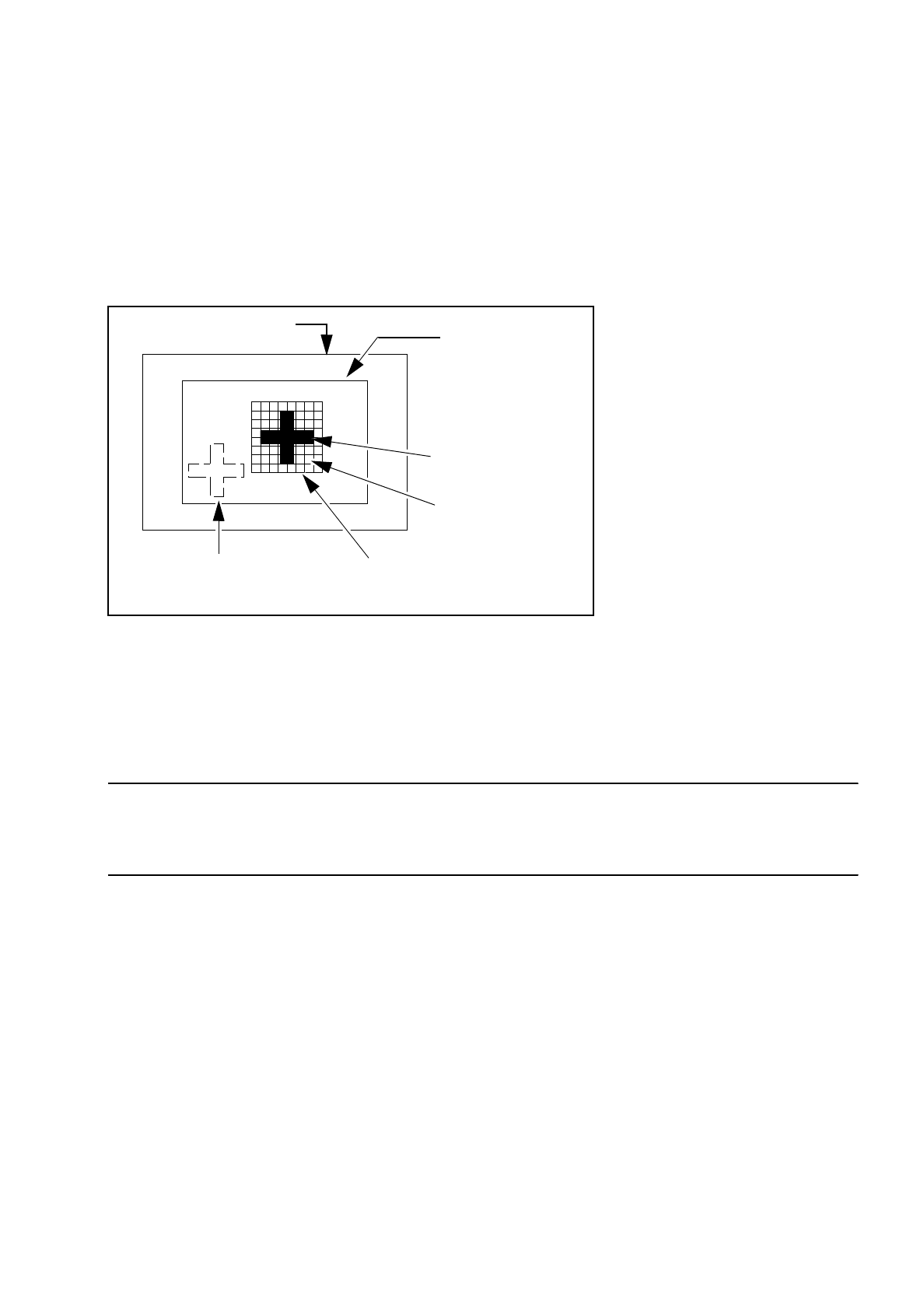
With the 2D pattern search procedure the template window is divided into in moxel areas. Moxels (
mo
saic pi
x-
el
s) are pixel fields with, for example, 16 x 16, 8 x 8 pixels etc. The lower the number of pixels, the higher the
resolution and the lower the search speed.
Fig. 7.2.1 Explanation of camera field of view, search area and template window
The template window is moved over the search area in moxel steps. The grey-scale values of each individual
moxel of the reference pattern are calculated. This reduced data structure contains enough information on the
rough structure and position of the reference pattern.
NOTE
The search window should be selected as small as possible in order to achieve a high search speed, but
should still be large enough to ensure clear reidentification of the fiducial.
The 1D pattern search procedure is used for the exact determination of the pattern and position of the fiducial.
The fiducial image is analyzed by column and row and the grey-scale values within each individual column
and row added up. The next Figure shows this procedure using a double cross.
Search area for the
camera
≤
field of view
(The fiducial is
searched for within
this area)
Reference pattern
Moxel = pixel field
e.g. 16 x 16 pixels
Field of view of the camera
Fiducial to be found
Template window
(It contains the reference fiducial)